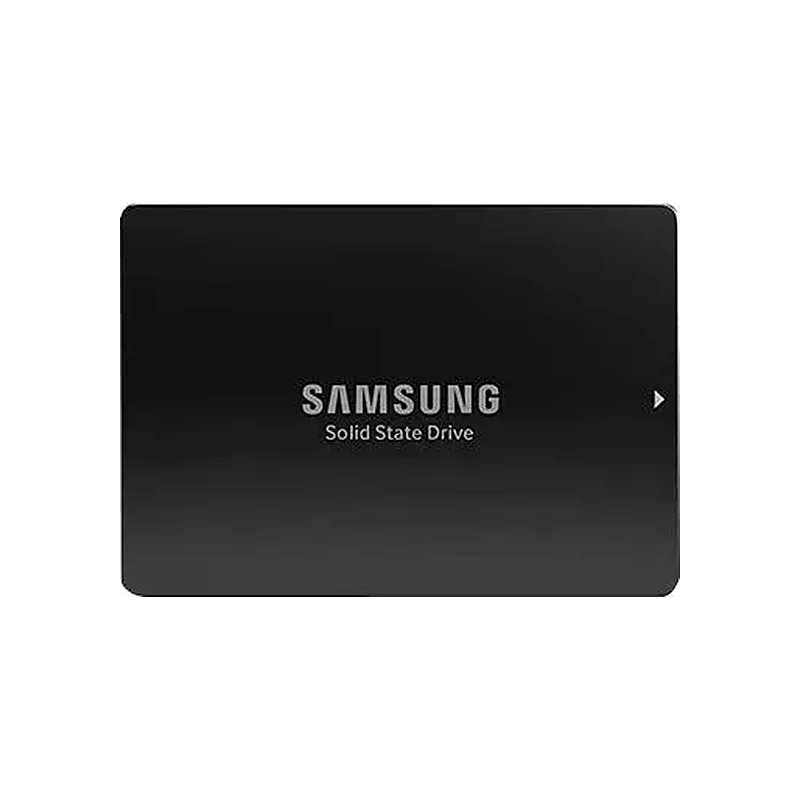
Samsung PM897 960GB SATA SSD (MZ7L3960HBLT)
960 GB 2.5-inch SATA mixed-use SSD, ordering code MZ7L3960HBLT-00B7C
- Part Number
- MZ7L3960HBLT
- Brand
- Samsung
- Category
- Enterprise & Data Center SSD
- Accepted Payments
- T/T Bank Transfer PayPal Western Union
Technical Specifications
| Capacity | 960 GB |
|---|---|
| Interface | SATA |
| Form Factor | 2.5-inch 7mm |
| PCIe Version | Not applicable |
| NAND Type | TLC |
| Endurance (DWPD) | 3 |
| TBW | 5,256 TB |
| Sequential Read | 560 MB/s |
| Sequential Write | 530 MB/s |
| Random Read IOPS | 97K IOPS |
| Random Write IOPS | 60K IOPS |
| Power | 2.3 W |
| DRAM Cache | Yes |
| Power Loss Protection | Yes |
| Encryption | Opal 2.0 |
| Condition | New · Used |
Frequently Asked Questions
Samsung PM897 960 GB, 2.5-inch 7 mm SATA, catalogue code MZ7L3960HBLT, ordering code MZ7L3960HBLT-00B7C. 560 MB/s sequential read, 530 MB/s sequential write, 97K random read and 60K random write IOPS at 4 KB, 5,256 TBW — 3.0 drive-writes-per-day over five years — on Samsung V6 128-layer 3-bit TLC V-NAND, with TCG Opal 2.0 and capacitor-backed power-loss protection. Stocked new or as tested pulls with a 1-year warranty from us.
This is the capacity the PM897 range is built around. The 480 GB member is the same drive at half the bytes, and it is enough for a journal, a cache or a boot pair; 960 GB is the first capacity in the range that holds a real data volume as well as the system that fronts it. It is also the point where the endurance question stops being a question: at 3.0 drive-writes-per-day this drive carries 5,256 TBW, or 2.88 TB of writes every day for five years.
Why 960 GB is the capacity this range is built around
Capacity does two things at once on a mixed-use drive. It raises the total write budget in direct proportion — doubling the bytes doubles the TBW at the same DWPD rating — and it changes which roles the drive can hold. At 480 GB the honest list is a journal, a write-back cache, a logging volume, a mirrored boot pair. At 960 GB that list gains a VMFS datastore for a small cluster, a single-instance database with its logs on the same device, a backup staging area that is rewritten nightly, and a pair of ZFS special vdevs with room to grow. The drive has not changed; the workloads that fit on it have.
The endurance figure is what makes that practical rather than theoretical. 5,256 TB is 2.88 TB of writes every day for five years, which is more than any of those roles will produce. A 960 GB volume carrying a database and its WAL that turns over 400 GB a day uses 14% of the daily allowance. The same volume turning over 2 TB a day uses 69% and still has headroom. Below this capacity the arithmetic starts to bite; above it the arithmetic stops being the reason to choose one part over another.
It is also the capacity where the surrounding decisions stay simple. Below it the write budget is thin enough that a growing workload outruns it; above it the array-level concerns take over — rebuild time measured in hours, spare holding, and one more failure domain per device — and those are decisions about the platform rather than about the drive.
Technical specifications
| Product family | Samsung PM897 (V-NAND SSD, data centre / mixed-use) |
|---|---|
| PN | MZ7L3960HBLT (catalogue code) |
| Ordering code | MZ7L3960HBLT-00B7C |
| Capacity | 960 GB (512-byte sectors, decimal capacity) |
| Form factor | 2.5-inch, 7.00 mm (100.20 × 69.85 × 7.00 mm, max 70 g) |
| Interface | SATA 6 Gb/s, Serial ATA 3.3, ATA/ATAPI ACS-4 |
| NAND | Samsung V6 V-NAND, 128-layer, 3-bit (TLC) |
| Sequential read / write | 560 MB/s / 530 MB/s (128 KB, QD32) |
| Random 4 KB (QD32) | 97K IOPS read / 60K IOPS write |
| Random 8 KB (QD32) | 57K IOPS read / 40K IOPS write |
| IOPS consistency | 95% read / 90% write at 4 KB, sustained |
| Latency and QoS | 105 µs read / 30 µs write at QD1; 99.99th percentile 0.2 ms read, 0.05 ms write at QD1; 0.6 ms and 0.7 ms at QD32 |
| Endurance | 5,256 TBW — 3.0 DWPD over five years (TBW = DWPD × 365 × 5 × capacity) |
| Power | Active read 2.3 W; active write 3.0 W; idle 1.4 W (DIPM off); supply 5 V ±5% |
| Power-loss protection | Yes — capacitor hold-up transfers cached DRAM data to flash on failure; no hold-up time published |
| Data security | AES-XTS 256-bit encryption engine, TCG Opal 2.0 compliant |
| Features | TRIM, NCQ to depth 32, S.M.A.R.T., end-to-end data integrity, RoHS |
| Reliability | MTBF 2.0 million hours; UBER 1 sector per 1017 bits read |
| Environmental | Operating 0 °C to 70 °C (case); non-operating −40 °C to 85 °C; humidity 5–95% non-condensing |
Ordering codes and what the part number records
| Code | Type | Condition | Quote |
|---|---|---|---|
| MZ7L3960HBLT | Catalogue code | New / used | Enquire |
| MZ7L3960HBLT-00B7C | Ordering code | New / used | Enquire |
Two digits separate this drive from its 480 GB sibling and nothing else changes: 480 becomes 960 in the capacity block, and the trailing HBLT build code is identical. That is worth knowing when a mixed batch arrives, because the two parts are visually and electrically interchangeable and only the label separates 2,628 TBW from 5,256.
The -00B7C suffix is shared across the whole PM897 range and is not interchangeable with the -00A07 or -00B07 codes, which belong to the read-intensive PM893a and to the PM897a build of this range; those carry different endurance ratings or a different firmware identity. Quote the full string on a PO and we will ship against exactly that.
Samsung's part-number table also fixes the build code per capacity: 480 GB and 960 GB carry HBLT, while 1.92 TB and 3.84 TB carry HBNA. The a-build of this range groups them differently — HELT at 480 GB, HELA at the 960 GB member, HENA at the top two — so a pallet mixing both builds carries three codes rather than two. The 1.92 TB member is the first capacity built that way, at twice this drive's bytes and twice its write budget. There is no 240 GB and no 7.68 TB PM897, so a deployment that outgrows 3.84 TB per device has to change family rather than step up a rung.
One performance specification, four capacities
One performance table covers the whole range: 560/530 MB/s, 97K/60K IOPS, 95/90 consistency, 105/30 µs, 2.3/3.0 W. Only the TBW column is split by capacity. That is not how Samsung's read-intensive ranges behave — the PM893a at 960 GB writes at 530 MB/s while its 480 GB member manages 360, and the PM883 moves its random-write figure by 1K between capacities. On this range the step from 480 to 960 adds bytes and write budget and changes nothing about how the drive behaves.
For a buyer that is a simplification worth stating plainly. Choosing 960 GB over 480 GB is not a performance upgrade, a latency upgrade or a power upgrade — it is twice the capacity, twice the total write budget, and the same drive. Sizing therefore depends on the volume, the write rate and the number of devices the array needs, not on whether the smaller part is fast enough, because the smaller part is the same speed.
It also means the figures on this page can be read against any other member of the range without adjustment. A comparison that puts this drive against the 3.84 TB member is a comparison of space and endurance only; the IOPS, latency and power lines will be identical.
What a terabyte of write budget costs here
5,256 TB written flat out at 530 MB/s would last about 115 days, so the ceiling is finite — but the useful measure is the daily allowance, 2.88 TB, and what it costs relative to the alternative. Set against the read-intensive PM893 at 960 GB, this drive carries three times the write budget (5,256 against 1,752 TBW) for roughly twice the price at current listing, which works out to about a third less per terabyte written. Read the other way: if a workload will actually consume that budget, buying the mixed-use part is cheaper per unit of work than buying the read-intensive part and replacing it early.
That comparison flips the moment the workload does not write much. A read-serving tier that touches 20% of its endurance is paying for headroom it will never use, and the read-intensive drive at 1.0 DWPD is the correct purchase there — it also carries 98K random read against 97K here. The mixed-use premium is only rational when the queue is write-heavy enough to consume it.
Against the previous generation the arithmetic is simpler: the SM883 at 960 GB carries the identical 5,256 TBW and the identical 3.0 DWPD, so the two are interchangeable on endurance and the decision comes down to speed and supply. This drive doubles random write, adds 20 MB/s of sequential read and 10 MB/s of sequential write, and draws half a watt less on read.
How 960 GB compares with the rest of the Samsung SATA line
| Model | Capacity | Sequential read / write | Random 4K read / write | Endurance | Class |
|---|---|---|---|---|---|
| PM897 960 GB | 960 GB | 560 / 530 MB/s | 97K / 60K IOPS | 5,256 TB (3.0 DWPD) | Mixed-use |
| SM883 960 GB | 960 GB | 540 / 520 MB/s | 97K / 29K IOPS | 5,256 TB (3.0 DWPD) | Mixed-use, MLC |
| SM863a 960 GB | 960 GB | 510 / 485 MB/s | 95K / 25K IOPS | 6,160 TB (3.5 DWPD) | Mixed-use, MLC |
| PM893 960 GB | 960 GB | 550 / 520 MB/s | 98K / 30K IOPS | 1,752 TB (1.0 DWPD) | Read-intensive |
| PM893a 960 GB | 960 GB | 560 / 530 MB/s | 97K / 31K IOPS | 1,752 TB (1.0 DWPD) | Read-intensive |
| PM883 960 GB | 960 GB | 550 / 520 MB/s | 98K / 25K IOPS | 1,366 TB (0.78 DWPD) | Read-intensive |
| PM863a 960 GB | 960 GB | 520 / 480 MB/s | 97K / 24K IOPS | 1,366 TB (0.78 DWPD) | Read-intensive |
Read the class column first, because it sorts the table better than any single figure. The three mixed-use rows carry between 5,256 and 6,160 TBW; the four read-intensive rows carry between 1,366 and 1,752. Within the mixed-use group this drive has the highest random write by a wide margin — 60K against 29K on the MLC SM883 and 25K on the SM863a — while the SM863a holds the largest write budget at 3.5 DWPD and pays for it with 510/485 MB/s.
Within the read-intensive group the choice is about how much read performance and Opal compliance the deployment needs. The PM893a matches this drive on both sequential figures and on random read, gives up almost half its random write, and carries a third of the endurance; the PM893 is 10 MB/s slower on both sequential lines and sits at the same 1,752 TBW; the PM863a is the oldest design in the table at 520/480 MB/s and 1,366 TBW. None of them should be specified for a volume that is written continuously.
The honest summary of this table is that 960 GB is the capacity where the Samsung SATA line splits cleanly in two, and the split is endurance rather than speed. Sequential performance has converged across all seven rows to within 50 MB/s; what separates them is how many times you may write the whole drive, and this row writes 60,000 times a second in 4K blocks while doing it.
How each drive is tested before it ships
- Label, capacity and model line checked against the order: PM897 2.5" SATA SSD 960 GB with MZ7L3960HBLT, and the -00B7C suffix recorded on the invoice.
- SMART attribute dump first — power-on hours, host writes, media wear, program/erase counts and grown defect count — kept on file for the individual drive shipped.
- Full-surface read scan, then a SMART extended self-test run to completion rather than a sample.
- Sequential read and write verified near 560 / 530 MB/s on a native SATA 6 Gb/s port.
- Random 4 KB measured at queue depth 32 in both directions; on this part the 60K write figure is the reason to buy it and the first thing a worn unit loses.
- Sustained write exercise to confirm the drive holds its rate and its 95/90 consistency once caches are spent, rather than only in the first minute.
- Firmware revision read and recorded, and checked against the latest firmware revision for the PM897.
- TRIM and secure-erase exercised, drive returned to a clean state, then final inspection, anti-static bag and foam packing.
Warranty, lead time and purchasing
Every drive carries a 1-year warranty from us against defects in workmanship and function. Verified faulty units are replaced or refunded and we cover return shipping. Stock is held in both new and used condition; the condition you order is confirmed before dispatch, and used units are pull-tested rather than untested lots. Stock is held in our own warehouse and normally dispatches within three to seven working days, with tracking issued at dispatch.
The listing price is a starting price for the capacity; the final figure moves with condition, quantity and batch. Send the quantity, the condition you need and the platform the drives are going into, and you will get a quote with lead time the same working day. Matched pairs for mirroring are selected from a single batch where stock allows, including firmware revision and wear level.
Get Pricing For This Part
Tell us who you are — we reply within one working day with a firm quote, stock status and lead time. Volume discounts available.
Related Products
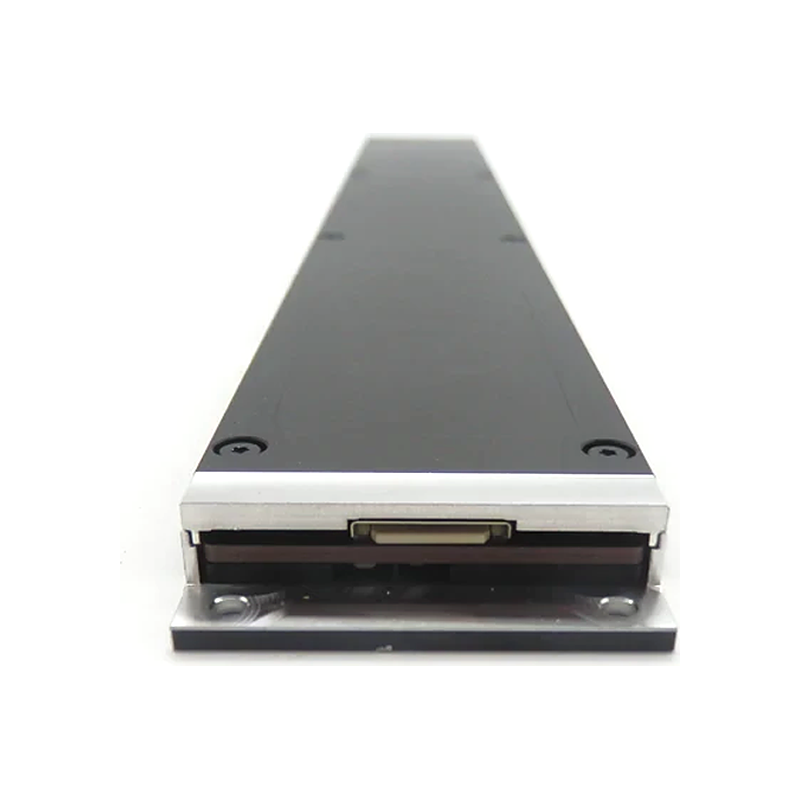
15.36 TB E1.L 1U long ruler NVMe SSD, PCIe 4.0, ordering code MZEL215THBLA-00AMV
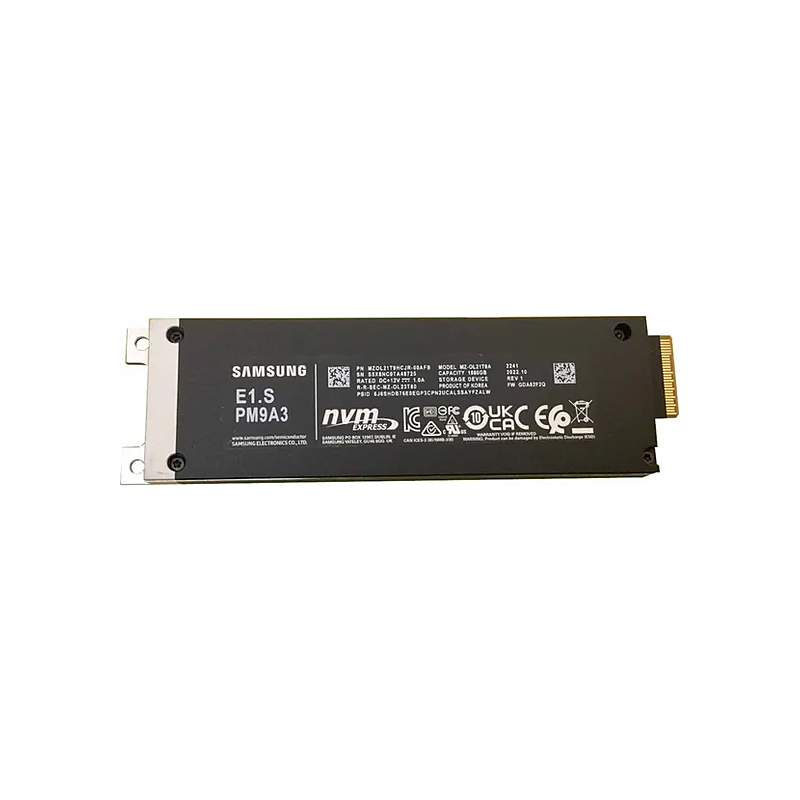
7.68 TB E1.S 1T NVMe SSD, PCIe 4.0, ordering codes MZCL27T6HBLA-00AMV / MZTL27T6HBLA-00A07
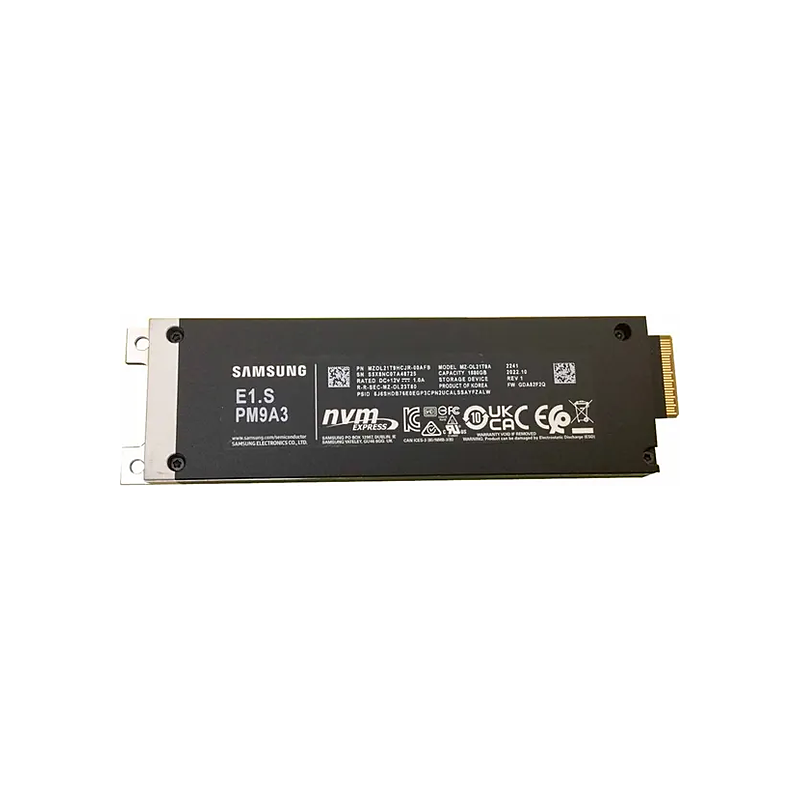
3.84 TB E1.S 1T NVMe SSD, PCIe 4.0, ordering codes MZCL23T8HCLS-00AMV / MZTL23T8HCLS-00A07
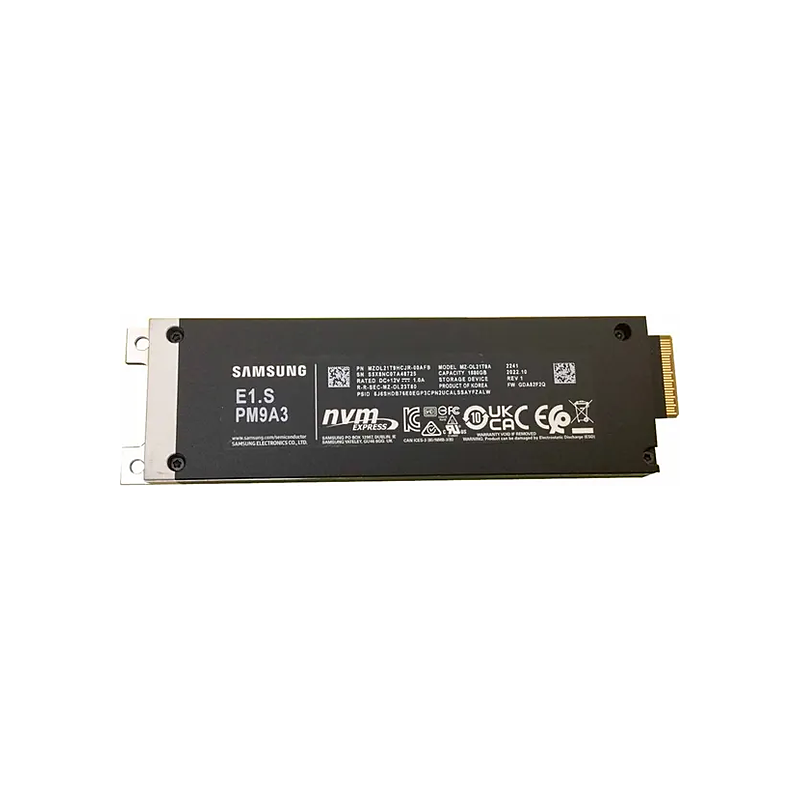
1.92 TB E1.S 1T (9.5 mm) NVMe SSD, PCIe 4.0, ordering code MZCL21T9HCJR-00AMV