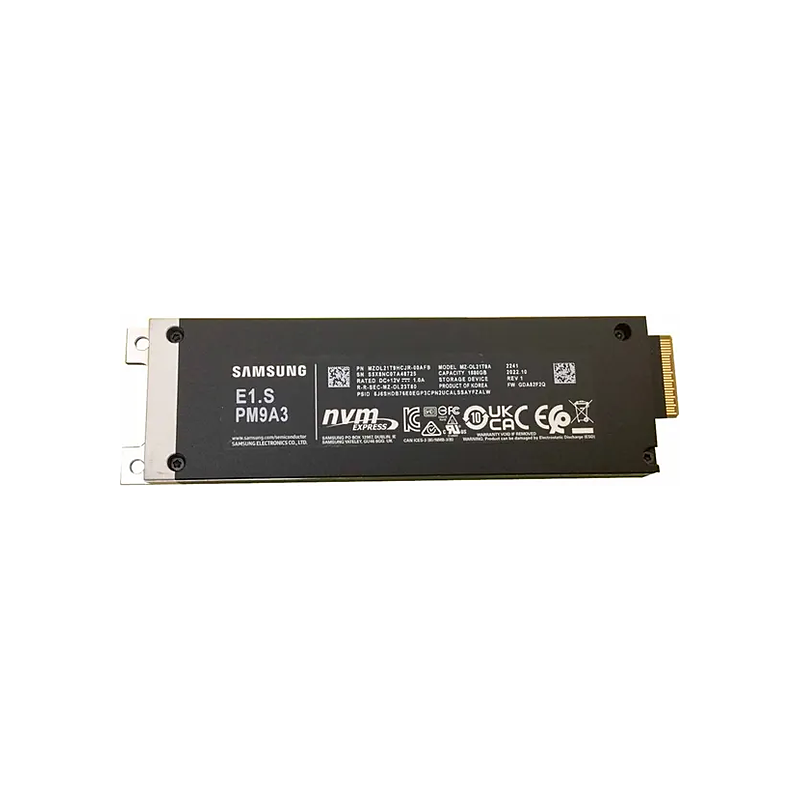
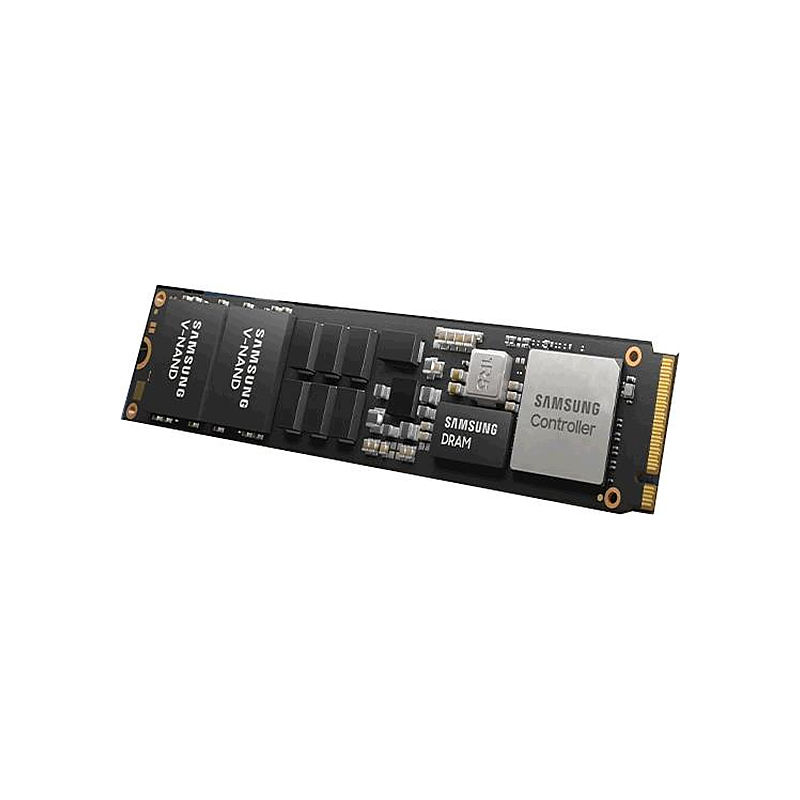
Samsung PM9A3 1.92TB E1.S NVMe SSD (MZCL21T9HCJR)
1.92 TB E1.S 1T (9.5 mm) NVMe SSD, PCIe 4.0, ordering code MZCL21T9HCJR-00AMV
- Part Number
- MZCL21T9HCJR
- Brand
- Samsung
- Category
- Enterprise & Data Center SSD
- Accepted Payments
- T/T Bank Transfer PayPal Western Union
Technical Specifications
| Capacity | 1.92 TB |
|---|---|
| Interface | NVMe |
| Form Factor | E1.S |
| PCIe Version | PCIe 4.0 |
| NAND Type | TLC |
| Endurance (DWPD) | 1 |
| TBW | 3,504 TB |
| Sequential Read | 6,800 MB/s |
| Sequential Write | 2,700 MB/s |
| Random Read IOPS | 850K IOPS |
| Random Write IOPS | 130K IOPS |
| Power | 11 W |
| DRAM Cache | Yes |
| Power Loss Protection | Yes |
| Encryption | AES-XTS 256 |
| Condition | New · Used |
Frequently Asked Questions
Samsung PM9A3 1.92 TB E1.S, single-width 1T at 9.5 mm (33.75 × 118.75 × 9.50 mm), catalogue code MZCL21T9HCJR, ordering code MZCL21T9HCJR-00AMV. 6,800 MB/s sequential read and 2,700 MB/s write on PCIe 4.0 x4, 850K random read and 130K random write IOPS, 3,504 TBW at 1 DWPD. 128-layer TLC V-NAND, capacitor-backed PLP, AES 256-bit full disk encryption, up to 11 W active in either direction. New and used both stocked.
The drive is the same as the 2.5-inch version at this capacity; what changes is what a chassis can hold. An E1.S shelf carries four times as many devices per rack unit as a 2.5-inch shelf, and at 1.92 TB that density is the whole argument, because the capacity per device is deliberately small. This page is about the shelf as much as the drive.
Technical specifications
| Product family | Samsung PM9A3 (PCIe 4.0 data centre NVMe SSD, 1 DWPD) |
|---|---|
| PN | MZCL21T9HCJR (catalogue code) |
| Ordering code | MZCL21T9HCJR-00AMV |
| Capacity | 1.92 TB (unformatted; 1 GB = 1 billion bytes, formatted capacity is less) |
| Form factor | E1.S, 1T single width, 9.5 mm (33.75 × 118.75 × 9.50 mm) |
| Interface | PCIe 4.0 x4, NVMe 1.4, EDSFF E1.S connector, 12 V |
| NAND | Samsung V6 (128-layer) V-NAND TLC |
| Sequential read | 6,800 MB/s (128 KB transfer size, queue depth 32) |
| Sequential write | 2,700 MB/s |
| Random 4K read | 850K IOPS (queue depth 32) |
| Random 4K write | 130K IOPS (queue depth 32) |
| Endurance (TBW) | 3,504 TB |
| Endurance (DWPD) | 1 drive write per day for five years |
| Power | Up to 11 W active read, up to 13.5 W active write (published E1.S ceiling) |
| Power-loss protection | Yes, capacitor-backed, with end-to-end data path protection |
| Encryption | AES 256-bit full disk encryption, TCG Opal, power-loss protection |
| MTBF | 2.0 million hours |
| Environment | 0 to 70 °C operating, 5 to 95% non-condensing humidity |
| Features | TRIM, garbage collection, S.M.A.R.T., secure boot, NVMe-MI over SMBus |
Five drives at 1.92 TB, three carriers and two generations
| Model | Capacity | Carrier | Seq read / write | Random 4 KB | TBW | Power |
|---|---|---|---|---|---|---|
| PM983 | 1.92 TB | U.2 7 mm | 3,200 / 2,000 MB/s | 540K / 50K | 2,733 TB | 10.6 W |
| PM9A3 | 1.92 TB | E1.S 1T | 6,800 / 2,700 MB/s | 850K / 130K | 3,504 TB | 11 W |
| PM9A3 | 1.92 TB | U.2 7 mm | 6,800 / 2,700 MB/s | 850K / 130K | 3,504 TB | 10 W |
| PM9A3 | 1.92 TB | M.2 22110 | 5,500 / 2,000 MB/s | 800K / 85K | 3,504 TB | 8 W |
| PM9D3a | 1.92 TB | U.2 15 mm | 12,000 / 3,500 MB/s | 1,700K / 150K | 3,504 TB | 11.2 W |
The three PM9A3 rows are the same drive in three carriers, and they are not equal: U.2 and E1.S sit at 6,800 and 2,700, while the M.2 module falls to 5,500 and 2,000. The 2.5-inch shell and the E1.S shell both have a 12 V rail and enough metal to move the heat of a 10 W drive, which the 110 mm module does not. That is why this carrier keeps the full rating and the module does not.
The Gen3 row at 3,200 and 2,000 shows what two link generations bought at this capacity, and the Gen5 row at 12,000 and 3,500 shows what the next one bought. Between the Gen5 drive and this one the difference is the link and the controller, not the flash: both carry 3,504 TB, because endurance at one drive write a day is arithmetic rather than engineering.
What the E1.S shelf changes
A 1U chassis built for E1.S 1T takes thirty-two drives across the front, against eight to twelve 2.5-inch bays in the same rack unit. At 1.92 TB that is 61 TB per shelf where a U.2 shelf holds 15 to 23 TB, and it happens without a single cable: the drives plug into the midplane from the front and are removed the same way.
Power follows the drive count rather than the capacity. Thirty-two of these at 11 W is 352 W of active read, which is 5.7 W per terabyte — worse than a 7.68 TB U.2 shelf by a factor of two and a half. The reason to build it is IOPS and rebuild granularity, not efficiency: thirty-two independent devices give you 27 million random read IOPS and a rebuild that touches 1.92 TB instead of 15.
The catch is the same one that applies to every EDSFF build: the chassis is the investment. An E1.S drive is useless without a midplane and a caddy design that expects it, and those are bought once for a generation of hardware. If the shelves are already 2.5-inch, the 2.5-inch drive at the same capacity is the cheaper answer for the same performance.
What Samsung publishes for E1.S, and what it does not
Samsung's U.2 data sheet covers 960 GB to 15.36 TB and stops there; it has no E1.S section. The official white paper says the E1.S, E1.L and U.3 form factors perform "similar to U.2 based products" and that detailed numbers are provided only to contracted OEMs. The published E1.S column on Samsung's OCP listing gives the family envelope: 6,800 MB/s read, 4,000 MB/s write, 1,000K and 180K IOPS, and a power ceiling of 11 W read and 13.5 W write.
Those are maxima across the E1.S capacities Samsung listed at the time, not numbers for this drive, and the gap matters: 4,000 MB/s is the 3.84 TB figure. The figures on this page are the 1.92 TB values, which is the only per-capacity set Samsung documents for this hardware, and a distributor listing for the E1.S part at this capacity quotes the same pair. Where a quote for an E1.S drive claims 4,000 MB/s of write at 1.92 TB, it has been copied from the larger capacity.
What 3,504 TBW buys
One drive write a day for five years on 1.92 TB is 1.92 TB of host writes a day, or 22 MB/s averaged. At the rated 2,700 MB/s a full fill takes twelve minutes. At the random write ceiling of 130K IOPS the drive absorbs 532 MB/s, and 3,504 TB at that rate lasts about seventy-six days — which is the number that decides whether a small E1.S drive can be used as a cache rather than a system volume.
In a thirty-two bay shelf the aggregate is what matters rather than the per-drive figure: 61 TB of capacity with 112 PB of combined endurance, and a rebuild that rewrites one 1.92 TB device in twelve minutes at rated speed. That combination — small fast devices, many of them — is the reason E1.S exists at all, and it is also why this capacity is the natural size for it.
Ordering codes and what to check at goods-in
| Code | Type | Capacity | Condition | Quote |
|---|---|---|---|---|
| MZCL21T9HCJR | Catalogue code | 1.92 TB | New / used | Enquire |
| MZCL21T9HCJR-00AMV | Ordering code | 1.92 TB | New / used | Enquire |
One suffix is listed for this carrier. The prefix is what identifies it: MZCL is the E1.S drive, MZQL is the 2.5-inch U.2 drive at the same capacity, and MZ1L is the M.2 22110 module. All three carry 3,504 TBW and the same controller, and only one of them fits a given slot — but the E1.S and U.2 versions are the pair that people confuse, because their catalogues print the same tail.
- MZCL, not MZQL. Same capacity, same endurance, different connector. A U.2 drive will not enter an E1.S slot and forcing it is a broken midplane.
- 1T, 9.5 mm. Single width. A 2T caddy takes it but wastes the second position; a 1T caddy will not accept a 2T drive.
- 3,504 TBW. Shared with the U.2 and M.2 versions at this capacity, so a lower figure means a different class of drive.
- Connector wear. EDSFF contacts are rated for a finite number of insertions; a pull that has been moved between shelves repeatedly should be inspected rather than assumed good.
- Firmware and SMART record. These drives usually served in dense shelves managed by a BMC, so ask for the log against the serial rather than relying on the label.
Warranty, lead time and purchasing
Purchases carry one year of cover regardless of condition, and the cover is attached to the serial number rather than to the invoice, so a drive that changes hands keeps it. Each pull is erased to a verifiable standard, graded and photographed before packing, with its SMART log archived alongside. Orders leave in three to seven working days and tracking is issued when they do. The minimum is two pieces per line, other capacities and carriers in this family can travel on the same order, and a quotation is returned the same working day once part number, condition and quantity are clear.
Get Pricing For This Part
Tell us who you are — we reply within one working day with a firm quote, stock status and lead time. Volume discounts available.
Related Products
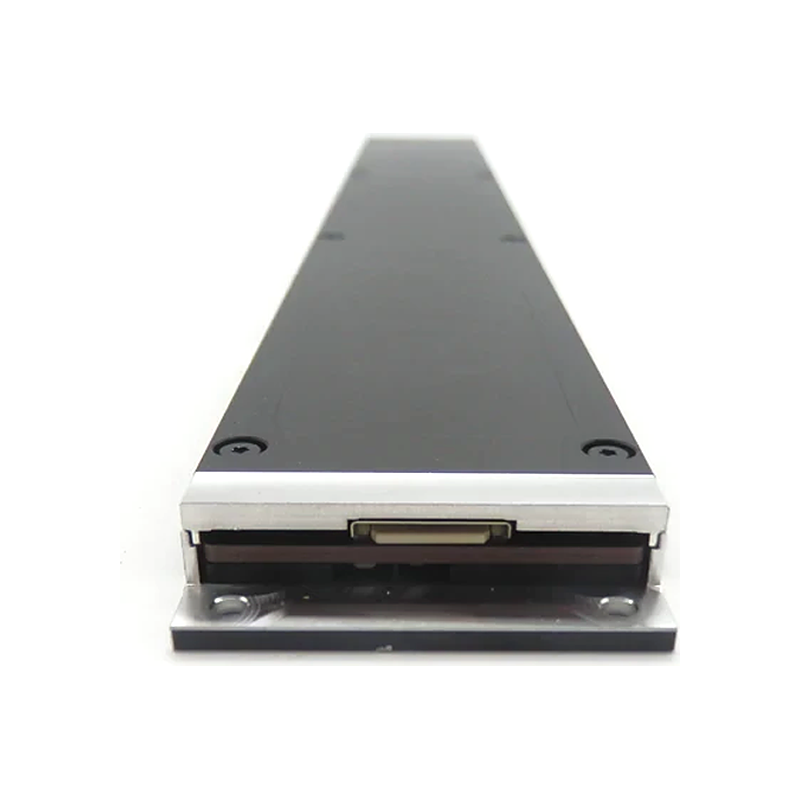
15.36 TB E1.L 1U long ruler NVMe SSD, PCIe 4.0, ordering code MZEL215THBLA-00AMV
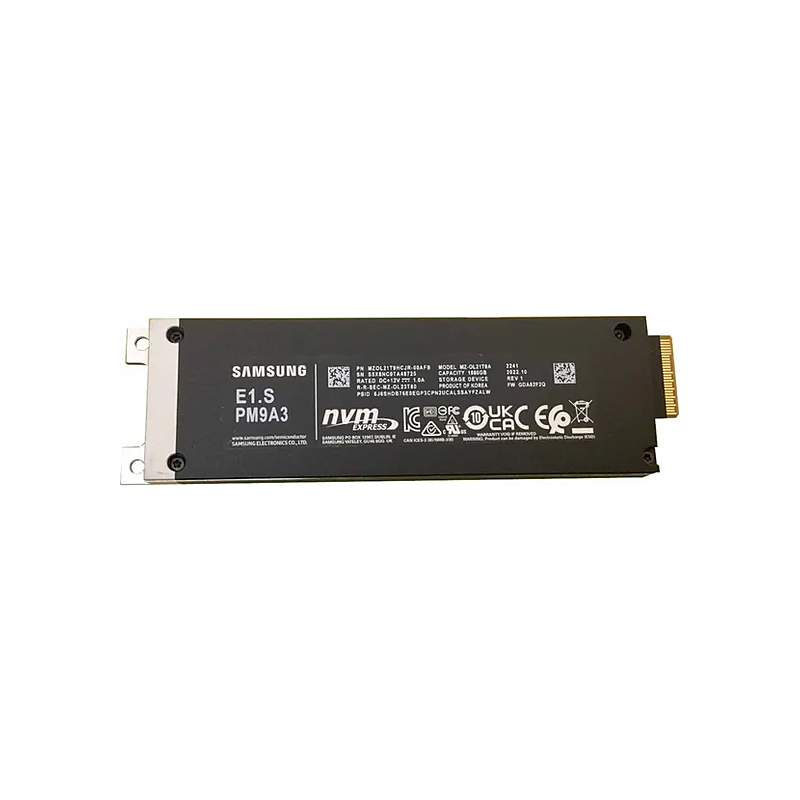
7.68 TB E1.S 1T NVMe SSD, PCIe 4.0, ordering codes MZCL27T6HBLA-00AMV / MZTL27T6HBLA-00A07
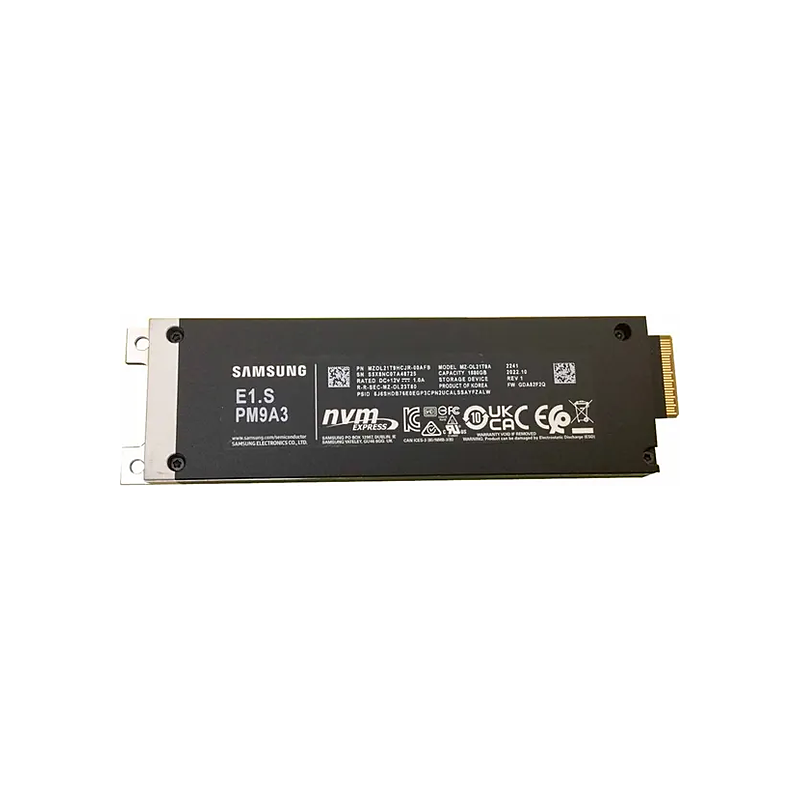
3.84 TB E1.S 1T NVMe SSD, PCIe 4.0, ordering codes MZCL23T8HCLS-00AMV / MZTL23T8HCLS-00A07
3.84 TB M.2 22110 NVMe SSD, PCIe 4.0, ordering codes MZ1L23T8HBLA-00A07 / -00B7C