Micron 5200 ECO 1.92TB SATA SSD (MTFDDAK1T9TDC)
1.92 TB 2.5-inch SATA read-intensive SSD, ordering code MTFDDAK1T9TDC-1AT1ZABYY
- Part Number
- MTFDDAK1T9TDC
- Brand
- Micron
- Category
- Enterprise & Data Center SSD
- Accepted Payments
- T/T Bank Transfer PayPal Western Union
Technical Specifications
| Capacity | 1.92 TB |
|---|---|
| Interface | SATA |
| Form Factor | 2.5-inch 7mm |
| PCIe Version | Not applicable |
| NAND Type | TLC |
| Endurance (DWPD) | 1 |
| TBW | 3,500 TB |
| Sequential Read | 540 MB/s |
| Sequential Write | 520 MB/s |
| Random Read IOPS | 95K IOPS |
| Random Write IOPS | 22K IOPS |
| Power | 3.6 W |
| DRAM Cache | Yes |
| Power Loss Protection | Yes |
| Encryption | TCG Enterprise |
| Condition | New · Used |
Frequently Asked Questions
Micron 5200 ECO 1.92 TB, 2.5-inch 7 mm SATA, catalogue code MTFDDAK1T9TDC, ordering code MTFDDAK1T9TDC-1AT1ZABYY. 540 MB/s sequential read, 520 MB/s sequential write, 95K random read and 22K random write IOPS at 4 KB, 3,500 TBW — one drive write a day for five years — on Micron 64-layer 3D TLC, with 200 µs read and 300 µs write latency and capacitor-backed power-loss protection on TCG Enterprise. Stocked new or as tested pulls with a 1-year warranty from us.
This is the capacity where the read-intensive tier stops improving and starts only doubling. Read and write rates are the same as the 960 GB member, random read is the same 95K, and the only figures that move are the write budget, which doubles to 3,500 TB, and random write, which falls from 28K to 22K. Whether that is a good buy depends entirely on which of the two you need, and the drive in the photograph shows that it also arrives under more than one label.
Two labels, one drive
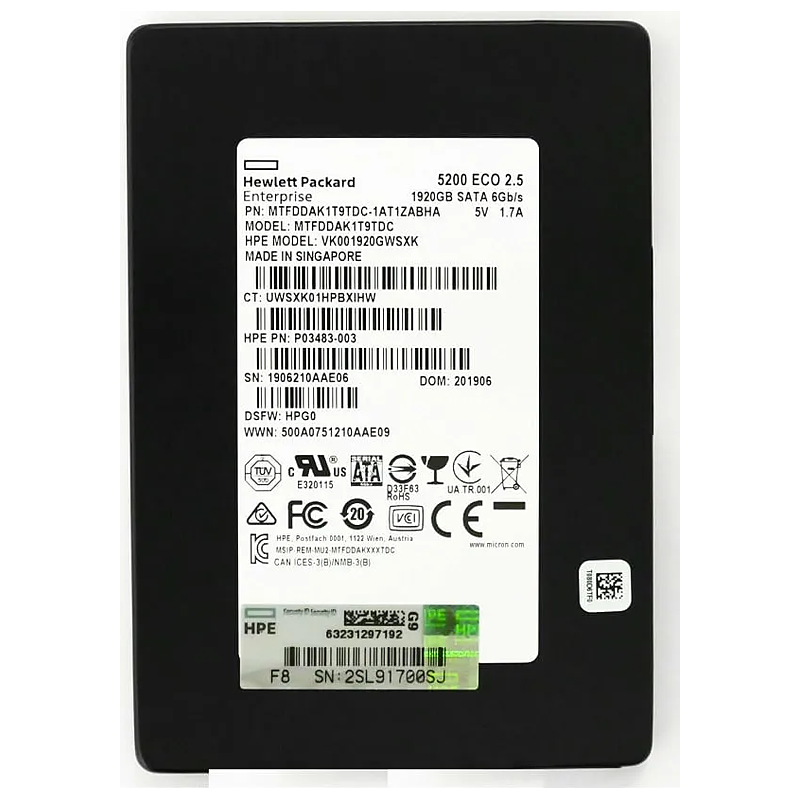
The unit photographed here is an OEM build, not the plain Micron box. The label reads Hewlett Packard Enterprise across the top, carries the Micron model number MTFDDAK1T9TDC in the model field, and adds an HPE model of its own, VK001920GWSXK, next to an HPE part number. The Micron ordering code on that label ends -1AT1ZABHA rather than the -1AT1ZABYY we list, so a goods-in check that only compares the last four characters will flag a correct drive as wrong.
Read the model field first, then the capacity block inside it. MTFDDAK1T9TDC is the same drive whether the label above it says Micron or an OEM name, and TDC is what makes it a 5200 ECO rather than a PRO or a MAX. The final letters of the ordering code describe the configuration and the channel the drive was built for, not the drive itself.
The other label field worth reading is the input rating: 5 V 1.7 A, which is 8.5 W. That is a supply ceiling for the connector, not a measured draw — the drive is rated at 3.6 W maximum on sequential write, 3.0 W on sequential read and 1.5 W idle. Size the rail against the label and the thermal budget against the performance figures, because the two answer different questions. The same label carries a date of manufacture and a serial, both of which are worth recording per unit when drives arrive in mixed batches.
Technical specifications
| Product family | Micron 5200 ECO (SATA NAND Flash SSD, read-intensive data centre) |
|---|---|
| PN | MTFDDAK1T9TDC (catalogue code) |
| Ordering code | MTFDDAK1T9TDC-1AT1ZABYY |
| Capacity | 1.92 TB (unformatted; 1 GB = 1 billion bytes, formatted capacity is less) |
| Form factor | 2.5-inch, 7 mm (100.45 × 69.85 × 7.00 mm) |
| Interface | SATA 6 Gb/s, ATA-8 ACS-3, hot-plug capable, NCQ to depth 32 |
| NAND | Micron 64-layer 3D TLC |
| Sequential read / write | 540 MB/s / 520 MB/s (128 KB, steady state) |
| Random 4 KB (QD32) | 95K IOPS read / 22K IOPS write |
| Quality of service | 200 µs read / 300 µs write at the 99.9th percentile; 1,000 µs / 700 µs at the 99.999th |
| Endurance | 3,500 TBW — 1.0 DWPD over five years |
| TBW basis | Drive held full under a random write workload over the five-year rating period |
| Power | 3.6 W maximum on sequential write, 3.0 W maximum on sequential read, 1.5 W idle; connector rated 5 V 1.7 A |
| Power-loss protection | Yes — data-protection capacitor with capacitor monitoring reported by firmware |
| Data security | AES 256-bit encryption, TCG Enterprise configurability |
| DRAM cache | Yes |
| Features | Flex Capacity, end-to-end data path protection, adaptive thermal monitoring, RAIN recovery, S.M.A.R.T., secure and fast erase, secure firmware |
| Reliability | MTTF 3.0 million device hours; UBER under 1 sector per 1017 bits read |
| Environmental | Operating 0 °C to 70 °C; non-operating shock 1500G at 0.5 ms; vibration 3.13G RMS at 5–800 Hz |
What the step from 960 GB buys, and what it costs
Doubling the bytes does not change the read path at all: 540 MB/s sequential, 95K random read, 200 µs at the 99.9th percentile, all three identical to the 960 GB member. Sequential write stays at 520 MB/s as well, because that figure has been at its platform ceiling since 960 GB. What doubles is the write budget, from 1,750 to 3,500 TB, and what improves without being advertised is power per byte: the same 3.6 W maximum now covers twice the capacity, so a shelf draws 1.9 W per terabyte instead of 3.8.
The cost is on the small-block write side, and it is the largest such step in the tier. Random write falls from 28K to 22K, a 21% drop, and at 22K this drive carries the lowest 4 KB write figure of any drive on the comparison table below — below the PM863a at 24K, the PM883 at 25K and the PM893a at 31K. For a volume whose load is dominated by concurrent small writers, that matters more than the budget does.
One capacity further up, the 3.84 TB member changes two things this drive does not: it is the only capacity in the family rated above a fill a day, at 1.1, and its write tail stretches — 500 µs at the 99.9th percentile against 300 here, and 10 ms at the 99.999th against 700 µs.
So the capacity is honest about what it is for. A working set that has grown past a terabyte but writes about a fill a day — a document store, a media cache, a virtualisation datastore holding mostly cold guests — gets the space, the budget and the lower power per byte with nothing given up that its workload uses. A volume that is small-write heavy at this capacity belongs in the mixed-use tier, where the PRO member quotes 37K for the same 540/520 MB/s.
What 3,500 TBW means at 1.92 TB
3,500 TB over five years is 1,918 GB of writes every day, one full fill of the drive. Written flat out at 520 MB/s the whole allowance would last about 78 days; the rating assumes that daily allowance spread across 1,825 days instead. A boot and log pair writing 80 GB a day uses 4% of the allowance, and a cache that rewrites a fifth of its capacity daily — 384 GB — uses 20%. A full rebuild at 520 MB/s takes about an hour, which is the number to quote when planning a maintenance window rather than a purchase.
The generational comparison is thinner here than at smaller capacities, and that is the point worth making. The 5100 ECO at 1.92 TB carries 3,200 TB at 0.9 drive writes a day, so this drive's budget is only 9% higher — where at 480 GB the step was 93% and at 960 GB it was 94%. The older tier raised its rating at the larger capacities and the newer one held it at one fill a day, so the gap closes as the bytes grow. What does not close is random read, which is 95K here against 93K there.
Against the tiers above, the budget is behind and deliberately so: the PRO member carries 8,800 TB at 2.5 drive writes a day and the MAX member 17,600 TB at five, both at the same 540/520 MB/s and both with more small-block write throughput. This drive is the read-intensive tier at one fill a day, and a volume that writes more than that should be buying one of those rather than stretching this one.
Ordering codes and the generation block
| Code | Type | Condition | Quote |
|---|---|---|---|
| MTFDDAK1T9TDC | Catalogue code | New / used | Enquire |
| MTFDDAK1T9TDC-1AT1ZABYY | Ordering code | New / used | Enquire |
The part number decodes by position. MTFDDAK is the prefix Micron uses for its SATA solid-state drives in this form factor, 1T9 is the capacity, and the block after it identifies the series and tier. TDC is 5200 ECO; the same family reserves TDD for PRO and TDN for MAX, and the previous generation used TBY, TCB and TCC in those positions.
The capacity block is the field that gets misread most often, because Micron writes terabyte capacities in decimal shorthand: 1T9 is 1.92 TB, 3T8 is 3.84 TB and 7T6 is 7.68 TB, while 960 and 480 are written out as plain digits. A pallet holding 1.92 TB and 960 GB units of the same family looks identical from the outside, so the check belongs on the label and the carton count rather than on the case. OEM-labelled units add a second code set — the HPE model and part number in the photograph — and should be reconciled against the Micron model number before they are booked in.
How it compares across the 1.92 TB SATA line
| Model | Capacity | Sequential read / write | Random 4K read / write | Endurance | Power | Class |
|---|---|---|---|---|---|---|
| Micron 5200 ECO 1.92 TB | 1.92 TB | 540 / 520 MB/s | 95K / 22K IOPS | 3,500 TB (1.0 DWPD) | 3.6 W max | Read-intensive, 64-layer TLC |
| Micron 5100 ECO 1.92 TB | 1.92 TB | 540 / 520 MB/s | 93K / 24K IOPS | 3,200 TB (0.9 DWPD) | 5.5 W typ | Read-intensive, 32-layer TLC |
| Micron 5100 PRO 1.92 TB | 1.92 TB | 540 / 520 MB/s | 93K / 37K IOPS | 8,800 TB (2.5 DWPD) | 5.5 W typ | Mixed-use, 3D eTLC |
| Micron 5100 MAX 1.92 TB | 1.92 TB | 540 / 520 MB/s | 93K / 66K IOPS | 17,600 TB (5.0 DWPD) | 5.5 W typ | Write-intensive, 3D eTLC |
| Samsung PM893a 1.92 TB | 1.92 TB | 560 / 530 MB/s | 97K / 31K IOPS | 3,504 TB (1.0 DWPD) | 2.2 W | Read-intensive, TLC |
| Samsung PM883 1.92 TB | 1.92 TB | 550 / 520 MB/s | 98K / 25K IOPS | 2,733 TB (0.78 DWPD) | 2.3 W | Read-intensive, TLC |
| Samsung PM863a 1.92 TB | 1.92 TB | 520 / 480 MB/s | 97K / 24K IOPS | 2,733 TB (0.78 DWPD) | 4 W | Read-intensive, TLC |
Read straight across. This drive is third on sequential read at 540 MB/s, level with the three 5100 rows and behind the 550 and 560 of the two newer Samsung rows; second on sequential write at 520 MB/s, level with four rows and behind only the 530 of the PM893a; fourth on random read at 95K; and last on random write at 22K, below every other row including the PM863a at 24K.
On write budget it is fourth at 3,500 TB, four terabytes behind the PM893a and 9% above the 5100 ECO, which is the narrowest generational gap in the whole 5200 range. On power the 3.6 W is a maximum rather than a typical figure, so it sits above the 2.2 and 2.3 W the two Samsung TLC rows quote and below the 5.5 W of the Micron tiers above, with none of the three sets measured the same way. The 1.5 W idle figure is the one that governs a mostly-idle shelf.
Two rows decide most purchases at this capacity. Against the PM893a the two drives are within four terabytes of budget and the Samsung is ahead on every throughput figure — 20 MB/s of read, 10 MB/s of write, 2K of random read and 9K of random write — while drawing less power; this drive's case rests on availability, condition and price rather than on the table. Against the 5100 ECO the case is thinner than at 480 GB or 960 GB: 9% more budget and 2K more random read, at the cost of 2K of random write.
How each drive is tested before it ships
- Label read first and in full: 5200 ECO with MTFDDAK1T9TDC in the model field, the TDC series block checked against TDD and TDN, the 1T9 capacity block confirmed, and any OEM code set recorded alongside it.
- SMART read before anything else — power-on hours, total LBAs written, percentage used, reallocated sectors and grown defect count — kept on file for the individual drive shipped.
- Full-surface read scan across the whole 1.92 TB, then the drive's extended self-test run to completion rather than a sample.
- Sequential read verified near 540 MB/s and write near 520 MB/s on a native SATA 6 Gb/s port, measured in steady state rather than on a fresh drive's first pass.
- Random 4 KB measured at queue depth 32 in both directions; 95K read and 22K write are the two figures that place this capacity in the tier, and the write figure is the one to watch on a used unit.
- Latency sampled at queue depth 1, since the 200 µs and 300 µs percentile figures move with firmware state.
- TCG Enterprise state queried, and power-loss protection checked at the firmware level, before the drive is listed rather than after it ships.
- Secure erase and sanitize exercised, drive returned to a clean state, then final inspection, anti-static bag and foam packing.
Warranty, lead time and purchasing
Every drive carries a 1-year warranty from us against defects in workmanship and function. Verified faulty units are replaced or refunded and we cover return shipping. Stock is held in both new and used condition; the condition you order is confirmed before dispatch, and used units are pull-tested rather than untested lots. Stock is held in our own warehouse and normally dispatches within three to seven working days, with tracking issued at dispatch.
At 1.92 TB the drives arrive both as plain Micron units and as OEM-labelled ones of the same model number, and the two are worth separating when a build needs matched labels across a shelf. Tell us the quantity, the condition, the platform and whether OEM labelling is acceptable, and you will get a quote with lead time the same working day.
Get Pricing For This Part
Tell us who you are — we reply within one working day with a firm quote, stock status and lead time. Volume discounts available.
Related Products
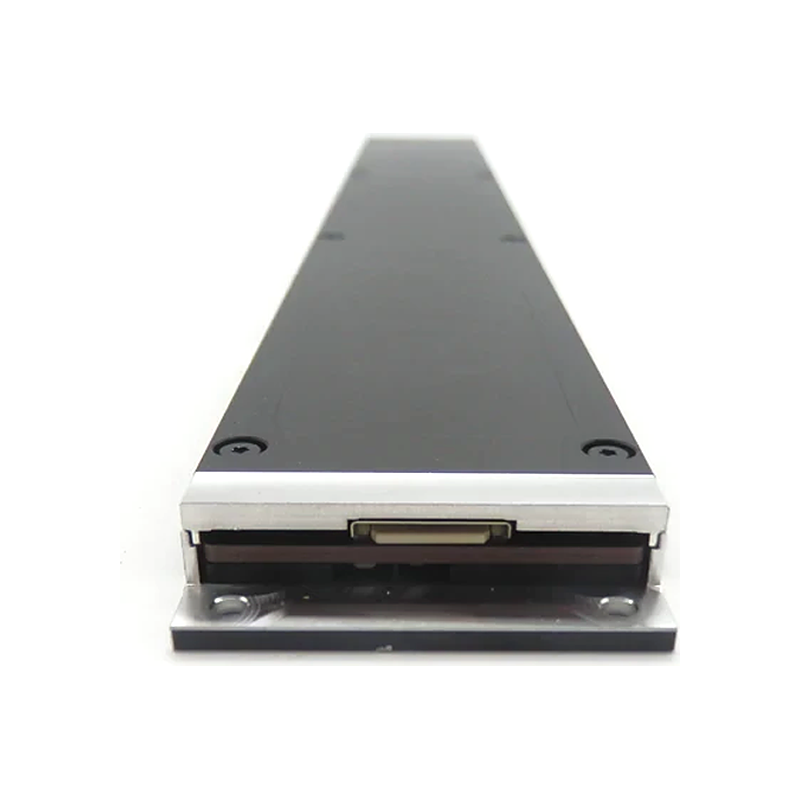
15.36 TB E1.L 1U long ruler NVMe SSD, PCIe 4.0, ordering code MZEL215THBLA-00AMV
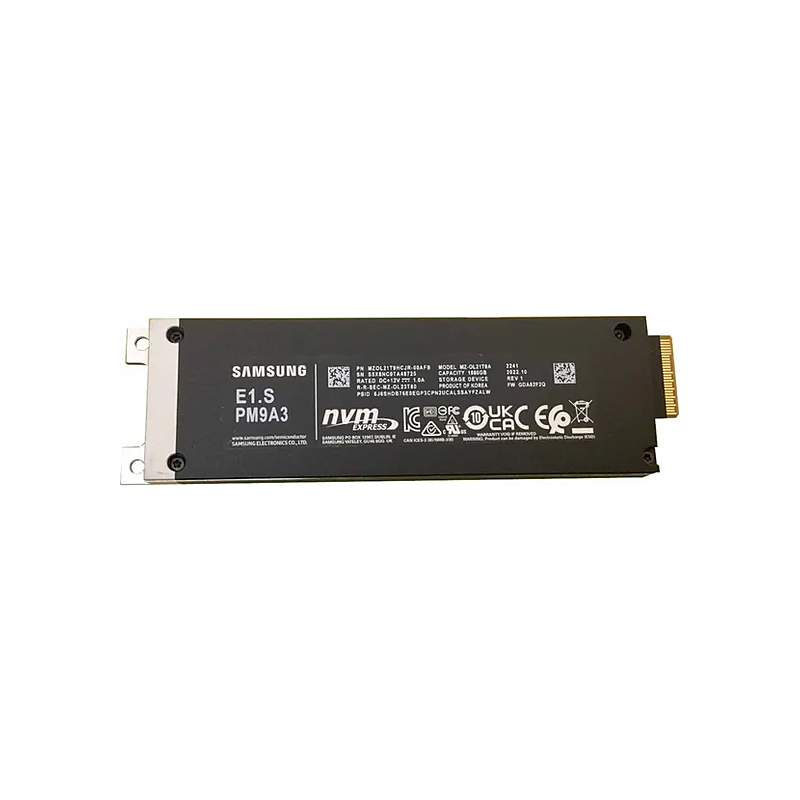
7.68 TB E1.S 1T NVMe SSD, PCIe 4.0, ordering codes MZCL27T6HBLA-00AMV / MZTL27T6HBLA-00A07
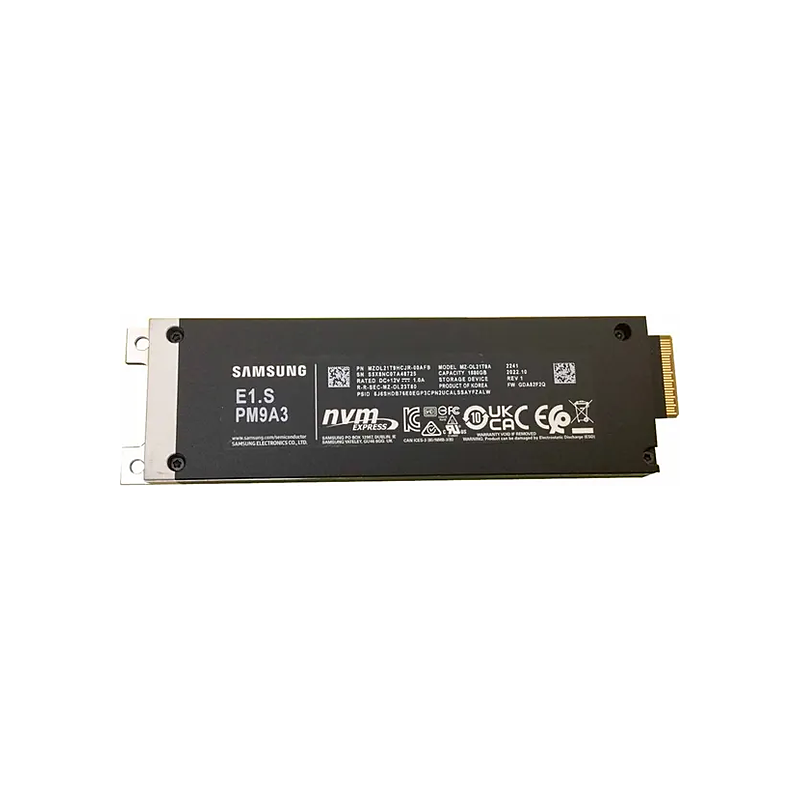
3.84 TB E1.S 1T NVMe SSD, PCIe 4.0, ordering codes MZCL23T8HCLS-00AMV / MZTL23T8HCLS-00A07
1.92 TB E1.S 1T (9.5 mm) NVMe SSD, PCIe 4.0, ordering code MZCL21T9HCJR-00AMV