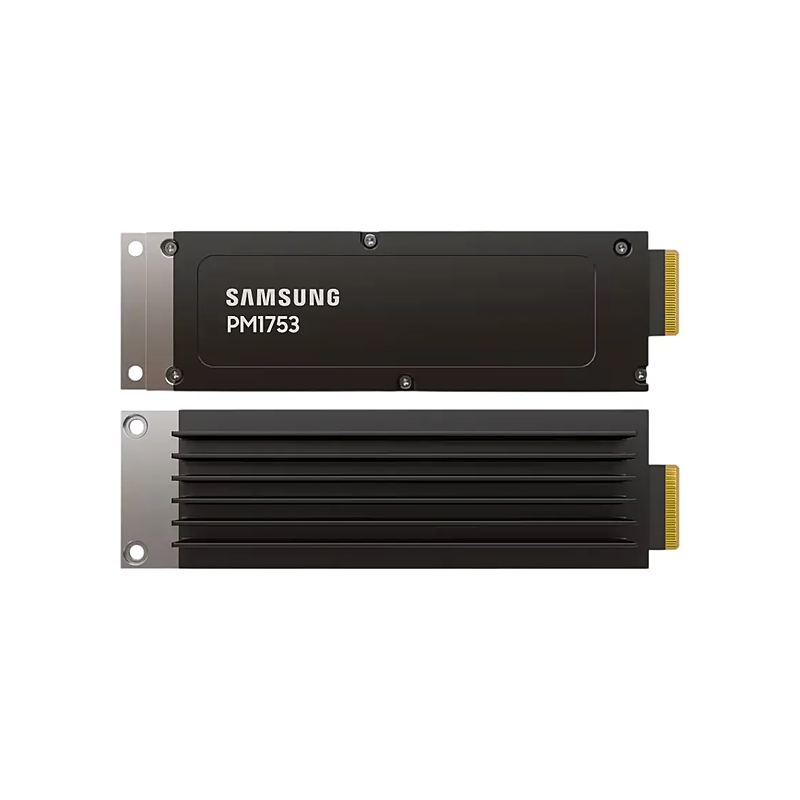
Samsung PM1753 15.36TB E3.S NVMe SSD (MZ3L915THBLC)
15.36 TB E3.S (EDSFF) NVMe SSD, ordering code MZ3L915THBLC-00AW7
- Part Number
- MZ3L915THBLC
- Brand
- Samsung
- Category
- Enterprise & Data Center SSD
- Accepted Payments
- T/T Bank Transfer PayPal Western Union
Technical Specifications
| Capacity | 15.36 TB |
|---|---|
| Interface | NVMe |
| Form Factor | E3.S |
| PCIe Version | PCIe 5.0 |
| NAND Type | TLC |
| Endurance (DWPD) | 1 |
| TBW | 28,032 TB |
| Sequential Read | 14,000 MB/s |
| Sequential Write | 10,000 MB/s |
| Random Read IOPS | 3,200K IOPS |
| Random Write IOPS | 620K IOPS |
| Power | 21.34 W |
| DRAM Cache | Yes |
| Power Loss Protection | Yes |
| Encryption | AES-XTS 256 |
| Condition | New · Used |
Frequently Asked Questions
Samsung PM1753 15.36 TB in the E3.S form factor, 7.5 mm EDSFF, catalogue code MZ3L915THBLC, supplied under ordering code MZ3L915THBLC-00AW7. 14,000 MB/s sequential read, 10,000 MB/s sequential write, 3,200K random read and 620K random write IOPS at 4 KB, 28,032 TBW at one drive write a day over five years, on ninth-generation V-NAND TLC, with AES-XTS 256-bit encryption, power-loss protection and OCP compliance. Stocked new or as tested pulls with a 1-year warranty from us.
The silicon is the same as the 2.5-inch member of this family. What changes is the package: 112.75 × 76.25 × 7.5 mm against 100.20 × 69.85 × 15.00 mm, and a connector that faces the airflow rather than the front of the bay. That difference is worth a chassis decision rather than a footnote, because E3.S density is quoted per rack unit and not per drive.
What E3.S changes in a 1U chassis
A 1U server takes 20 E3.S drives where the same unit takes 10 in 2.5-inch bays, and a 2U takes 36 against 24. At 15.36 TB that is 307 TB in a single rack unit and 552 TB in 2U, against 368 TB for the 2.5-inch version of the same drive in the same 2U. Nothing about the NAND changes between those two shelves; the physical format does.
Power follows the same shape. Idle draw is 3.94 W, sequential write 19.09 W and the ceiling 21.34 W, so a full 1U of twenty idle drives pulls about 79 W and the same shelf writing flat out pulls about 427 W. Twenty drives at 14,000 MB/s is 280 GB/s of theoretical read bandwidth per rack unit, which is a fabric question long before it is a drive question.
The format also changes the service story. E3.S is hot-pluggable in a cabled or caddyless carrier, and the 7.5 mm body sits in the airflow path rather than behind a bay wall, which is why the same controller and NAND can be rated without the derating a 15 mm 2.5-inch drive sometimes needs in a dense shelf.
Technical specifications
| Product family | Samsung PM1753 (PCIe 5.0 enterprise NVMe SSD, EDSFF) |
|---|---|
| PN | MZ3L915THBLC (catalogue code) |
| Ordering code | MZ3L915THBLC-00AW7 |
| Capacity | 15.36 TB (unformatted; 1 GB = 1 billion bytes, formatted capacity is less) |
| Form factor | E3.S (EDSFF), 7.5 mm, 112.75 × 76.25 × 7.5 mm |
| Interface | PCIe 5.0 x4, NVMe 2.0, hot-pluggable in an E3.S carrier |
| NAND | Samsung ninth-generation V-NAND TLC |
| Sequential read / write | 14,000 MB/s / 10,000 MB/s |
| Random 4 KB | 3,200K IOPS read / 620K IOPS write |
| Endurance | 28,032 TBW — 1 DWPD over five years |
| TBW basis | Drive held full under a sequential write workload over the five-year rating period |
| Power | 21.34 W maximum, 19.09 W sequential write, 3.94 W idle |
| Power-loss protection | Yes — integrated PLP with capacitor health reported by firmware |
| Data security | AES-XTS 256-bit encryption, secure erase, TCG security subsystem |
| DRAM cache | Yes |
| Features | PLP, end-to-end data protection, S.M.A.R.T., OCP 2.0 compliance, hot-plug, sanitize and secure erase |
| Reliability | MTBF 2.5 million hours; UBER under 1 sector per 1017 bits read |
| Environmental | Operating 0 °C to 70 °C case temperature; non-operating −40 °C to 85 °C |
What 28,032 TBW means at 15.36 TB
28,032 TB over five years is 15,360 GB of writes every day, one full fill of the drive. Written flat out at 10,000 MB/s the allowance would last about 32 days; the rating spreads it across 1,825 days instead. A volume rewriting a fifth of its capacity daily uses 20% of the allowance and a log partition writing 200 GB a day uses 1.3%.
The number that matters in a dense shelf is the aggregate. Twenty drives in one rack unit carry 560,640 TB of rated writes between them, which is one full fill per terabyte every day: 307 TB of writing daily across the whole unit. A rebuild of one member at 10,000 MB/s is about 26 minutes of pure transfer, so a failed drive in a 20-bay unit costs minutes of degraded redundancy rather than the hours a large 2.5-inch shelf used to cost.
Ordering codes and the model block
| Code | Type | Form factor | Condition | Quote |
|---|---|---|---|---|
| MZ3L915THBLC | Catalogue code | E3.S | New / used | Enquire |
| MZ3L915THBLC-00AW7 | Ordering code | E3.S | New / used | Enquire |
The prefix is where this drive separates from its 2.5-inch sibling. MZ3 is the EDSFF family of this generation and MZW is the 2.5-inch family, so a part number beginning MZ3L is the E3.S build and one beginning MZWL is the U.2 build, with identical capacity, endurance and silicon behind the difference. The 15T block is the capacity, 15.36 TB, and -00AW7 is the build and channel block.
That prefix is the practical check at goods-in, because the two drives are not interchangeable in a chassis and a quotation that names only the capacity does not say which one is on the pallet. Ask for the prefix, not the family name.
U.2 or E3.S: the same drive, two shelves
| Model | Form factor | Capacity | Seq read / write | Random 4 KB | Max power | TBW | DWPD |
|---|---|---|---|---|---|---|---|
| PM1753 15.36 TB E3.S | E3.S 7.5 mm | 15.36 TB | 14,000 / 10,000 MB/s | 3,200K / 620K | 21.34 W | 28,032 TB | 1 |
| PM1753 15.36 TB U.2 | 2.5-inch U.2 15 mm | 15.36 TB | 14,000 / 10,000 MB/s | 3,200K / 620K | 20.8 W | 28,032 TB | 1 |
| PM893a 7.68 TB | 2.5-inch SATA | 7.68 TB | 560 / 530 MB/s | 97K / 31K | 3.6 W | 14,016 TB | 1 |
| 5200 ECO 7.68 TB | 2.5-inch SATA | 7.68 TB | 540 / 520 MB/s | 95K / 9.5K | 3.6 W | 8,400 TB | 0.6 |
Against the 2.5-inch U.2 version of the same drive the specifications are identical line for line: the same 14,000/10,000 MB/s, the same 3,200K/620K IOPS, the same 28,032 TBW. The choice is made by the chassis. A 2U with 24 front-loading 2.5-inch bays takes the U.2 part and gains nothing from E3.S. A 2U EDSFF shelf takes 36 E3.S drives and reaches 552 TB where the 2.5-inch version would stop at 368 TB in the same rack space. Buying the wrong form factor is the one mistake in this family that no amount of firmware will fix.
Against the SATA parts the comparison is about interface generation rather than tier. A PM893a 7.68 TB reads at 560 MB/s on a 6 Gb/s link, which is twenty-five times less sequential read than this drive, and the gap on random read is thirty-three times. The PM883 at 7.68 TB sits within 10 MB/s of that on the same link, which is the point: the interface, not the model, sets the ceiling. What SATA still owns is the entry cost of the slot around it, and that is a platform argument rather than a drive argument.
Why the form factor decides the shelf, not the drive
EDSFF was designed for the problem that 2.5-inch bays cannot solve: the drive is no longer the tallest object in the server. An E3.S drive is 7.5 mm thick and its connector sits on the short edge, so the drives can be packed across the width of a 1U chassis with the airflow passing between them instead of over a 15 mm wall. That is the entire density gain, and it is why a 1U can hold 20 of them.
For a buyer the consequence is that the shelf decision comes before the drive decision. A platform with E3.S carriers cannot take the U.2 part no matter how it is cabled, and a 2.5-inch backplane cannot take an E3.S drive without an adapter that defeats the density case. Confirm the carrier type on the platform side first; the drive follows.
What to check at goods-in
- Model prefix. MZ3L915THBLC is this E3.S build. A part beginning MZWL is the 2.5-inch U.2 drive of the same capacity, and the two will not interchange, so the prefix is the first field to read.
- Body thickness. 7.5 mm with a 112.75 × 76.25 mm footprint. A carrier designed for E3.S 2T is deeper and will not close on a 1T drive without the right spacer.
- Carrier, not just the drive. Most E3.S shelves need the drive in a carrier or caddy. Confirm whether the units you are buying include it, because a bare drive is not installable in every chassis and the carrier is a separate part number.
- SMART and the NVMe log. Percentage used, data units written and power-on hours are readable through the NVMe admin command set. On this drive 20% used means 5,606 TB of the 28,032 TB allowance has been spent.
- Firmware and sanitize state. Record the firmware revision and confirm the drive has been sanitized rather than quick-erased, since mixed revisions in one EDSFF shelf complicate service.
Every drive is listed after inspection rather than before: label fields recorded, SMART read and kept against the unit, a full-surface read scan, the drive's own self-test run to completion, sequential and random performance measured on a native PCIe 5.0 port, latency sampled at queue depth one, and a secure erase before packing. Stock normally leaves our warehouse within three to seven working days, with tracking issued at dispatch.
Current capacity and interface availability is in the enterprise SSD catalog. If the platform decision is still open, the read-intensive versus mixed-use guide covers how the endurance tiers are set and where the write budget stops doubling. Send us the chassis model and the carrier type, and we will confirm which of the two PM1753 formats fits before anything is quoted.
Get Pricing For This Part
Tell us who you are — we reply within one working day with a firm quote, stock status and lead time. Volume discounts available.
Related Products
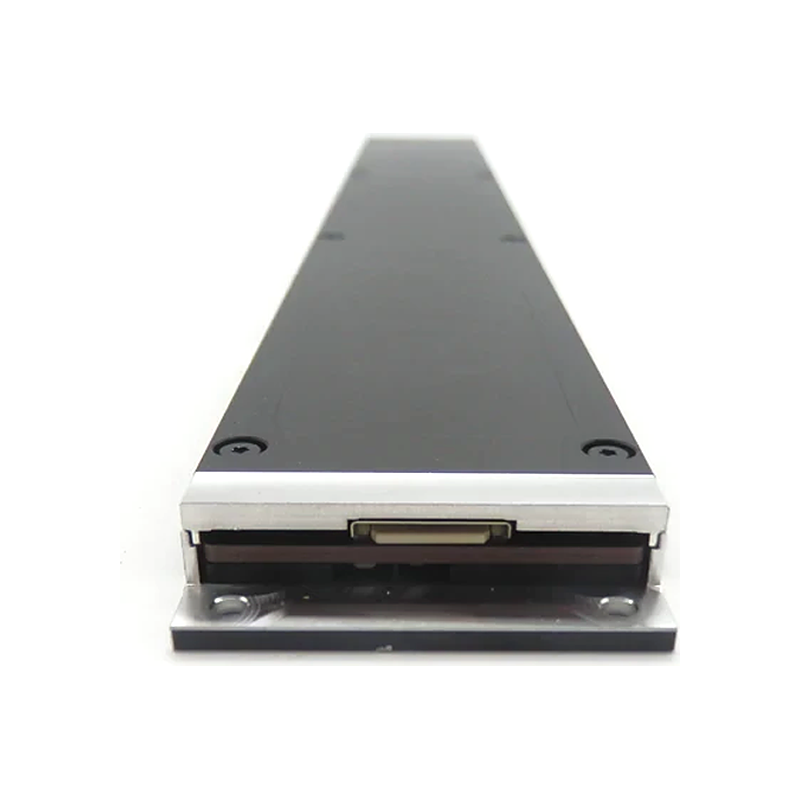
15.36 TB E1.L 1U long ruler NVMe SSD, PCIe 4.0, ordering code MZEL215THBLA-00AMV
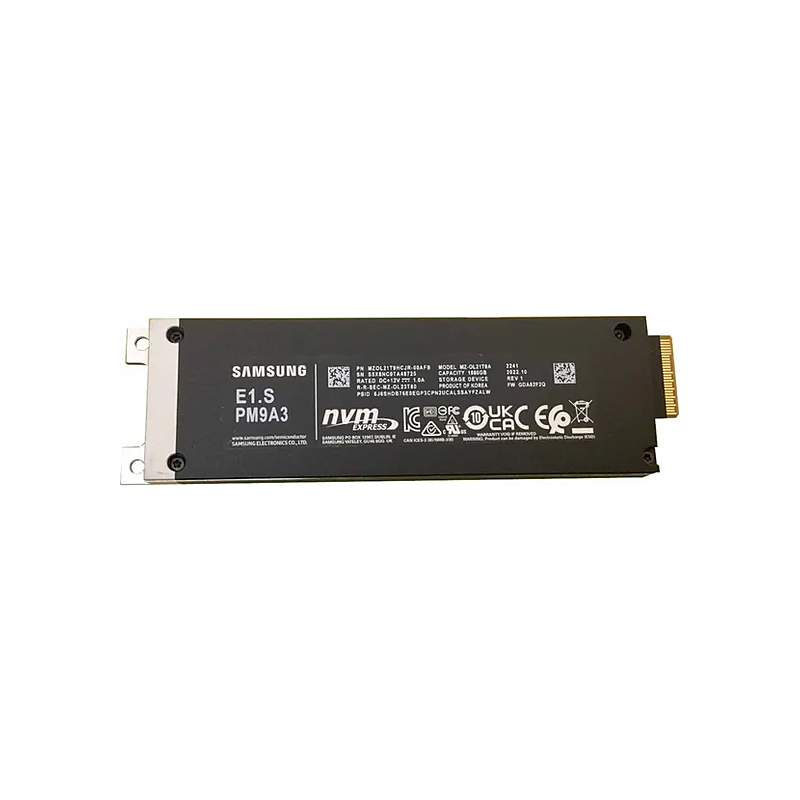
7.68 TB E1.S 1T NVMe SSD, PCIe 4.0, ordering codes MZCL27T6HBLA-00AMV / MZTL27T6HBLA-00A07
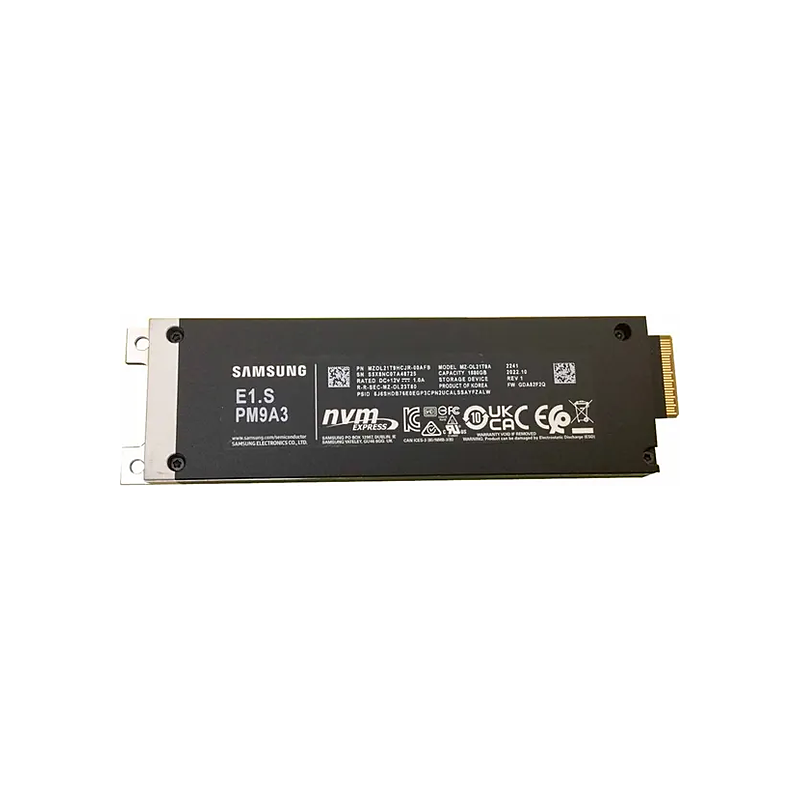
3.84 TB E1.S 1T NVMe SSD, PCIe 4.0, ordering codes MZCL23T8HCLS-00AMV / MZTL23T8HCLS-00A07
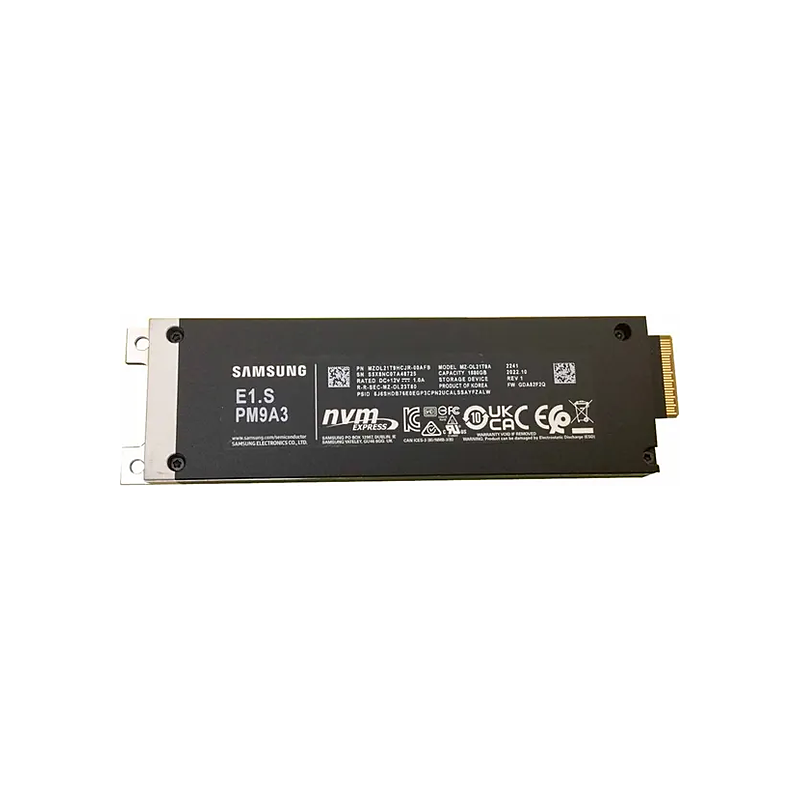
1.92 TB E1.S 1T (9.5 mm) NVMe SSD, PCIe 4.0, ordering code MZCL21T9HCJR-00AMV