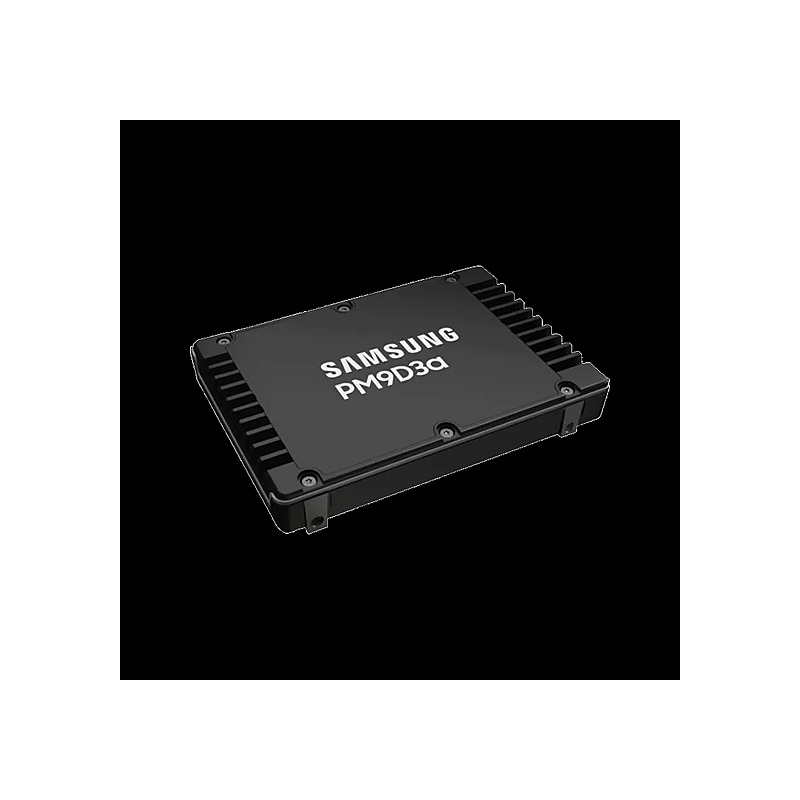
Samsung PM9D3a 15.36TB PCIe 5.0 NVMe U.2 SSD (MZWL615THBLF)
15.36 TB 2.5-inch U.2 NVMe SSD, PCIe 5.0, ordering code MZWL615THBLF-00AW7
- Part Number
- MZWL615THBLF
- Brand
- Samsung
- Category
- Enterprise & Data Center SSD
- Accepted Payments
- T/T Bank Transfer PayPal Western Union
Technical Specifications
| Capacity | 15.36 TB |
|---|---|
| Interface | NVMe |
| Form Factor | U.2 15mm |
| PCIe Version | PCIe 5.0 |
| NAND Type | TLC |
| Endurance (DWPD) | 1 |
| TBW | 28,032 TB |
| Sequential Read | 12,000 MB/s |
| Sequential Write | 7,000 MB/s |
| Random Read IOPS | 1,800K IOPS |
| Random Write IOPS | 400K IOPS |
| Power | 14.1 W |
| DRAM Cache | Yes |
| Power Loss Protection | Yes |
| Encryption | AES-XTS 256 |
| Condition | New · Used |
Frequently Asked Questions
Samsung PM9D3a 15.36 TB, 2.5-inch U.2 at 15 mm, catalogue code MZWL615THBLF, ordering code MZWL615THBLF-00AW7. 12,000 MB/s sequential read and 7,000 MB/s write on PCIe 5.0 x4, 1,800K random read and 400K random write IOPS, 28,032 TBW at one drive write a day for five years. Eighth-generation V-NAND TLC, NVMe 2.0, 14.1 W reading and 16.4 W writing. New and used both stocked.
This is the largest capacity in the range and the least thirsty drive in it: 14.1 W reading where the other Samsung Gen5 parts at this capacity draw 20.8 to 24.6. It is not the fastest. The PM1753 writes at 10,000 MB/s and reads 3,200K random IOPS, and the PM1743 reads 14,000. What this one does is hold 15.36 TB for 0.92 W per terabyte, which is the lowest figure in the whole family.
Technical specifications
| Product family | Samsung PM9D3a (PCIe 5.0 data centre NVMe SSD, 1 DWPD) |
|---|---|
| PN | MZWL615THBLF (catalogue code) |
| Ordering code | MZWL615THBLF-00AW7 |
| Capacity | 15.36 TB (unformatted; 1 GB = 1 billion bytes, formatted capacity is less) |
| Form factor | 2.5-inch U.2, 15 mm (100.45 × 69.85 × 15 mm, up to 170 g) |
| Interface | PCIe 5.0 x4, NVMe 2.0, backwards compatible with PCIe 4.0 and 3.0 |
| NAND | Samsung V-NAND TLC (8th generation) |
| Sequential read | 12,000 MB/s (128 KB, queue depth 256) |
| Sequential write | 7,000 MB/s |
| Random 4K read | 1,800K IOPS (queue depth 64, four workers) |
| Random 4K write | 400K IOPS |
| Endurance (TBW) | 28,032 TB |
| Endurance (DWPD) | 1 drive write per day for five years |
| Latency | 65 µs random read, 9 µs random write (queue depth 1, median) |
| QoS 99% | 0.09 ms read at queue depth 1, 0.15 ms at depth 32; 0.015 / 0.16 ms write |
| Power | 14.1 W typical read, 16.4 W typical write, 4.3 W idle on PCIe 5.0 (12 V rail) |
| Power on PCIe 4.0 | 13 W read, 15.1 W write, 3.5 W idle |
| Power-loss protection | Yes, capacitor-backed, with end-to-end data path protection |
| Encryption | AES-XTS 256-bit engine, TCG Opal compliant |
| Sector size | 512, 520, 4096 or 4160 bytes, formattable |
| MTBF / UBER | 2.5 million hours / 1 sector per 1017 bits read |
| Drive ready | 13 s from power-on to accepting commands |
Four drives, 15.36 TB each, four different jobs
| Model | Capacity | Bus and form factor | Seq read / write | Random 4 KB | TBW | DWPD | Power |
|---|---|---|---|---|---|---|---|
| PM1733a | 15.36 TB | PCIe 4.0, U.2 15 mm | 7,500 / 4,100 MB/s | 1,600K / 170K | 28,032 TB | 1 | 19 W |
| PM1743 | 15.36 TB | PCIe 5.0, U.2 15 mm | 14,000 / 7,100 MB/s | 2,500K / 360K | 28,032 TB | 1 | 24.6 W |
| PM1753 | 15.36 TB | PCIe 5.0, U.2 15 mm | 14,000 / 10,000 MB/s | 3,200K / 620K | 28,032 TB | 1 | 20.8 W |
| PM9D3a | 15.36 TB | PCIe 5.0, U.2 15 mm | 12,000 / 7,000 MB/s | 1,800K / 400K | 28,032 TB | 1 | 14.1 W |
The endurance column reads the same on all four, and that is the first thing worth noticing about this table.
Why all four carry 28,032 TB
Fifteen point three six terabytes of host writes a day for 1,825 days is 28,032 TB. That is multiplication, not engineering: any 15.36 TB drive rated at one drive write a day lands on the same figure, whatever controller sits behind it and whatever generation of flash it uses. The PM1733a on a Gen4 link and the PM1753 at 10,000 MB/s sequential write both carry exactly the same endurance number as this drive.
So TBW cannot be used to choose among them, and any page that leads with it is selling the one thing that is identical across the range. Raising it takes a different DWPD rating or a larger capacity, not a faster drive. What actually separates these four is performance per watt and price per gigabyte, which is a less comfortable argument to make on a specification sheet and a more useful one to buy on.
What separates them is how much performance each one buys with how many watts, and the order is not what a model number would suggest. The PM1753 is the fastest and uses less power than the PM1743. The PM9D3a is the slowest and uses the least. Read across the last two columns rather than the first two.
The cheapest watts in the range
Fourteen point one watts against 24.6 is a 43 percent saving per drive, and at this capacity that compounds fast. A 24-bay shelf holds 368 TB either way. Filled with this drive it draws 338 W reading; filled with the PM1743 it draws 590 W. That is 252 W per shelf, and a floor of forty shelves is ten kilowatts of load that does not appear on any datasheet comparison table.
Per terabyte the figure is 0.92 W, against 1.60 for the PM1743 and 1.35 for the PM1753. Take the family as a whole: 11.5 W per terabyte at 960 GB, 5.8 at 1.92 TB, 3.33 at 3.84 TB, 1.76 at 7.68 TB and 0.92 here. Each capacity doubling halves the power per gigabyte, which is the single most reliable argument for buying the largest drive a slot will take.
The same curve runs backwards on IOPS. Random read per terabyte is 1,042K at 960 GB and 117K here, roughly nine times less. A 24-bay shelf of this drive gives 43 million random read IOPS over 368 TB; the same shelf of 960 GB drives gives 24 million over 23 TB. Density and IOPS density are not the same measurement and a fleet rarely needs both at once.
What you give up against PM1753 and PM1743
The PM1753 is the hard comparison at this capacity, because it is better on every performance axis and only four watts behind on power: 14,000 against 12,000 read, 10,000 against 7,000 write, 3,200K against 1,800K random read, 620K against 400K random write, at 20.8 W against 14.1.
Four watts per drive is 96 W per shelf, which is real but not decisive. The honest reading is that the PM1753 wins on throughput and this drive wins on power and price, and a buyer who needs 10,000 MB/s sequential writes should not be looking here at all. What this drive offers is a Gen5 link, 15.36 TB and the lowest power draw in the family, for the tiers that are capacity-bound rather than bandwidth-bound.
Against the PM1743 the trade is the same shape it was at 7.68 TB: 10.5 watts less, 2,000 MB/s less read, 700K less random read, 40K more random write. The write side stays competitive; the read side clearly does not.
On a Gen4 link: 4,100 and 200K
PCIe 4.0 brings the drive to 7,000 MB/s read and 4,100 write, random read 1,100K, random write 200K, at 13 W reading and 3.5 W idle. Sequential write gives up 41 percent, random read 39 percent and random write exactly half.
At this capacity the comparison that matters is the PM1733a on its native Gen4 link: 4,100 sequential write and 170K random write against this drive's 4,100 and 200K. The sequential gap disappears entirely and the random write advantage shrinks to 18 percent. A Gen4 server that does not need 15.36 TB per slot is usually better served by the older, cheaper drive.
Ordering codes: MZWL615 and the -00AW7 suffix
| Code | Type | Capacity | Condition | Quote |
|---|---|---|---|---|
| MZWL615THBLF | Catalogue code | 15.36 TB | New / used | Enquire |
| MZWL615THBLF-00AW7 | Ordering code | 15.36 TB | New / used | Enquire |
The suffix is a distribution block, not a specification. The datasheet lists this capacity as -00B07 and channel stock usually carries -00AW7. Both are the 15.36 TB U.2 drive.
Four strings at this capacity are easy to mix up, and only one of them is this drive. MZWLO15THBLA is the PM1743, with a letter O in the fifth position. MZWL915THBLF is the PM1753. MZ3LO15THBLA is the PM1743 in E3.S at 7.5 mm and will not fit a U.2 bay. This one is MZWL6 with a digit 6, then 15THBLF.
Checks worth running on delivery:
- Digit 6 in the fifth position. MZWL615THBLF is PM9D3a; MZWLO15THBLA is PM1743; MZWL915THBLF is PM1753. Three different drives, one character apart.
- Reported capacity. 15.36 TB reports about 13.96 TiB. A 7.68 TB drive in the same shell reports about 6.98 TiB.
- Drive-ready time. 13 seconds at this capacity, the longest in the family. A full shelf powering on together draws inrush current from every bay at once.
- Host bytes written against 28,032 TB. Even a heavily used pull usually has room, but the figure belongs in the asset record before the wipe, not after.
Warranty, lead time and purchasing
New and used drives both come with a one year warranty from us that stays with the drive when it changes hands. Stock typically moves out of the warehouse within three to seven working days and tracking is issued on dispatch. The minimum order is two pieces, the five capacities in this family combine on one order, and once part number, condition and quantity reach us a price goes back the same day.
Get Pricing For This Part
Tell us who you are — we reply within one working day with a firm quote, stock status and lead time. Volume discounts available.
Related Products
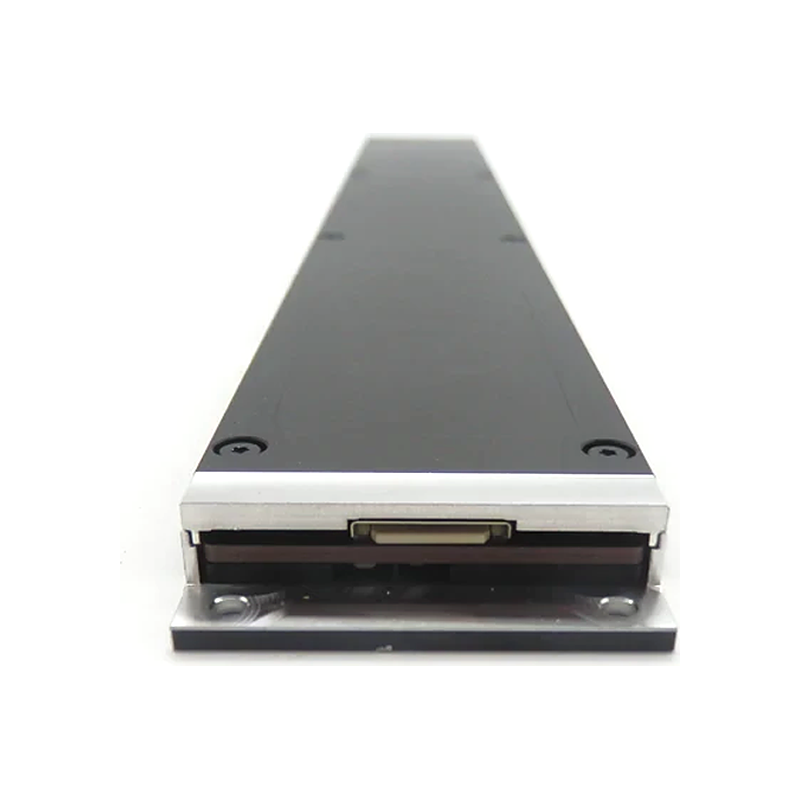
15.36 TB E1.L 1U long ruler NVMe SSD, PCIe 4.0, ordering code MZEL215THBLA-00AMV
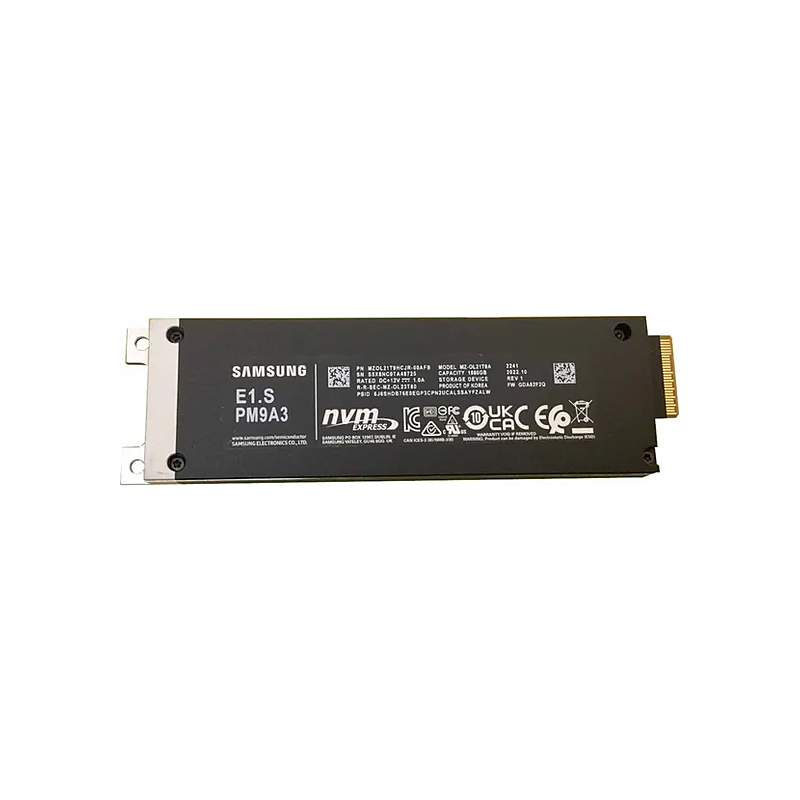
7.68 TB E1.S 1T NVMe SSD, PCIe 4.0, ordering codes MZCL27T6HBLA-00AMV / MZTL27T6HBLA-00A07
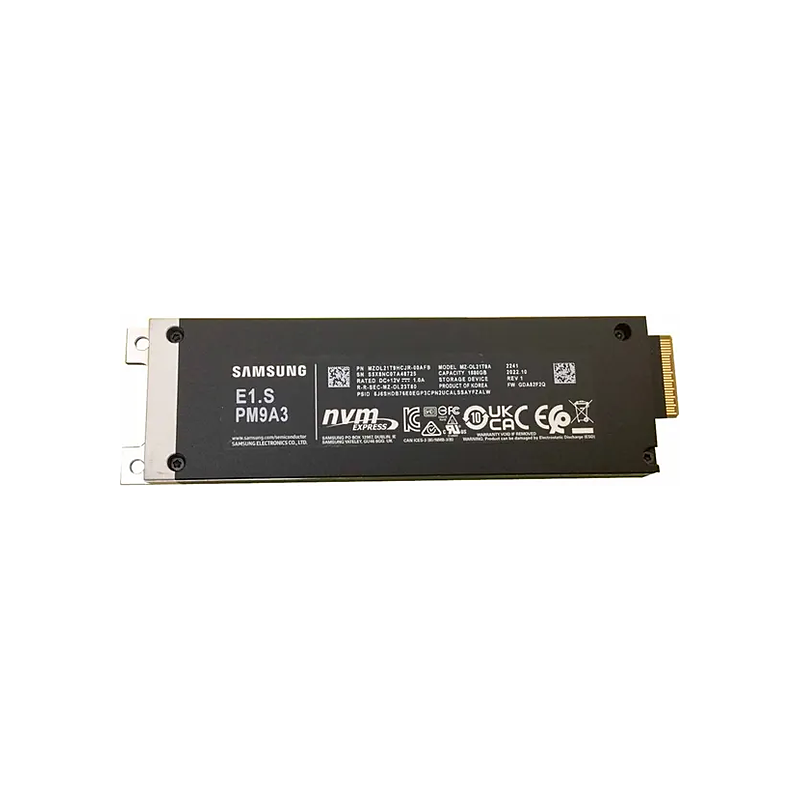
3.84 TB E1.S 1T NVMe SSD, PCIe 4.0, ordering codes MZCL23T8HCLS-00AMV / MZTL23T8HCLS-00A07
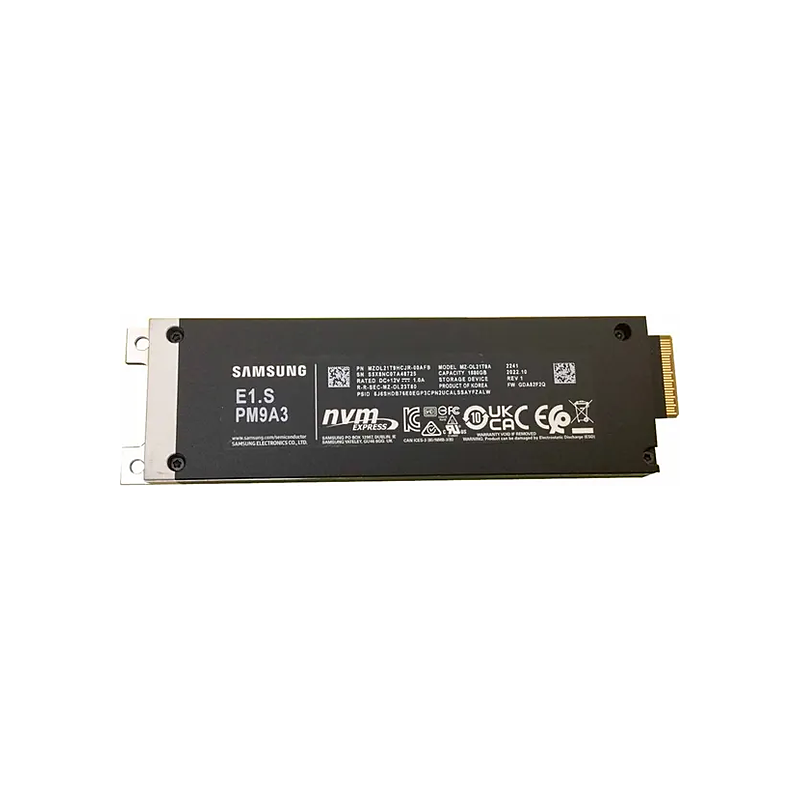
1.92 TB E1.S 1T (9.5 mm) NVMe SSD, PCIe 4.0, ordering code MZCL21T9HCJR-00AMV