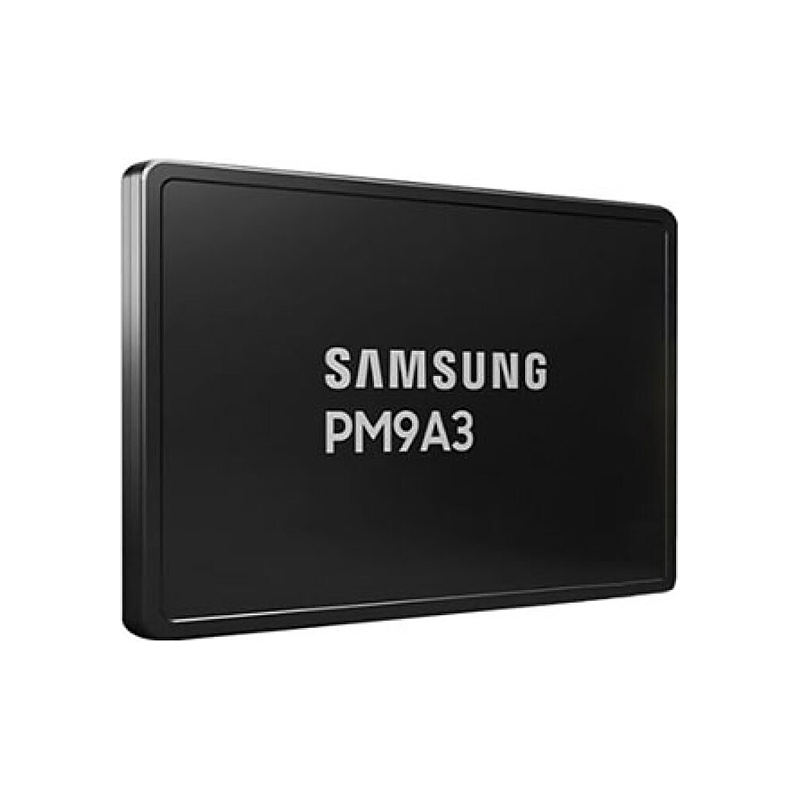
Samsung PM9A3 1.92TB PCIe 4.0 NVMe U.2 SSD (MZQL21T9HCJR)
1.92 TB 2.5-inch U.2 NVMe SSD, PCIe 4.0, ordering codes MZQL21T9HCJR-00A07 / -00W07 / -00B7C
- Part Number
- MZQL21T9HCJR
- Brand
- Samsung
- Category
- Enterprise & Data Center SSD
- Accepted Payments
- T/T Bank Transfer PayPal Western Union
Technical Specifications
| Capacity | 1.92 TB |
|---|---|
| Interface | NVMe |
| Form Factor | U.2 7mm |
| PCIe Version | PCIe 4.0 |
| NAND Type | TLC |
| Endurance (DWPD) | 1 |
| TBW | 3,504 TB |
| Sequential Read | 6,800 MB/s |
| Sequential Write | 2,700 MB/s |
| Random Read IOPS | 850K IOPS |
| Random Write IOPS | 130K IOPS |
| Power | 10 W |
| DRAM Cache | Yes |
| Power Loss Protection | Yes |
| Encryption | AES-XTS 256 |
| Condition | New · Used |
Frequently Asked Questions
Samsung PM9A3 1.92 TB, 2.5-inch U.2 at 7 mm, catalogue code MZQL21T9HCJR, orderable as -00A07, -00W07 and -00B7C. 6,800 MB/s sequential read and 2,700 MB/s write on PCIe 4.0 x4, 850K random read and 130K random write IOPS, 3,504 TBW at 1 DWPD. TLC V-NAND, capacitor-backed PLP, AES 256-bit full disk encryption, 10.0 W reading and 12.5 W writing. New and used both stocked.
Doubling the capacity from 960 GB does more to this drive than the table suggests. Sequential write goes from 1,500 to 2,700 MB/s and random write from 70K to 130K IOPS, while read barely moves in proportion, and the whole thing still fits a 7 mm carrier on a single PCIe 4.0 port at 1 DWPD. That combination is why this capacity, rather than the smaller one, is the sensible default for a general-purpose volume.
Technical specifications
| Product family | Samsung PM9A3 (PCIe 4.0 data centre NVMe SSD, 1 DWPD) |
|---|---|
| PN | MZQL21T9HCJR (catalogue code) |
| Ordering codes | MZQL21T9HCJR-00A07 / MZQL21T9HCJR-00W07 / MZQL21T9HCJR-00B7C |
| Capacity | 1.92 TB (unformatted; 1 GB = 1 billion bytes, formatted capacity is less) |
| Form factor | 2.5-inch U.2, 7 mm (100.20 × 69.85 × 7.0 mm) |
| Interface | PCIe 4.0 x4, NVMe 1.4, single port |
| NAND | Samsung V-NAND TLC |
| Sequential read | 6,800 MB/s (up to, 4 KB transfer size, queue depth 32, four workers) |
| Sequential write | 2,700 MB/s |
| Random 4K read | 850K IOPS (queue depth 32) |
| Random 4K write | 130K IOPS (queue depth 32) |
| Endurance (TBW) | 3,504 TB |
| Endurance (DWPD) | 1 drive write per day for five years |
| Power | 10.0 W active read, 12.5 W active write, 3.5 W idle with DIPM off |
| Power-loss protection | Yes, capacitor-backed, with end-to-end data path protection |
| Encryption | AES 256-bit full disk encryption, TCG Opal 2.0, IEEE 1667 encrypted drive |
| MTBF | 2.0 million hours |
| Environment | 0 to 70 °C operating, −40 to 85 °C non-operating, 5 to 95% non-condensing |
| Features | TRIM, garbage collection, S.M.A.R.T. |
Five drives at 1.92 TB, three generations
| Model | Capacity | Interface | Seq read / write | Random 4 KB | TBW | Power |
|---|---|---|---|---|---|---|
| PM963 | 1.92 TB | PCIe 3.0 x4 | 2,000 / 1,200 MB/s | 430K / 40K | 2,733 TB | 7.5 W |
| PM983 | 1.92 TB | PCIe 3.0 x4 | 3,200 / 2,000 MB/s | 540K / 50K | 2,733 TB | 10.6 W |
| PM1733 | 1.92 TB | PCIe 4.0 x4 | 7,000 / 2,400 MB/s | 800K / 100K | 3,504 TB | 15 W |
| PM9A3 | 1.92 TB | PCIe 4.0 x4 | 6,800 / 2,700 MB/s | 850K / 130K | 3,504 TB | 10.0 W |
| PM9D3a | 1.92 TB | PCIe 5.0 x4 | 12,000 / 3,500 MB/s | 1,700K / 150K | 3,504 TB | 11.2 W |
Read the random column first, because it is the one that changed most between generations and the one most workloads actually feel. The Gen3 PM963 sits at 430K, the Gen3 PM983 at 540K, this drive at 850K, and the Gen5 part at 1,700K. Sequential read moved from 2,000 to 12,000 over the same span, but sequential read is what a benchmark reports rather than what a database does.
The write columns tell a different story and they are not monotonic in the way the read columns are. Sequential write went 1,200, 2,000, 2,700, 3,500 across the four generations, and random write went 40K, 50K, 130K, 150K. Most of the random write gain landed in the Gen3 to Gen4 step, not the Gen4 to Gen5 one.
This is where Gen5 starts buying write bandwidth
At 960 GB in this family, the Gen5 part buys roughly seven percent more sequential write than the Gen4 part and no additional random write at all. Here the same comparison buys thirty percent more sequential write and fifteen percent more random write, on top of a doubling of random read. The 960 GB page works through the arithmetic of why that is; the short version is that the smaller capacity does not carry enough dies to keep the write pipeline full, so a faster link cannot help it, and at 1.92 TB there are enough dies for the link to become the limit again.
For a buyer that means the argument for a newer generation depends on the capacity being bought, which is not how product ranges are usually explained. At 960 GB, on a Gen4 host, the Gen5 drive is a read upgrade only. At 1.92 TB and above it starts to be a write upgrade too, and that changes when the refresh is worth paying for.
PM9A3 against PM1733 at the same capacity
Both of these are Gen4, both are 2.5-inch, both carry 3,504 TBW at 1 DWPD, and they are both in stock here. They are not interchangeable, and the difference is not the one a model number suggests.
The PM1733 quotes 7,000 MB/s sequential read against 6,800 here, which is three percent and invisible outside a benchmark. On every other column this drive is ahead: 2,700 against 2,400 on sequential write, 850K against 800K on random read, 130K against 100K on random write. And it does that at 10 W against 15 W, in a 7 mm shell rather than a 15 mm one.
Twenty-four bays make the power gap concrete: 228 W against 360 W, a difference of 132 W per shelf that has to come off the same circuit as everything else. The height matters separately, because a 7 mm drive fits every 2.5-inch bay including the shallow caddies, and a 15 mm drive does not. If a chassis is already populated with 15 mm parts, mixing this one in is a decision about whether the power saving justifies two part numbers in the same fleet, and that is an operational question rather than a technical one.
What 3,504 TBW buys at this capacity
One drive write a day for five years on 1.92 TB is 1.92 TB of host writes a day, which averages 22 MB/s. At the rated 2,700 MB/s, a full fill of the drive takes about twelve minutes, so the rating permits a complete rewrite every day of the warranty and the rewrite itself is a coffee break.
The limit only shows up at the random write ceiling. At 130K IOPS of 4 KB writes the drive absorbs 532 MB/s, and 3,504 TB at that rate lasts about seventy-six days. Peak random write is not a working state, but a log file that sits at half of it for a month is worth measuring, and a used pull should have its host-writes figure checked against the role it is going into.
Write per terabyte is also worth looking at across the range, because it does not stay flat: 1,500 MB/s over 960 GB is 1,563 MB/s per terabyte, 2,700 over 1.92 TB is 1,406, 4,100 over 3.84 TB is 1,068, and 4,000 over 7.68 TB is 521. The smallest capacity in this family gives the most write bandwidth per terabyte of any of them, and it falls by two thirds by the top of the range. Anyone buying capacity for a write-bound job should read that curve before the headline sequential figure.
Ordering codes and what to check at goods-in
| Code | Type | Capacity | Condition | Quote |
|---|---|---|---|---|
| MZQL21T9HCJR | Catalogue code | 1.92 TB | New / used | Enquire |
| MZQL21T9HCJR-00A07 | Ordering code | 1.92 TB | New / used | Enquire |
| MZQL21T9HCJR-00W07 | Ordering code | 1.92 TB | New / used | Enquire |
| MZQL21T9HCJR-00B7C | Ordering code | 1.92 TB | New / used | Enquire |
The suffix records the distribution block and the build rather than the capacity or the performance, and all three strings describe the same drive. Samsung prints -00W07 in its own part list; -00A07 and -00B7C are the same drive shipped through different channels. Quote the string the customer's system holds and check the packing list against it. The density field carries the meaning that survives at goods-in: MZQL is the 2.5-inch U.2 carrier, MZ1L is the M.2 22110 version at the same capacity, and the characters after MZQL read 1T9 here.
- MZQL, not MZ1L. The M.2 part carries the same performance numbers and will not fit a U.2 bay.
- 7 mm. Every PM9A3 U.2 drive is 7 mm; a 15 mm shell at this capacity belongs to a different product line.
- 3,504 TBW. At 1.92 TB that is what 1 DWPD for five years produces, and a different number means a different endurance class.
- Host bytes written and power-on hours. A pull at this capacity has usually been a general-purpose volume, so both figures should be read rather than assumed.
- Firmware revision. These drives are re-provisioned before resale more often than the smaller capacity is; ask for the SMART record against the serial.
Warranty, lead time and purchasing
Every drive carries one year of cover from us, sealed or pulled from service, and the cover travels with the drive rather than with the server it was removed from. Tested pulls are wiped, graded and photographed before packing, and the SMART log stays attached to the serial number so it can be produced later. Orders leave the warehouse inside three to seven working days and the tracking number is issued when they do. The minimum on a line is two pieces, capacities and carriers in this family can ride a single order together, and a quotation goes back the same working day once the part number, condition and quantity are confirmed.
Get Pricing For This Part
Tell us who you are — we reply within one working day with a firm quote, stock status and lead time. Volume discounts available.
Related Products
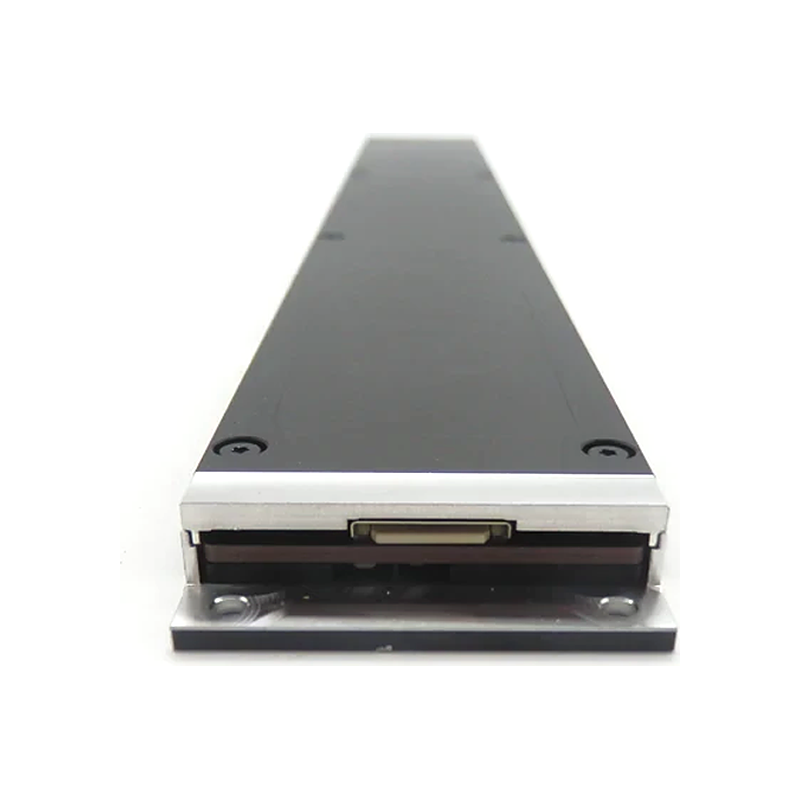
15.36 TB E1.L 1U long ruler NVMe SSD, PCIe 4.0, ordering code MZEL215THBLA-00AMV
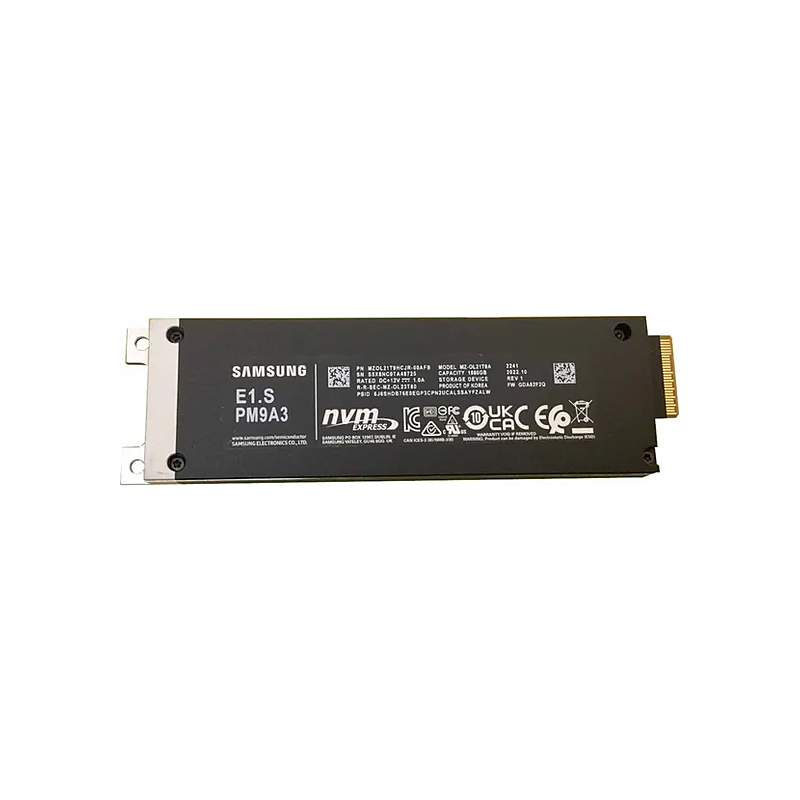
7.68 TB E1.S 1T NVMe SSD, PCIe 4.0, ordering codes MZCL27T6HBLA-00AMV / MZTL27T6HBLA-00A07
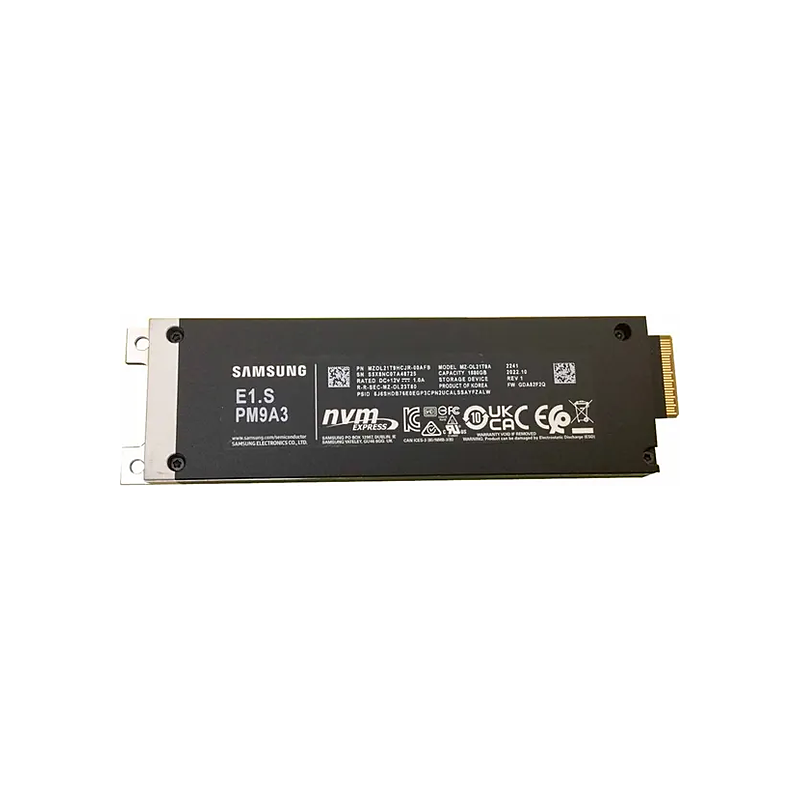
3.84 TB E1.S 1T NVMe SSD, PCIe 4.0, ordering codes MZCL23T8HCLS-00AMV / MZTL23T8HCLS-00A07
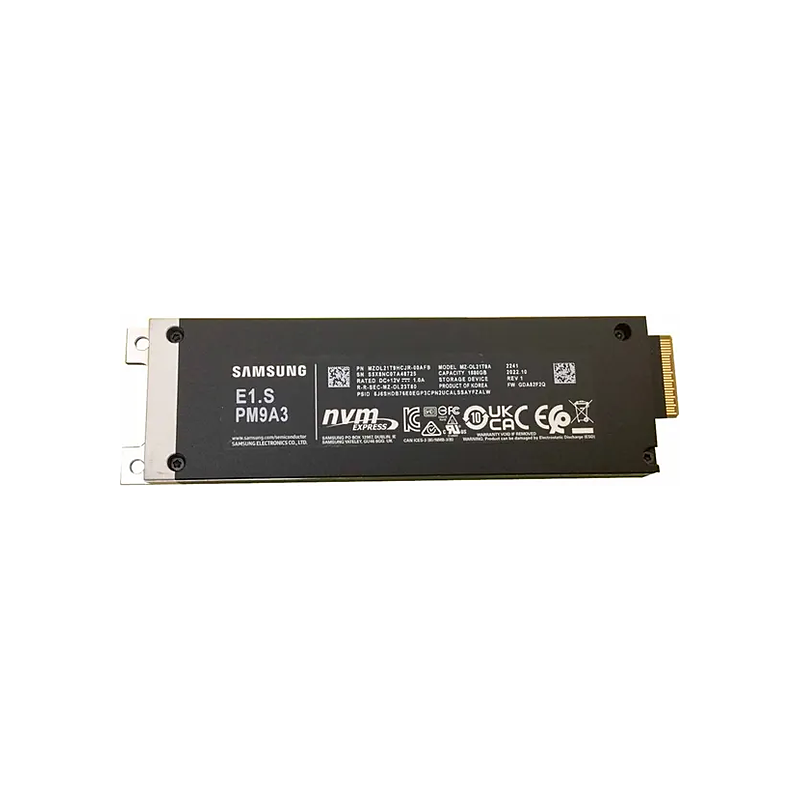
1.92 TB E1.S 1T (9.5 mm) NVMe SSD, PCIe 4.0, ordering code MZCL21T9HCJR-00AMV