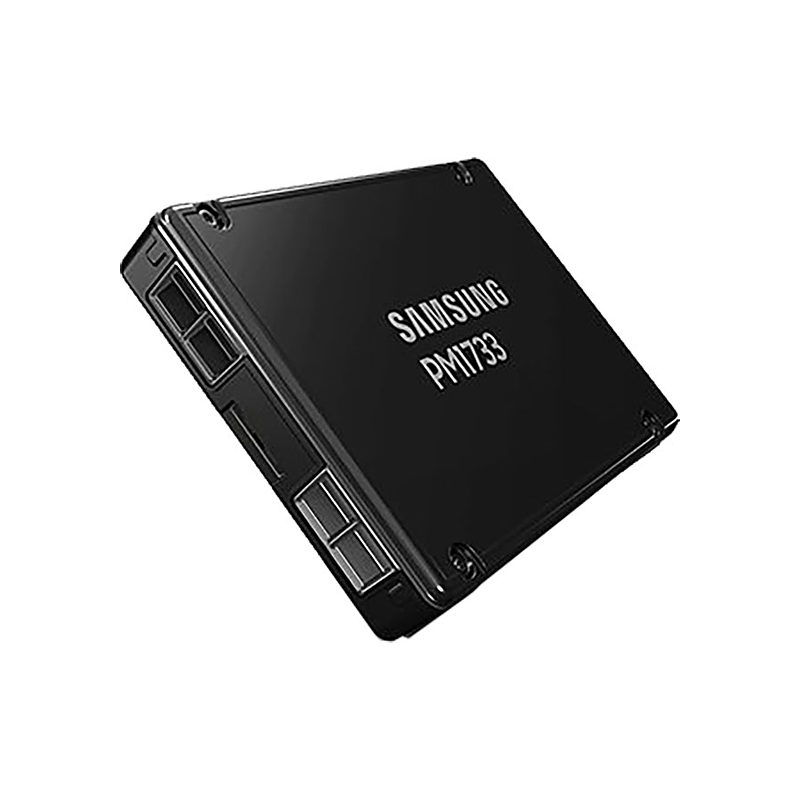
Samsung PM1733 3.84TB PCIe 4.0 NVMe U.2 SSD (MZWLJ3T8HBLS)
3.84 TB 2.5-inch U.2 NVMe SSD, PCIe 4.0, ordering code MZWLJ3T8HBLS-00007
- Part Number
- MZWLJ3T8HBLS
- Brand
- Samsung
- Category
- Enterprise & Data Center SSD
- Accepted Payments
- T/T Bank Transfer PayPal Western Union
Technical Specifications
| Capacity | 3.84 TB |
|---|---|
| Interface | NVMe |
| Form Factor | U.2 15mm |
| PCIe Version | PCIe 4.0 |
| NAND Type | TLC |
| Endurance (DWPD) | 1 |
| TBW | 7,008 TB |
| Sequential Read | 7,000 MB/s |
| Sequential Write | 3,800 MB/s |
| Random Read IOPS | 1,500K IOPS |
| Random Write IOPS | 135K IOPS |
| Power | 20 W |
| DRAM Cache | Yes |
| Power Loss Protection | Yes |
| Encryption | AES-XTS 256 |
| Condition | New · Used |
Frequently Asked Questions
Samsung PM1733 3.84 TB, the 15 mm U.2 version, catalogue code MZWLJ3T8HBLS, ordering code MZWLJ3T8HBLS-00007. 7,000 MB/s sequential read and 3,800 MB/s write on a PCIe 4.0 host, 1,500K random read and 135K random write IOPS, 7,008 TBW at one drive write a day for five years. V-NAND TLC, PCIe 4.0 x4, NVMe 1.3, 20 W. Both conditions stocked, one-year warranty either way.
At 1.92 TB this family reads like a cache drive: full read bandwidth, but a write side that never gets past 2,400 MB/s and 100K IOPS. Double the capacity and the read ceiling stays where it was while everything else moves. The write rate goes up by more than half, random read nearly doubles, and the daily write budget goes from one 1.92 TB drive to one 3.84 TB drive. Same controller, same bus, twice the dies behind it.
Where the extra write speed comes from
A Gen4 x4 link caps out around 7 GB/s and this drive already uses it for reads. Writes are not link-limited at 3,800 MB/s, they are limited by how many planes the controller can keep busy, which is a function of die count. The 1.92 TB part has half as many, so it writes at 2,400; this one writes at 3,800. The 7.68 TB part does not go faster again, which is the usual sign that the controller has been reached rather than the flash.
One number to keep straight when you are comparing quotes: Samsung's own page for MZWLJ3T8HBLS-00007 lists 3,800 MB/s, while Lenovo's ThinkSystem guide for the same drive lists 3,500. Both are in print. We publish Samsung's figure for the ordering code and mention the lower one here, so that a quote built from the platform guide does not look like an error. Treat 3,500 as the floor you can promise.
Technical specifications
| Product family | Samsung PM1733 (PCIe 4.0 enterprise NVMe SSD, 1 DWPD) |
|---|---|
| PN | MZWLJ3T8HBLS (catalogue code) |
| Ordering code | MZWLJ3T8HBLS-00007 |
| Capacity | 3.84 TB (unformatted; 1 GB = 1 billion bytes, formatted capacity is less) |
| Form factor | 2.5-inch U.2, SFF-8639, 15 mm (100 × 70 × 15 mm) |
| Interface | PCIe 4.0 x4, dual-port x2, NVMe 1.3, backwards compatible with PCIe 3.0 x4 |
| NAND | Samsung V-NAND TLC (5th generation) |
| Sequential read | 7,000 MB/s on PCIe 4.0; 3,400 MB/s on PCIe 3.0 |
| Sequential write | 3,800 MB/s on PCIe 4.0; 3,200 MB/s on PCIe 3.0 |
| Random 4K read | 1,500K IOPS on PCIe 4.0; 800K on PCIe 3.0 |
| Random 4K write | 135K IOPS on either host generation |
| Latency, random read / write | 100 µs / 25 µs |
| Latency, sequential read / write | 220 µs / 80 µs on PCIe 4.0; 250 µs / 100 µs on PCIe 3.0 |
| Endurance (TBW) | 7,008 TB |
| Endurance (DWPD) | 1 drive write per day for five years |
| Power | 20 W typical read, 20 W typical write on a PCIe 4.0 host (15 W read on PCIe 3.0); 8.5 W idle; 22 W maximum |
| DRAM cache | Yes |
| Power-loss protection | Yes, capacitor-backed, with end-to-end data protection and surge handling |
| Encryption | AES-XTS 256-bit, TCG Opal 2.0 compliant |
| MTTF | 2 million hours |
What 7,008 TB works out to
7,008 TB spread over 1,825 days is 3.84 TB of host writes a day, which is exactly one full drive every day for five years. Because the rating is a flat 1 DWPD, the daily allowance doubles with the capacity — unlike the read-intensive families, where the lifetime total plateaus near 2.7 or 5.5 PB and the per-day figure falls as the drive grows.
Against the PM983 at the same capacity that is 1,542 TB more, or about 845 GB a day, for a drive that also writes half again as fast. Against the 1.92 TB PM1733 it is simple arithmetic: same writes per day per terabyte, twice the terabytes.
How it lines up at 3.84 TB
| Model | Interface | Capacity | Seq read / write | Random 4 KB | TBW | DWPD |
|---|---|---|---|---|---|---|
| PM1733 3.84 TB | PCIe 4.0 x4 | 3.84 TB | 7,000 / 3,800 MB/s | 1,500K / 135K | 7,008 TB | 1 |
| PM983 3.84 TB | PCIe 3.0 x4 | 3.84 TB | 3,200 / 2,000 MB/s | 540K / 50K | 5,466 TB | 0.78 |
| PM963 3.84 TB | PCIe 3.0 x4 | 3.84 TB | 2,000 / 1,200 MB/s | 430K / 40K | 5,466 TB | 0.78 |
| 5400 MAX 3.84 TB | SATA 6 Gb/s | 3.84 TB | 540 / 520 MB/s | 95K / 34K | 23,827 TB | 3.4 |
Two of those rows are worth a second look. The PM983 and PM963 share a 5,466 TB rating exactly — the generation that doubled sequential read did not add a day of endurance, so the 7,008 here is the first real increase in the line. And the SATA row still carries three times the lifetime writes, which is the same trade at every capacity: if the workload is write-heavy rather than read-heavy, a Gen4 NVMe drive is the wrong purchase no matter how fast it is.
On a Gen3 host the picture changes by one column. Sequential read drops to 3,400 and write to 3,200, random read to 800K, and the drive still beats both Gen3 parts on every row — by 1,400 MB/s of read over the PM983 and 900K of random read. Random write stays at 135K either way, because that path was never bus-limited.
Twenty watts, fifteen millimetres
This is a 20 W drive on a Gen4 host, against 15 W for the 1.92 TB part. Twenty-four of them in one shelf is 480 W of flash — 120 W more than the same count of 1.92 TB drives for twice the storage, which is the trade a dense shelf is actually making. Idle is 8.5 W and the maximum is 22 W, so the backplane has to carry the peak through 12 V, not the typical figure.
The thickness is the harder constraint. At 15 mm it will not close in a carrier built for 7 mm drives, and a 24-bay shelf designed around thin drives will take half as many of these. Check the chassis before the datasheet: nothing in the specification tells you whether your bays are 7 or 15 mm.
Ordering codes and the HBLS build
| Code | Type | Capacity | Condition | Quote |
|---|---|---|---|---|
| MZWLJ3T8HBLS | Catalogue code | 3.84 TB | New / used | Enquire |
| MZWLJ3T8HBLS-00007 | Ordering code | 3.84 TB | New / used | Enquire |
MZWL is the PM1733 family in U.2, J the generation marker, 3T8 the capacity, HBLS the build, -00007 the channel suffix. The build block changes with capacity: the 1.92 TB part is HBJR, this one is HBLS. So MZWLJ3T8HBJR does not exist — a drive carrying that string is either a 1.92 TB part with a wrong label or a label with the wrong capacity, and both are worth rejecting at goods-in.
The family also ships as an HHHL add-in card with the same MZWL prefix and a different build block, running on eight lanes at 8,000 MB/s. That card will not go into a U.2 bay, and the first four characters will not tell you which one you have.
What to check at goods-in
- 15 mm clearance. Measure the carrier before the drive arrives. A 7 mm bay will not close on it.
- Host bytes written against 7,008 TB. Read the SMART counter before wiping. A pull at 20 percent has 5.6 PB left; one at 80 percent has 1.4 PB, which is still a year at full drive writes a day but changes what the drive is worth.
- Dual-port support. This SKU is wired as PCIe 4.0 x4 / dual-port x2. In a single-port backplane it runs normally; in a dual-port array it needs both paths wired and presented, or failover does nothing.
- Capacitor health. Power-loss protection and hot-insert surge handling share the same capacitors. Both fail without a warning.
- U.2 wiring. On a SAS or SATA backplane the drive powers up and never links. Still the most common reason a working NVMe drive looks dead.
Warranty, lead time and purchasing
Both conditions carry a year of cover from us, and the warranty stays with the drive rather than the server it came out of. Stock normally turns round in three to seven working days, with tracking issued as it leaves. Two pieces is the minimum order, the four capacities in this family combine on one order, and a quote follows once we have part number, condition and quantity — usually the same working day.
Get Pricing For This Part
Tell us who you are — we reply within one working day with a firm quote, stock status and lead time. Volume discounts available.
Related Products
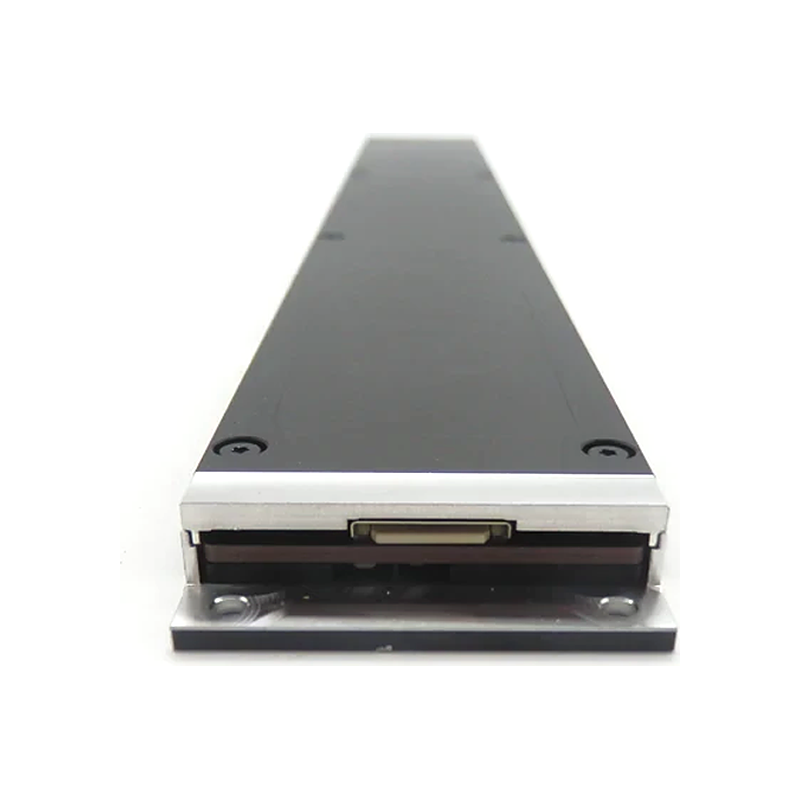
15.36 TB E1.L 1U long ruler NVMe SSD, PCIe 4.0, ordering code MZEL215THBLA-00AMV
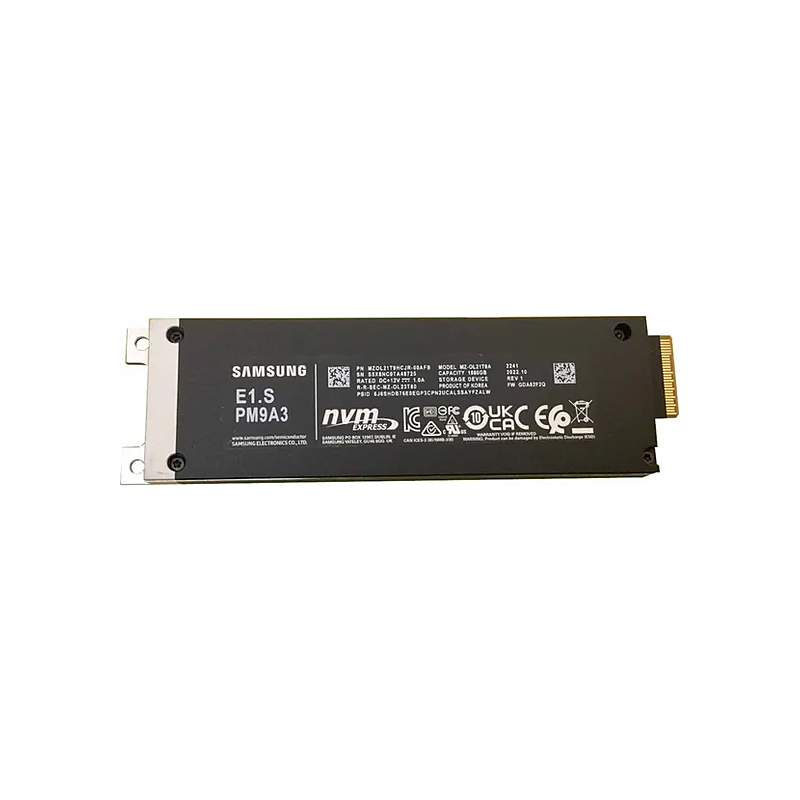
7.68 TB E1.S 1T NVMe SSD, PCIe 4.0, ordering codes MZCL27T6HBLA-00AMV / MZTL27T6HBLA-00A07
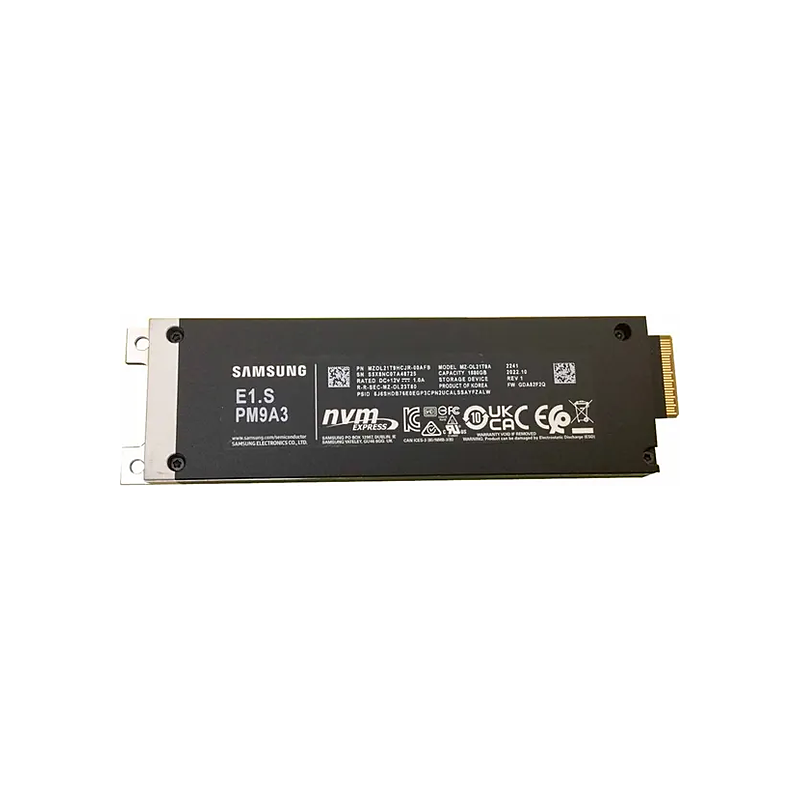
3.84 TB E1.S 1T NVMe SSD, PCIe 4.0, ordering codes MZCL23T8HCLS-00AMV / MZTL23T8HCLS-00A07
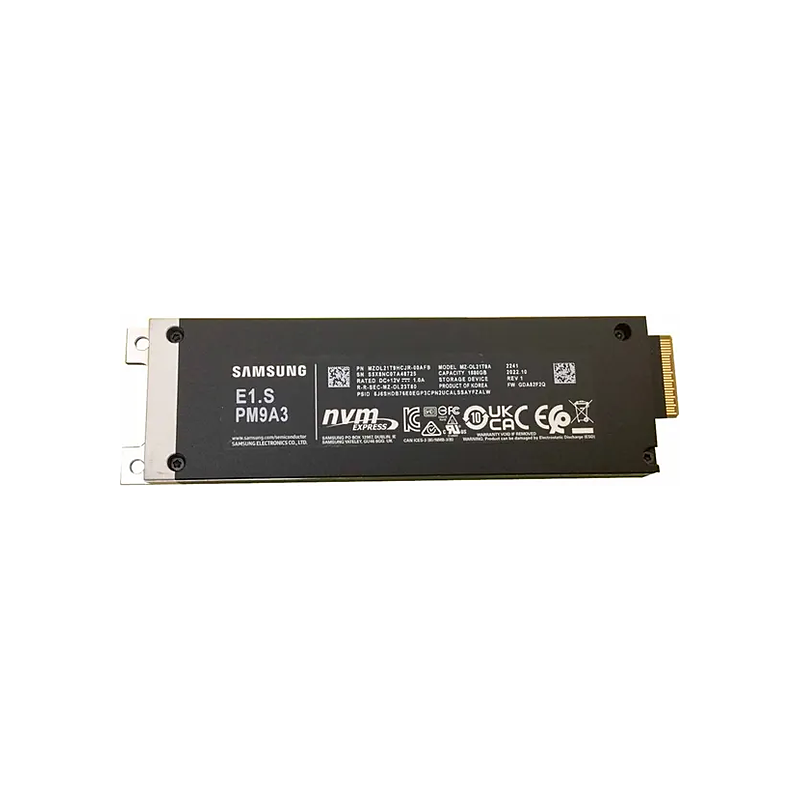
1.92 TB E1.S 1T (9.5 mm) NVMe SSD, PCIe 4.0, ordering code MZCL21T9HCJR-00AMV