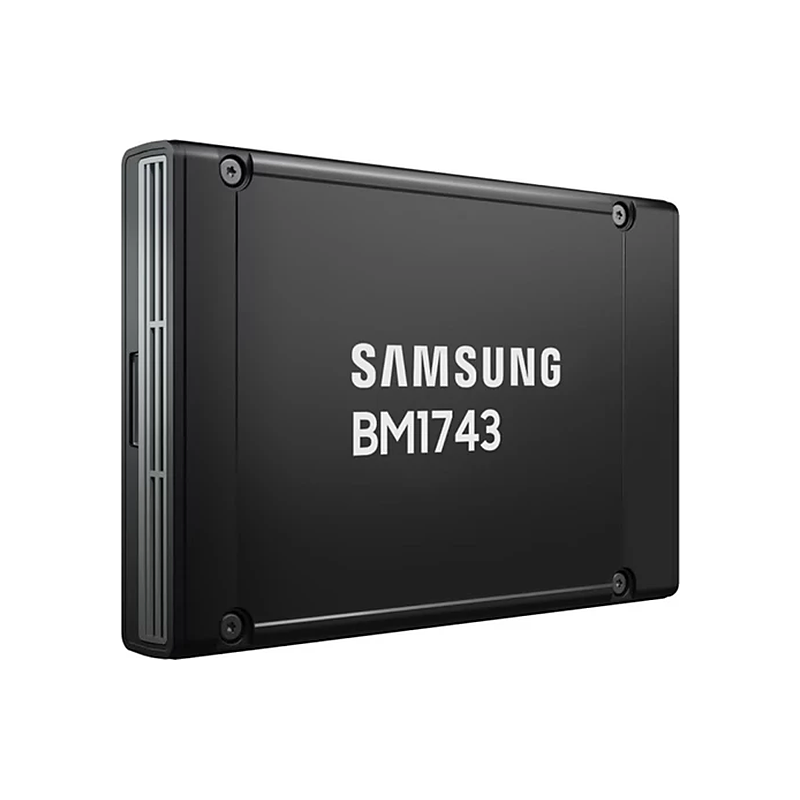
Samsung BM1743 15.36TB PCIe 5.0 QLC NVMe U.2 SSD (MZWMO15THCLF)
15.36 TB 2.5-inch U.2 QLC NVMe SSD, PCIe 5.0, ordering code MZWMO15THCLF-00AW7
- Part Number
- MZWMO15THCLF
- Brand
- Samsung
- Category
- Enterprise & Data Center SSD
- Accepted Payments
- T/T Bank Transfer PayPal Western Union
Technical Specifications
| Capacity | 15.36 TB |
|---|---|
| Interface | NVMe |
| Form Factor | U.2 15mm |
| PCIe Version | PCIe 5.0 |
| NAND Type | QLC |
| Endurance (DWPD) | 0.26 DWPD |
| TBW | 7,288 TB |
| Sequential Read | 14,200 MB/s |
| Sequential Write | 1,400 MB/s |
| Random Read IOPS | 1,500K IOPS |
| Random Write IOPS | 80K IOPS |
| Power | 23.1 W |
| DRAM Cache | Yes |
| Power Loss Protection | Yes |
| Encryption | AES-XTS 256 |
| Condition | New · Used |
Frequently Asked Questions
Samsung BM1743 15.36 TB, 2.5-inch U.2 at 15 mm, catalogue code MZWMO15THCLF, ordering code MZWMO15THCLF-00AW7. 14,200 MB/s sequential read and 1,400 MB/s write on PCIe 5.0 x4, 1,500K random read and 80K random write IOPS, 7,288 TBW at 0.26 DWPD. QLC V-NAND, TCG Opal 2.0, dual-port capable, 23.1 W reading and 24.4 W writing. New and used both stocked.
This is a read-intensive drive, and the number that defines it is not on the front of the box: 0.26 drive writes per day means the endurance budget is about forty-six megabytes a second, averaged over five years. Everything else on this page follows from that one figure. It is a capacity and read-through drive, priced for the workloads that fill it once and read it ten thousand times, and at 15.36 TB it is the entry rung of a family whose economics only really work two and four sizes up.
Technical specifications
| Product family | Samsung BM1743 (PCIe 5.0 read-intensive data centre NVMe SSD, 0.26 DWPD) |
|---|---|
| PN | MZWMO15THCLF (catalogue code) |
| Ordering code | MZWMO15THCLF-00AW7 |
| Capacity | 15.36 TB (unformatted; 1 GB = 1 billion bytes, formatted capacity is less) |
| Form factor | 2.5-inch U.2, 15 mm, hot-swap carrier |
| Interface | PCIe 5.0 x4 single port, or dual port x2, NVMe, 12 V ±10% |
| NAND | Samsung v7 QLC V-NAND (quad-level cell) |
| Sequential read | 14,200 MB/s (128 KB blocks) |
| Sequential write | 1,400 MB/s (128 KB blocks) |
| Random 4K read | 1,500K IOPS |
| Random 4K write | 80K IOPS |
| Endurance (TBW) | 7,288 TB |
| Endurance (DWPD) | 0.26 drive writes per day for five years |
| Latency | 150 µs random read, 20 µs random write |
| Power | 23.1 W typical read, 24.4 W typical write, about 5 W idle |
| Encryption | AES-XTS 256-bit, TCG Opal 2.0, self-encrypting drive |
| Power-loss protection | Yes, with end-to-end data path protection |
| MTBF / UBER | 2.5 million hours / 1 sector per 1017 bits read |
| Data retention | 3 months unpowered, 0 to 70 °C operating |
What 0.26 drive writes a day means in megabytes
Fifteen point three six terabytes at 0.26 writes a day is 3.99 TB of host writes a day, which is 46 MB/s averaged over five years. Put against the 1,400 MB/s the drive can absorb on a good day, the budget is one full fill every four days. That is the whole design brief: read this drive constantly, write to it rarely and in large sequential blocks.
Three consequences worth checking before an order. A full sequential fill at rated write takes about three hours, and the daily budget covers a quarter of one, so a nightly backup job that rewrites the whole drive will use up the rating in under a week. Random writes at 80K are 328 MB/s, and at that rate the budget lasts about six hours, so a database log volume on this drive is not a plan. And a used pull at this capacity has usually spent a real fraction of 7,288 TB, which makes the SMART host-writes figure the first thing to ask for.
Three drives at 15.36 TB, one of them QLC
| Model | Capacity | Seq read / write | Random 4 KB | TBW | DWPD | Power |
|---|---|---|---|---|---|---|
| PM9D3a | 15.36 TB | 12,000 / 7,000 MB/s | 1,800K / 400K | 28,032 TB | 1 | 14.1 W |
| PM1753 | 15.36 TB | 14,000 / 10,000 MB/s | 3,200K / 620K | 28,032 TB | 1 | 20.8 W |
| BM1743 | 15.36 TB | 14,200 / 1,400 MB/s | 1,500K / 80K | 7,288 TB | 0.26 | 23.1 W |
Read the last column pair first, because it is the least flattering. At this capacity the QLC drive is the slowest on write by a factor of five to seven, the lowest on random write by a factor of five to eight, carries a quarter of the endurance, and draws more power than either TLC drive. Sequential read is the one column where it leads, and it leads by 200 MB/s against the PM1753, which nobody will measure outside a benchmark.
So why does it exist? Because endurance is not a virtue you pay for twice. If a workload genuinely writes 40 MB/s per drive once and reads hard for five years, the extra 20,744 TB on the TLC parts is capacity that is bought and never used, and QLC lets the flash be denser and cheaper for the same slot. At 15.36 TB that saving is thin, which is why this page is honest about it being the entry rung rather than the sweet spot.
The one thing this drive does that the TLC drives cannot
BM1743 is the only QLC server SSD on the market with a dual-port option, and this part supports it: two hosts on two lanes each, so a cable or controller failure on one path does not drop the drive. The TLC parts above are single-port x4 only. In a dual-controller array, or anywhere a PCIe switch fabric wants two independent paths to the same slot, that is not a feature you can substitute for by buying two cheaper drives.
It costs bandwidth, and the arithmetic is worth stating plainly: the 14,200 MB/s rating on this page is the single-port x4 configuration. In dual-port x2 each host gets two lanes, so plan for roughly half the sequential figure per path and size the array on that number rather than the headline. The ratings are per-port ceilings, not aggregate through both.
Where the BM1743 economics actually work
QLC earns its premium per slot, not per terabyte, and this family spans 15.36, 30.72, 61.44 and 122.88 TB in the 2.5-inch carrier. At 61.44 TB a single slot holds what four of these do, and the write rating that looked like a compromise here becomes the price of a capacity tier that fits in a chassis rather than a rack. That is the configuration the family was designed around.
What that means for this page is simple. Buy 15.36 TB when you need the BM1743 interface behaviour — dual port, QLC firmware, one family across every tier — in a slot that only needs fifteen terabytes. Do not buy it as a performance tier, and do not buy it as a general-purpose replacement for a 1 DWPD drive, because both of the drives in the table above do that job better and cheaper to run.
Power at 23.1 W, and where it goes
Twenty-four bays of these hold 368 TB and draw 554 W, which is 1.50 W per terabyte. That is worth putting next to the PM1753 figures, 1.35 W per terabyte at the same capacity, because it cuts against the usual assumption that QLC is the power-efficient choice. At 15.36 TB it is not: the controller and the dual-port PHY cost what they cost regardless of capacity, and QLC's density advantage only shows up when the capacity per slot rises.
The idle figure is about 5 W, a little above the TLC parts, which matters in a read tier precisely because read tiers sit idle a lot. Three hundred and sixty-eight terabytes of cold data idling across 24 bays is 120 W, and that is the number a power study should start from rather than the peak.
Ordering codes: MZWMO15 and the -00AW7 suffix
| Code | Type | Capacity | Condition | Quote |
|---|---|---|---|---|
| MZWMO15THCLF | Catalogue code | 15.36 TB | New / used | Enquire |
| MZWMO15THCLF-00AW7 | Ordering code | 15.36 TB | New / used | Enquire |
The prefix identifies the carrier and the line: MZWM is the 2.5-inch U.2 BM1743, MZWL is the 2.5-inch U.2 PM-series drive and MZ3L is E3.S. The fifth character is a letter O, not a zero, and it is not a capacity marker — the capacity sits in the middle of the string as 15T. The tail changes between capacities and carriers, so treat it as a build stamp you verify rather than a code you order by.
Checks worth running on delivery:
- MZWM at the front. MZWL at the same capacity is a TLC drive with a 1 DWPD rating and completely different write behaviour. One character apart, and the wrong one is a return.
- QLC in the description, and 7,288 TB on the label. A 15.36 TB drive rated at 28,032 TBW is a TLC part, not this one.
- Sequential write near 1,400. Anything measuring above three thousand at this capacity is the PM-series drive in the wrong box.
- Host bytes written against 7,288 TB. This is the number that decides whether a used pull is worth its price, because a quarter of the budget can disappear in a fortnight of backup runs.
- Port configuration. Ask whether the unit is set for single-port x4 or dual-port x2; the same drive ships both ways and the bandwidth differs.
Warranty, lead time and purchasing
Cover runs for one year on new drives and on tested pulls alike, and it follows the drive rather than the chassis it came out of. Every used unit is tested, wiped and graded before packing, with the SMART record kept against its serial and available on request. Warehouse stock ships in three to seven working days and tracking is issued at dispatch. Two pieces is the minimum on a line, capacities in this family combine on one order, and a quotation is returned the same working day once part number, condition and quantity are with us.
Get Pricing For This Part
Tell us who you are — we reply within one working day with a firm quote, stock status and lead time. Volume discounts available.
Related Products
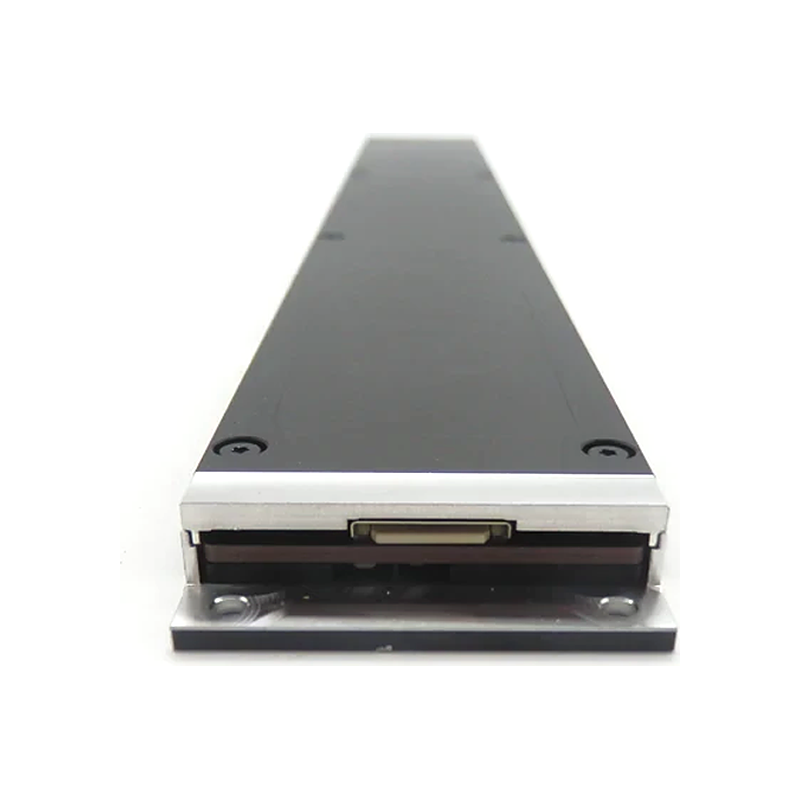
15.36 TB E1.L 1U long ruler NVMe SSD, PCIe 4.0, ordering code MZEL215THBLA-00AMV
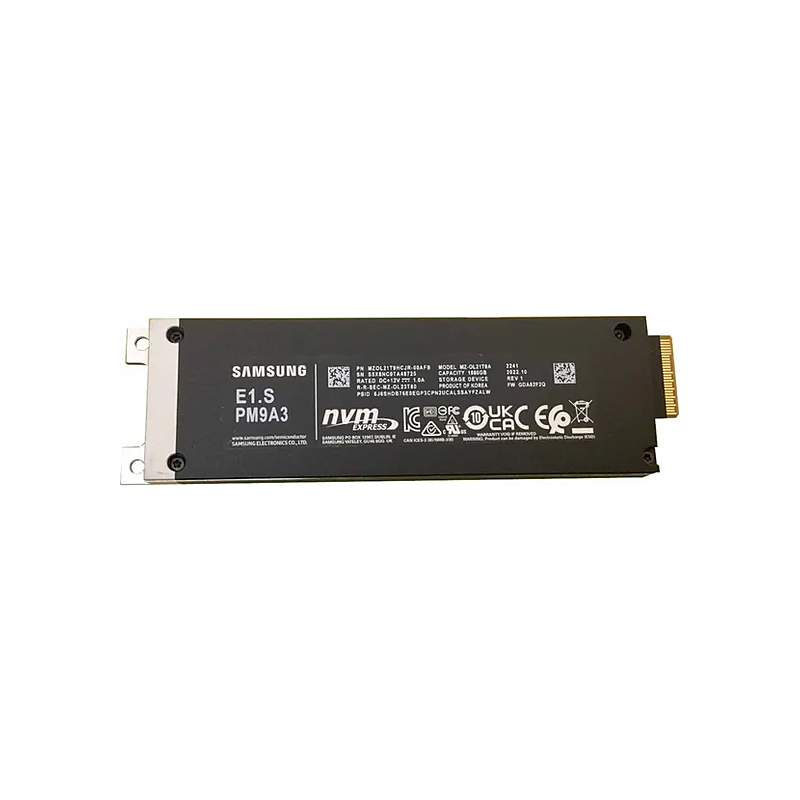
7.68 TB E1.S 1T NVMe SSD, PCIe 4.0, ordering codes MZCL27T6HBLA-00AMV / MZTL27T6HBLA-00A07
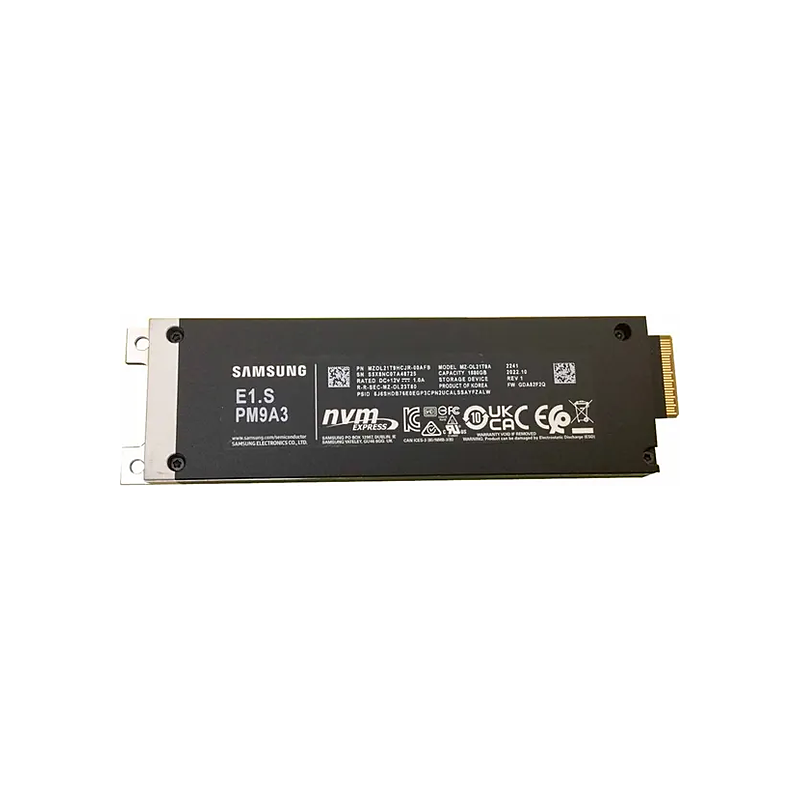
3.84 TB E1.S 1T NVMe SSD, PCIe 4.0, ordering codes MZCL23T8HCLS-00AMV / MZTL23T8HCLS-00A07
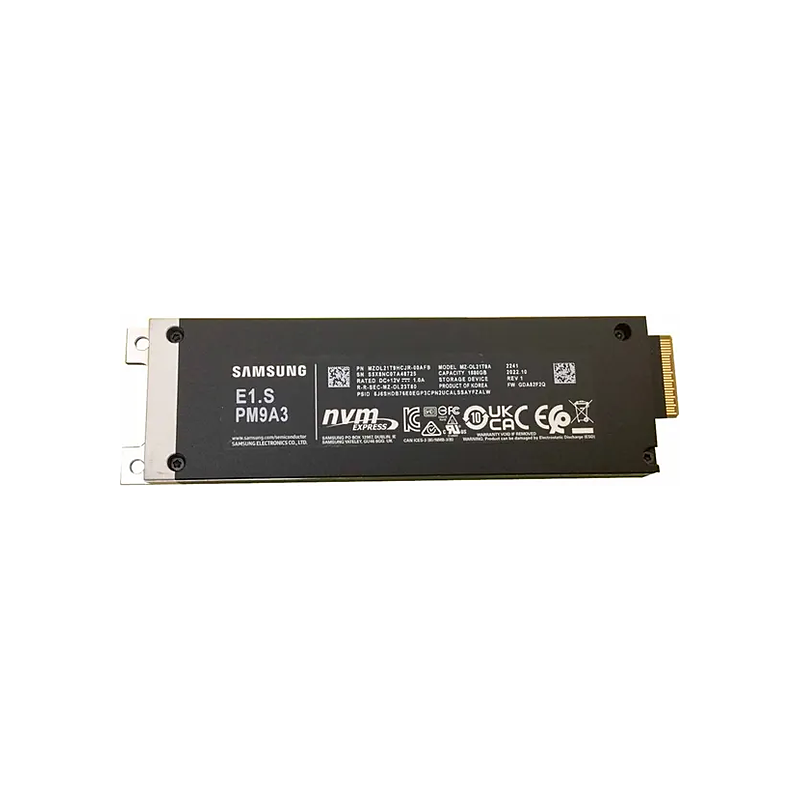
1.92 TB E1.S 1T (9.5 mm) NVMe SSD, PCIe 4.0, ordering code MZCL21T9HCJR-00AMV