Ask three suppliers what condition a processor is in and the same two words come back: new or used. The purchase order has a field for it, the invoice repeats it, and by the time the part is in the rack nobody looks again. The problem is what "used" has to cover. A tray that was opened and never powered. A chip that spent four years in a hypervisor host running at seventy percent. A loose part bought at auction with no paperwork at all. Three different objects, one word, and the price gap between them is real money.
What follows is how we sort them, what can be established from the part itself before it ships, and where sorting stops helping. The Xeon Gold 5218 and the Silver 4210 turn up as examples because they cross our bench constantly. Nothing here is specific to those two; it holds the same way across the server processor catalogue and the desktop line.
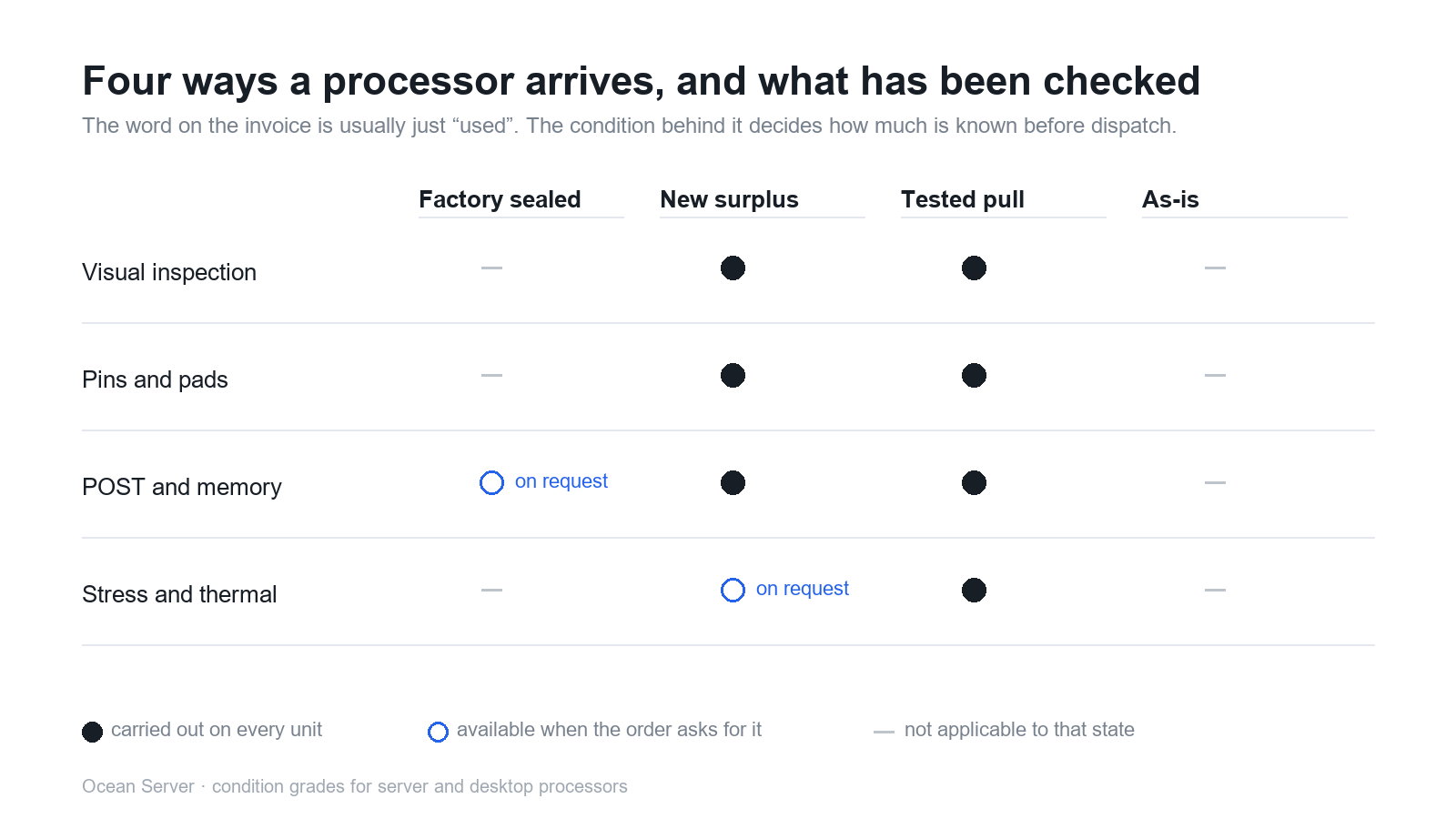
Two words on the invoice, four things in the warehouse
We list two conditions, new and used, because those are the two we can defend when a customer disputes an order. Behind them sit four physical states.
- Factory sealed. Still in the maker's box or sealed tray. Label intact, warranty clock started at the date printed on it. Nobody has opened it, us included. That is the whole value. The seal is the evidence.
- New surplus. Never installed, but the tray is open. Usually it came out of a build programme that shrank, an order that was cancelled, or stock that changed hands between integrators twice. Electrically unused. What it no longer has is the sealed pack, and often the maker's warranty.
- Tested pull. Ran in a live machine, came out, went through the bench before it was listed. The useful half of that sentence is "through the bench", not "pull".
- As-is. Untested, sold on part number and price. Fine if you own the test rig and the time. Not fine if the part goes into a node on Friday.
Two of those can go out as new. One goes out as used. The fourth we do not carry at all, because there is no honest way to list it without a warning stapled to the box.
What you know before it ships
Sorting the four by quality is the wrong exercise, and it is where most condition guides go wrong. What matters is how much is known about this particular unit before it leaves the building, and who did the knowing.
| State | Known before dispatch | Not known | Where it fits |
|---|---|---|---|
| Factory sealed | Maker, part number and production batch from the label; warranty runs from the printed date | Whether it posts, because nobody has opened it — us included | Regulated or serialised builds that have to show an unbroken chain |
| New surplus | Visual condition, pad or pin condition, a POST on a board we know | Where it was stored, and how the tray was handled | Volume builds where the saving beats having the box |
| Tested pull | All of the above, plus every memory channel and PCIe lane enumerated, a sustained load run, a thermal check | How hard the previous owner ran it, beyond what the date code hints at | Production capacity, spares pools, anything that has to work on insertion |
| As-is | The part number, and whatever the seller feels like saying | Almost everything else | Repair benches, delidding, parts recovery |
The third column is the one that matters. Sealed means you are trusting the maker's process and nothing else. As-is means you are trusting nobody. Everything in between comes down to how much bench time the seller paid for and whether they will describe it. A pull with a screen you can read about is often the better buy over a sealed box that nobody, including the seller, has ever powered.
What the markings prove
Three things identify a processor. They do not survive equally well.
The part number is laser-etched or printed on the heat spreader: sSpec for Intel, OPN for AMD. Etching is cut into the metal. It survives handling, cleaning and most of what happens inside a salvage bin. Ink does not. Ink can be lifted and re-applied, and a spreader that has been polished or re-marked should be rejected on sight, without further discussion. If the sSpec on the spreader does not match the part number on the invoice, stop there. One of the two is wrong and from that point you cannot learn which.
The date code gets misread more than anything else on the part. Four digits, year and week of manufacture. It records when the chip was built, not how long it ran. A unit from the last production year of a platform, pulled two years later, is younger than one built in the first year and pulled after five. Read next to the part number it narrows the production window, which is as close to a service history as a pull ever gets. Why there is so much of this stock in circulation is a separate question, dealt with in our note on end-of-life Xeon supply.
Then there is the sticker. Secondary-market parts usually carry one, and it means whatever the last seller wanted it to mean. Ignore it unless it is the only thing tying the unit to a document.
What actually fails
Almost all of the grading happens unpowered, under a lamp. That surprises people who read "tested" and picture a boot screen.
On a land-grid part the pads come first. One bent pad. A scratch running across six of them. Flux residue packed into the grid. Any of that can stop a memory channel from training, and once the chip is clamped into a socket you will never see it again. On older pin-grid parts the risk moves to the pins, where a bent pin can be straightened once. Straighten it twice and it snaps, usually in a customer's socket.
The spreader and the substrate carry the rest of it. Scratches on the spreader are cosmetic and tell you nothing. A crack running out of a substrate corner, a capacitor knocked off the board, brown discolouration around the die footprint — none of that is cosmetic. Socket witness marks on a pull are expected; the part was installed, that is what a pull is. The same marks on something sold as new surplus are a contradiction, and worth raising before you pay. Dried paste is not a defect either. How clean the part is when it arrives says something about the bench it came off.
The screen behind a tested pull
"Tested" on its own is a word. This is the list it stands for, and a seller who cannot recite something close to it is using the word as decoration.
Visual inspection under magnification. Pad or pin check across the entire grid, not a sample of it. POST on a board we know is good, with another part having posted in that same socket the same week. Enumeration of every memory channel the platform exposes. A check that the PCIe lanes the chip is supposed to provide actually come up. A sustained load run long enough to catch the ones that boot and then fall over. A thermal check under a reference cooler, watching for throttling rather than for a headline temperature.
Pass, and the unit goes on the shelf with its date code, batch, board and test date attached to the record. That record is what makes the warranty worth something eighteen months later, when the invoice is long gone and the only question left is whether this was the chip we tested.
The screen costs bench time per unit. That accounts for most of the gap between a graded pull and a pallet of untested ones, and it is the reason a tested pull is not the cheap option. Cover on what we list runs one year from dispatch, new stock and pulls alike. Dispatch is three to seven working days, two-piece minimum on most lines.
Which grade for which job
Start from what happens when the part dies on insertion. In a production fleet that means a node out of rotation and an engineer's afternoon, so the money goes to the screened pull with cover, plus a matched spare bought from the same batch so the replacement report reads clean. On a lab bench, where the part gets tested anyway and a dud costs an hour, as-is is a reasonable buy and we will say so.
Two situations break that pattern. Regulated or serialised environments, where the build has to demonstrate an unbroken chain: only the sealed box works, which is why identical silicon sells for more in that state. And cold spares that will sit in a cupboard for two years: buy the grade the fleet runs and store it the way the fleet is stored. The failure mode there is storage, not hours.
Platform choice cuts across all of it. Which memory generation the board takes usually decides which processors are worth holding at all, and at the moment that means the DDR4 to DDR5 transition.
Six questions before the pallet is booked
- Which of the four is it? If the answer is just "used", you have not been answered.
- What is on the spreader, and does it match the invoice? Get the sSpec or OPN and the date code in writing, not over a call.
- What board did it POST in? A model and a memory population. "Tested working" is not a board.
- How many channels and lanes came up? Marginal parts pass a boot test and fail here. On a scalable chip this is the question that separates a screen from a smoke test.
- What cover applies, and who pays return freight? The answer should not change between two pieces and two hundred.
- Can you tell me the date-code mix before it ships? Mixed batches in a large lot are normal. Finding out only when the pallet is open is how a fleet ends up mixing batches.
Where to go next
If you want the arrival-side checklist, what to look at first when the box is open and which discrepancies justify sending it back, read how to buy used server CPUs safely. The server processor catalogue is grouped by generation. For generation-specific detail the E5-2667 v4, Gold 6338 and Platinum 8260 pages are the ones people actually open, and desktop parts follow the same grading logic right down to a Core i3-12100.
If you have a quantity and a date rather than a single part, send the part numbers, the condition and the platform they are going into. You will get the grade we would ship and the reason behind it.