A 2U server rolls off the floor in 2019 with a pair of Xeon Platinum 8260s. It runs a warehouse ERP, an accounting stack, maybe a lab cluster. Nothing about the workload has changed in six years, but the CPUs have quietly moved through Intel’s product-change pipeline: order window closed, final shipment accepted, official price list entry gone. The machines are fine. The parts are the problem.
The secondary market is what keeps those machines repairable. If you buy for a fleet that still runs EOL silicon, it pays to understand how Intel retires a part, and how replacement stock keeps moving long after the price list is gone.
Intel’s EOL clock: how parts actually get retired
Intel does not switch a part off overnight. Retirement follows a published sequence: a product change or discontinuation notice goes to the channel, a last-order date passes, final shipments are accepted, and eventually the part disappears from Intel’s published price lists and the ARK database entirely. Between the notice and the last shipment there is a window of roughly six to twelve months where OEMs and distributors can still buy new stock, and channel inventory gets bought up fast.
After that, every unit sold anywhere is a unit that already exists. No new production, no warranty path through the OEM, and a vendor list that shrinks month by month. For a fleet standardized on that part, planning has to shift from “order more” to “secure what remains.”
Where each generation stands in 2026
| Generation | Launched | Channel status in 2026 | Where it still runs |
|---|---|---|---|
| Xeon E5-2600 v4 (Broadwell-EP) | 2016 | Long retired; no official channel supply | Storage nodes, legacy line-of-business servers |
| 1st Gen Xeon Scalable (Skylake-SP) | 2017 | Retired; parts available only via secondary market | Virtualization hosts, appliance OEM base units |
| 2nd Gen Xeon Scalable (Cascade Lake-SP) | 2019 | Discontinuation notices issued; final shipments largely complete | Still the single largest installed base in mid-market fleets |
| 3rd Gen Xeon Scalable (Ice Lake-SP) | 2021 | Low-volume from the start; supply thinning | Memory-bandwidth workloads, HPC niches |
| 4th/5th/6th Gen (Sapphire Rapids, Emerald Rapids, Granite Rapids) | 2023–2025 | Active on Intel’s price list | New deployments |
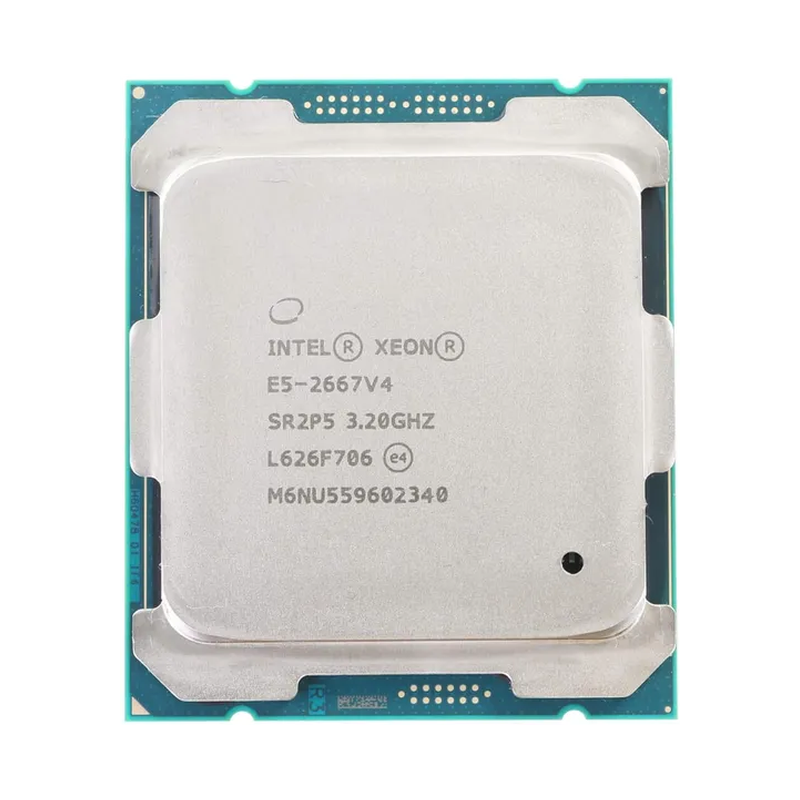
The table also explains why the secondary market stays busy. Broadwell E5 parts like the Xeon E5-2667 v4 have been out of official supply for years and still sell steadily, because the installed base outlives the channel by a wide margin. Cascade Lake matters more: parts like the Xeon Platinum 8260 and Xeon Gold 6258R anchor thousands of mid-market fleets, and the last of the official stock has just finished moving. Demand for these parts will run for years while supply keeps shrinking.
Why official channels dry up faster than the installed base
A server’s useful life is measured in seven to ten years. A Xeon generation’s official sales window is closer to four. Those two clocks were never aligned, and the gap widens every time an enterprise refreshes only part of its fleet, which is almost always how it happens.
Three things make the gap worse:
- OEM model rollovers. When a server vendor ends sales of a platform, its board BIOS and spare-parts catalogs freeze shortly after. The CPUs for those boards have nowhere to come from except existing stock.
- Cloud-driven decommissioning waves. Large data-center operators retire thousands of identical nodes on fixed schedules, releasing waves of tested, uniform CPUs into the market at once.
- Hyperscaler custom SKUs. Many of the highest-core-count parts were never sold retail. When those systems come out of service, the parts re-enter the market through brokers, not Intel.
How the secondary-market supply chain actually works
Decommissioning is the source
Every EOL part on the market today was pulled from a machine that was working yesterday. Fleet retirements, lease returns, and data-center clearances generate the inbound volume. The quality of what happens next (proper handling, anti-static packing, honest grading) is decided at this stage, long before a listing page.
Aggregation and matching
Brokers consolidate lots, normalize grading, and match supply to the buyers who still need a specific PN. For common parts this is efficient; for rare ones it is a search problem. A buyer who needs forty of a part that ships in lots of twelve needs someone who sees volume across many sellers.
Testing is the trust layer
The reason enterprises buy from specialist suppliers rather than marketplaces is verification. POST is not a test; a real one runs sustained load, checks thermals, and records results against the actual part number. That is what turns pulled parts into deployable inventory, and it is the same process we described in our guide to buying used server CPUs safely.
Reading the market: price and availability signals
EOL pricing follows a recognizable arc. Prices soften right after the discontinuation notice as holders liquidate. Then the installed base keeps consuming units, supply gets lumpier, and prices stabilize, sometimes for years, before climbing sharply once loose stock is gone. Broadwell E5 parts tracked this curve almost exactly.
Signals worth watching:
- Lot size. When offers drop from hundreds to dozens of units, the easy stock has moved.
- Seller churn. Fewer listings from generalist traders usually means the part has moved to specialists with real inventory.
- Condition mix. When listings shift from new-in-box to pulled-and-tested, sellers are working through existing stock, which is what EOL means in practice.
What to check before ordering EOL parts
The fundamentals do not change between active and EOL parts, but the stakes are higher: there is no re-order if a batch turns out bad.
- Verify the marking, not the label. OPN and stepping etched on the package, checked against the datasheet. Engineering samples and remarked chips circulate hardest in exactly these older generations.
- Ask what “tested” means. Sustained load at rated frequency, or a boot screen? If the seller cannot describe the procedure, assume the latter.
- Match the stepping to your fleet. Boards are usually tolerant, but mixed steppings in the same host can complicate firmware and microcode assumptions.
- Buy the spares you will need now. Prices on retired parts rarely fall back once loose stock starts to thin; every batch that moves makes the next one harder to find.
The detailed checklist is in our OPN and stepping guide; the short version is that most bad purchases were visible before payment.
Planning a two-year horizon
If your fleet still runs Cascade Lake or older, three moves are worth making this year: standardize on a single PN per role so spares are interchangeable; size a spare pool explicitly instead of topping up as parts fail; and pick a supplier who can quote volume, not just single units. Buyers who commit early tend to pay less and wait less than those who hold out for the final lots.
Sourcing EOL Xeon parts from us
We stock and actively source retired Xeon generations alongside current ones, from Broadwell E5 v4 through Cascade Lake Platinum and Gold, and every part is load-tested before dispatch with a warranty behind it. Browse the server processor catalog for current availability, or send us your fleet list and we will quote the parts you are most likely to need next.