A pallet of forty Xeon Gold 6132s lands at your dock. The listing said "tested, pulled from working servers." Half of them will be exactly that. The other half is where the money disappears — engineering samples sold as production parts, remarked chips with a fresh laser-etched number, or CPUs that POST in thirty seconds and then fall over under load six weeks into production. None of this shows up in the photos.
We test and grade server CPUs for a living, and the same handful of mistakes shows up again and again in failed purchases. Most of them are visible before you pay — if you know where to look.
Read the OPN, not the label
Every server CPU has two names. The marketing name — Xeon Gold 6248R, EPYC 7402P — is what listings use. The OPN (ordering part number) is what Intel or AMD actually etched onto the package when it was made, and it is the only identifier that matters.
On a Xeon Scalable part you will find it laser-etched on the second line of the IHS, in a format starting with something like CD8067.... AMD Ryzen and EPYC parts use the 100-000000591 style format — which is, as it happens, the exact OPN etched on a Ryzen 7 7700X. The sticker on the clamshell, the print on the box, the number in the listing — all of it is trivia. The etching is the part. Labels get swapped when trays get split; etchings don't (at least not cheaply — more on remarked chips below).
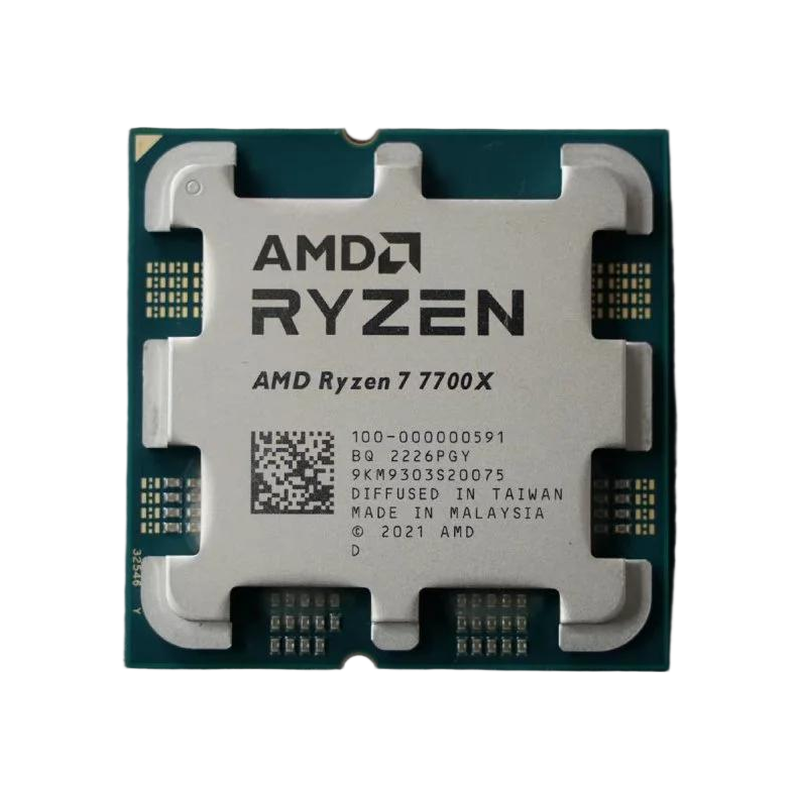
So step one, before anything else: ask your supplier for a photo of the actual etched OPN on the parts they will ship, and check it against the spec sheet for the model you think you're buying. If the OPN maps to a different SKU than the listing title — even a "better" one — walk away. Mismatched OPNs are the single most common reason a "6248R" turns out to be something else entirely.
Engineering samples: the trap that still catches buyers
Intel quietly released hundreds of QS (qualification sample) and ES (engineering sample) chips into the secondary market over the years. They are physically identical to production silicon, often benchmark close to it, and cost a fraction of the price. They also carry an Intel Confidential marking, and that marking means several things that matter to a business buyer:
- No microcode or security-update commitments from Intel.
- Some hypervisors and enterprise platforms behave unpredictably with them; vSphere environments in particular have a long history of QS-related headaches.
- If your customer audit or RMA process ever discovers them, you own the explanation.
The rules are simple: production silicon only, unless you personally know exactly why you want a QS chip. And if a price looks too good — 20% of market, say — assume ES until proven otherwise. Check for the Intel Confidential line on the IHS etching.
Steppings are not cosmetic
The last characters on that etched line are the stepping — SR3GK, for instance, on certain Cascade Lake parts. Two CPUs with the same model name can ship with different steppings, and the difference is not academic: steppings carry different errata, different microcode requirements, and occasionally different supported features. When you mix steppings across a fleet, you can end up managing two firmware baselines for hardware that's supposed to be identical.
Two practical moves:
- Ask which stepping you're getting, in writing, per batch.
- Check it against Intel's published spec-update documents for that family — they list every erratum by stepping, and some of them are ugly.
If a supplier can't tell you the stepping of the stock they're holding, they haven't actually looked at it.
POST is not a test
This one costs people the most money, because it's invisible at the moment of purchase.
Powering a CPU through BIOS POST proves that it boots. It says almost nothing about whether the part will survive a production workload. Marginal silicon can pass POST all day and then throw cache errors, thermal-throttle unpredictably, or hard-lock under sustained AVX-512 load. By the time your monitoring catches it, the return window is closed and the seller has moved on to the next pallet.
A real test looks different: extended full-load burn-in (we run each CPU for hours under sustained synthetic load), temperature logging throughout, and cache/memory-controller validation. It's slow and it costs labor, which is why pallet brokers who skip it can undercut everyone by 15%. That 15% is not a discount — it's the price of finding out later.
When you vet a supplier, ask what their test procedure actually is. "Tested and working" is marketing. "Eight-hour full-load burn-in with temperature logs, serials recorded" is a process. One of those can support an RMA; the other is a shrug.
New and used both belong in the mix
We stock both, and the honest answer about which to buy is: it depends on the workload and the audit you have to satisfy.
New tray parts make sense for regulated environments, long-lifecycle appliances, and anywhere procurement requires factory documentation. Used production parts — pulled from decommissioned fleets, load-tested, graded honestly — typically land 30–60% below list for silicon that has already survived years of data center duty. Server CPUs have no moving parts and run at conservative voltages; a used part that has passed load testing is a fundamentally different proposition from an untested "as-is" pull.
What you should insist on either way: the condition stated per unit, not per pallet. Mixed pallets with no per-unit grading are how one bad chip gets billed as a good batch.
The three questions that filter most sellers
Before you wire anything, ask:
- Was each part load-tested, and for how long? POST-only answers disqualify.
- What is the RMA window, in writing? Twelve months is the professional standard; 30 days is a clearance bin.
- Can you show tray photos of the actual stock, with OPNs visible? Stock photos from a broker's website are not stock photos of your broker's stock.
Suppliers who answer all three comfortably — with specifics, not adjectives — are rare and worth keeping. The ones who get vague at question two have told you everything you need to know.
One last thing about price
Used server CPUs are cheap because someone else paid full price three years ago, not because something is wrong with them. The secondary market rewards buyers who spend fifteen minutes on verification, and it punishes everyone else. Do it every time and you'll buy server silicon at a fraction of list for years — which is, more or less, the entire business we're in.
If you'd rather skip the vetting work: every CPU listed on Ocean Server passes the checks above before it goes in the catalog, and every quotation includes stock photos and test notes. Browse the server CPU catalog or request a quote — we answer with specifics. Take the Ryzen 9 5900X units in current stock: each one ships with its etched OPN photographed and a burn-in log attached to the quote.