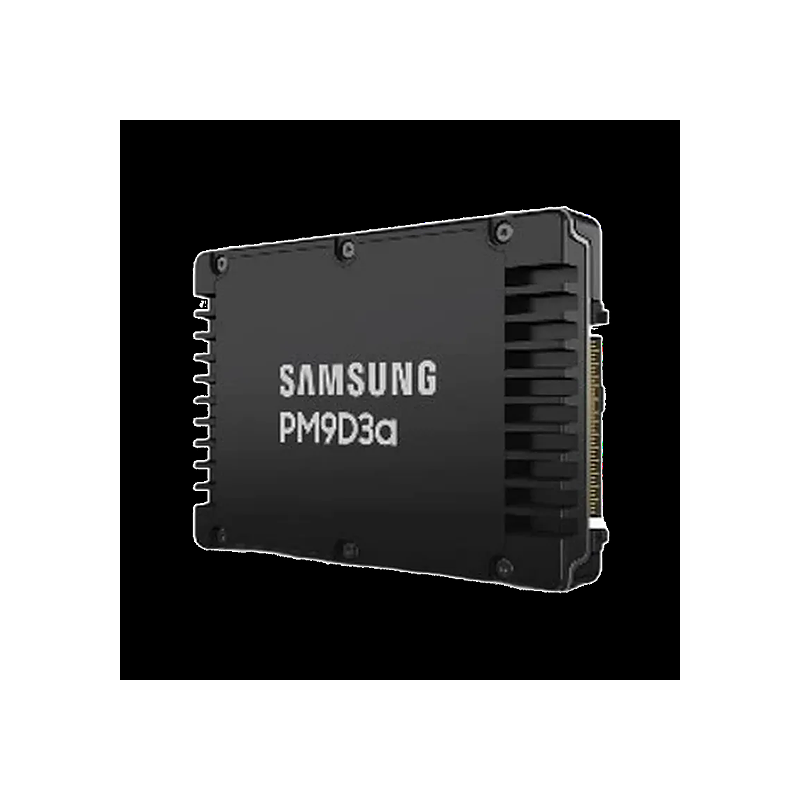
Samsung PM9D3a 960GB PCIe 5.0 NVMe U.2 SSD (MZWL6960HFJA)
960 GB 2.5-inch U.2 NVMe SSD, PCIe 5.0, ordering code MZWL6960HFJA-00AW7
- Part Number
- MZWL6960HFJA
- Brand
- Samsung
- Category
- Enterprise & Data Center SSD
- Accepted Payments
- T/T Bank Transfer PayPal Western Union
Technical Specifications
| Capacity | 960 GB |
|---|---|
| Interface | NVMe |
| Form Factor | U.2 15mm |
| PCIe Version | PCIe 5.0 |
| NAND Type | TLC |
| Endurance (DWPD) | 1 |
| TBW | 1,752 TB |
| Sequential Read | 12,000 MB/s |
| Sequential Write | 1,600 MB/s |
| Random Read IOPS | 1,000K IOPS |
| Random Write IOPS | 70K IOPS |
| Power | 11 W |
| DRAM Cache | Yes |
| Power Loss Protection | Yes |
| Encryption | AES-XTS 256 |
| Condition | New · Used |
Frequently Asked Questions
Samsung PM9D3a 960 GB, 2.5-inch U.2 at 15 mm, catalogue code MZWL6960HFJA, ordering code MZWL6960HFJA-00AW7. 12,000 MB/s sequential read and 1,600 MB/s write on PCIe 5.0 x4, 1,000K random read and 70K random write IOPS, 1,752 TBW at one drive write a day for five years. Eighth-generation V-NAND TLC, NVMe 2.0, 11 W reading and 8.1 W writing. New and used both stocked.
This is the smallest drive in the PM9D3a range and the only one where the write path is genuinely slow. Everything above it writes at 3,300 MB/s or better. If the job is a Gen5 boot device, a metadata tier or a read-heavy cache, nothing is missing here. If the job is ingest at line rate, the capacity is wrong and the two tables below say exactly how.
Technical specifications
| Product family | Samsung PM9D3a (PCIe 5.0 data centre NVMe SSD, 1 DWPD) |
|---|---|
| PN | MZWL6960HFJA (catalogue code) |
| Ordering code | MZWL6960HFJA-00AW7 |
| Capacity | 960 GB (unformatted; 1 GB = 1 billion bytes, formatted capacity is less) |
| Form factor | 2.5-inch U.2, 15 mm (100.45 × 69.85 × 15 mm, up to 170 g) |
| Interface | PCIe 5.0 x4, NVMe 2.0, backwards compatible with PCIe 4.0 and 3.0 |
| NAND | Samsung V-NAND TLC (8th generation) |
| Sequential read | 12,000 MB/s (128 KB, queue depth 256) |
| Sequential write | 1,600 MB/s |
| Random 4K read | 1,000K IOPS (queue depth 64, four workers) |
| Random 4K write | 70K IOPS |
| Endurance (TBW) | 1,752 TB |
| Endurance (DWPD) | 1 drive write per day for five years |
| Latency | 65 µs random read, 9 µs random write (queue depth 1, median) |
| QoS 99% | 0.08 ms read at queue depth 1, 0.20 ms at depth 32; 0.015 / 0.5 ms write |
| Power | 11 W typical read, 8.1 W typical write, 3.9 W idle on PCIe 5.0 (12 V rail) |
| Power on PCIe 4.0 | 8 W read, 7.3 W write, 3.1 W idle |
| Power-loss protection | Yes, capacitor-backed, with end-to-end data path protection |
| Encryption | AES-XTS 256-bit engine, TCG Opal compliant |
| Sector size | 512, 520, 4096 or 4160 bytes, formattable |
| MTBF / UBER | 2.5 million hours / 1 sector per 1017 bits read |
| Drive ready | 8 s from power-on to accepting commands |
Twelve times the read, less than twice the write
| Model | Capacity | Bus and form factor | Seq read / write | Random 4 KB | TBW | DWPD |
|---|---|---|---|---|---|---|
| PM953 | 960 GB | PCIe 3.0, U.2 7 mm | 1,000 / 870 MB/s | 240K / 19K | 1,400 TB | 0.8 |
| PM963 | 960 GB | PCIe 3.0, U.2 7 mm | 1,800 / 930 MB/s | 350K / 30K | 1,366 TB | 0.78 |
| PM983 | 960 GB | PCIe 3.0, U.2 7 mm | 3,200 / 1,100 MB/s | 400K / 40K | 1,366 TB | 0.78 |
| PM893 | 960 GB | SATA 6 Gb/s, 2.5-inch 7 mm | 550 / 520 MB/s | 98K / 30K | 1,752 TB | 1 |
| PM9D3a | 960 GB | PCIe 5.0, U.2 15 mm | 12,000 / 1,600 MB/s | 1,000K / 70K | 1,752 TB | 1 |
Read the endurance column first, because it has barely moved in a decade. Every drive here is rated 1,366 to 1,752 TB, and the newest part ties with the oldest SATA one at 1,752. Nine hundred and sixty gigabytes at one drive write a day is arithmetic, not engineering: 0.96 TB times 1,825 days. No controller generation changes it.
What changed is how fast the drive answers. Sequential read went up twelve times, from 1,000 to 12,000 MB/s. Sequential write did not quite double, from 870 to 1,600. Random read multiplied by four, random write by 3.7.
Both figures come off the same flash. A 960 GB drive carries a sixteenth of the dies a 15.36 TB drive carries. Write bandwidth scales with die count, because every die has to be programmed, so the small drive is permanently short of parallel write channels. Read bandwidth scales with the host link, and the link went from 8 GT/s per lane to 32. That is the whole table in one sentence: the interface got four times faster, the flash did not get bigger.
Why 1,600 MB/s is the ceiling at this capacity
Samsung's own range makes the point without needing a benchmark. Inside one PM9D3a family: 960 GB writes at 1,600 MB/s, 1.92 TB at 3,300, 3.84 TB at 6,700, and everything above 6,700. Random write climbs the same ladder, 70K, 150K, 250K, 400K. Nothing was held back from the small drive. There are simply fewer dies to hit in parallel.
That has a practical consequence worth stating plainly. If a quote needs Gen5 for ingest, archiving or backup targets, 960 GB is the wrong capacity and no firmware setting fixes it. If the same quote needs Gen5 because the platform is Gen5 and the drive is a boot volume, a journal or a cache, 960 GB is the cheapest way onto that platform and the weak write path will never be the thing that limits the box.
There is one more number that looks worse than it is. Random write is 70K IOPS, which is 280 MB/s of 4 KB writes. The endurance budget is 0.96 TB a day, or 11 MB/s averaged over 24 hours. The drive can absorb twenty-five times its own warranty rate before the endurance column becomes relevant, so 70K is a latency figure, not a limit on how much you can write.
The number that favours 960 GB
Random read per terabyte is where small drives win, and it is the only axis on which this one beats its own family. 960 GB quotes 1,000K IOPS, which is 1.04 million IOPS for every terabyte of capacity. The 15.36 TB drive quotes 1,800K, or 117K per terabyte, nine times less.
Aggregate the same capacity and the gap becomes the purchase argument. Twenty-four 960 GB drives hold 23 TB behind 24 controllers and quote 24 million random read IOPS. The same 23 TB built from 1.92 TB drives fits in 12 slots and quotes 18 million. From 3.84 TB, six slots and 10.2 million. Same rack space, same usable capacity, four times the read throughput at the bottom of the range.
Note what this argument does not say. It does not claim the drive is cheap per gigabyte, because it is not. It does not claim endurance, because endurance is identical at 1,752 TB. It says that when a workload is IOPS-bound and capacity-light, the cheapest IOPS is on the smallest die count you can spread across the most slots.
Power and slot maths at 24 drives
Twenty-four 960 GB drives hold 23 TB and draw 264 W while reading, which is 11.5 W per terabyte. Two 15.36 TB drives hold 30.7 TB for 28.2 W, or 0.92 W per terabyte. The small drive costs twelve and a half times more power for the same data, and it takes twenty-four bays to deliver what two bays hold.
So the fill is only rational when the chassis is already there and the bays are empty. A 24-bay server built from 960 GB drives is 24 independent failure domains, 23 TB of hot data, and one drive failure costs half an hour of rebuild at 500 MB/s rather than eight hours for a 15.36 TB member. In a cache tier where drives are expected to fail and be swapped without ceremony, that rebuild profile is worth more than the power difference. In a capacity tier it never is.
What happens in a Gen4 slot
On a PCIe 4.0 link the drive negotiates down to 6,400 MB/s sequential read and 1,400 MB/s write, with random read at 950K and random write unchanged at 70K. Power falls to 8 W reading and 3.1 W idle.
Read the two comparisons separately. Sequential read halves. Sequential write drops 12 percent. Random figures barely move at all. If a Gen4 server runs a random workload, this drive keeps almost everything it was bought for and runs cooler doing it. If the workload is large sequential reads, half the reason to pay for Gen5 is gone and a Gen4 part would serve.
Ordering codes: MZWL6 and the -00AW7 suffix
| Code | Type | Capacity | Condition | Quote |
|---|---|---|---|---|
| MZWL6960HFJA | Catalogue code | 960 GB | New / used | Enquire |
| MZWL6960HFJA-00AW7 | Ordering code | 960 GB | New / used | Enquire |
The suffix matters on a purchase order even though the hardware is the same. Samsung's datasheet lists this capacity as -00B07; channel stock commonly carries -00AW7, and both are the 960 GB U.2 drive, separated by distribution block and region. Order the full string, and accept either.
Two neighbouring capacities share the same first five characters and are easy to confuse on a packing list. MZWL61T9HFLT is 1.92 TB, MZWL63T8HFLT is 3.84 TB, MZWL67T6HBLC is 7.68 TB and MZWL615THBLF is 15.36 TB. The 960 GB string ends in HFJA, and the sixth character from the end is where the capacity is encoded.
Checks worth running on delivery:
- Full suffix on the label. MZWL6960HFJA plus -00AW7 or -00B07. A bare catalogue code on the invoice means the block is unspecified.
- Reported capacity. 960 GB reports about 894 GiB. A 1.92 TB drive in the same 15 mm carrier looks identical and reports double.
- Thickness against the bay. 15 mm, not 7 mm. The PM983 and PM963 bays that came out of the same servers will not close on it.
- Host bytes written. Record it before wiping. On a pull, the delta against 1,752 TB is the only figure that tells you how much life is left.
Warranty, lead time and purchasing
Sealed drives and tested pulls each carry a one year warranty from us, and the cover follows the drive rather than the server it came out of. Warehouse stock normally ships in three to seven working days with tracking issued when it leaves. Minimum order is two pieces, capacities in this family combine on one order, and a price comes back the same working day once part number, condition and quantity are with us.
Get Pricing For This Part
Tell us who you are — we reply within one working day with a firm quote, stock status and lead time. Volume discounts available.
Related Products
15.36 TB E1.L 1U long ruler NVMe SSD, PCIe 4.0, ordering code MZEL215THBLA-00AMV
7.68 TB E1.S 1T NVMe SSD, PCIe 4.0, ordering codes MZCL27T6HBLA-00AMV / MZTL27T6HBLA-00A07
3.84 TB E1.S 1T NVMe SSD, PCIe 4.0, ordering codes MZCL23T8HCLS-00AMV / MZTL23T8HCLS-00A07
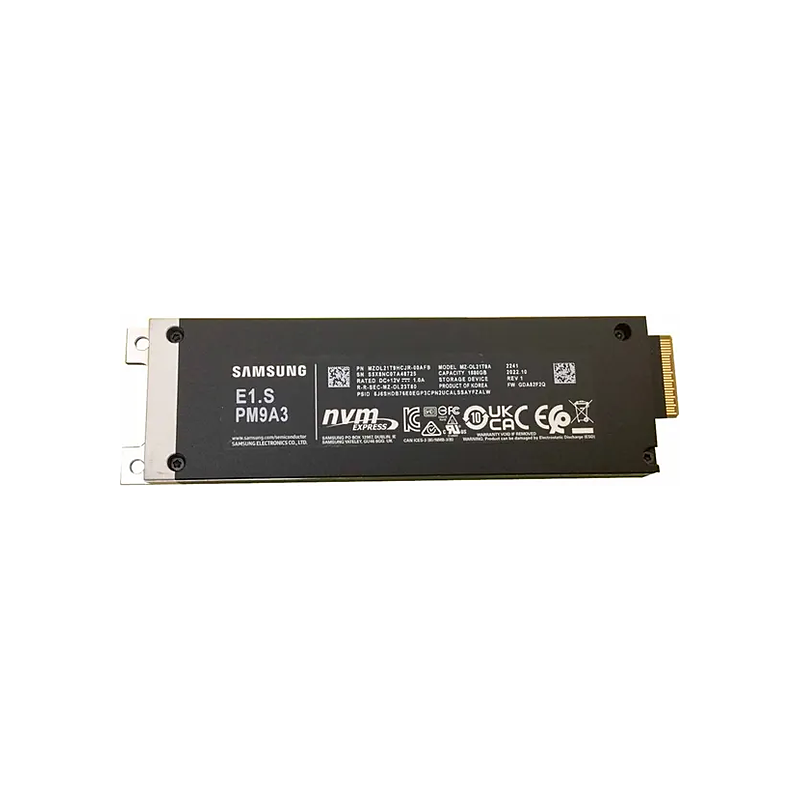
1.92 TB E1.S 1T (9.5 mm) NVMe SSD, PCIe 4.0, ordering code MZCL21T9HCJR-00AMV