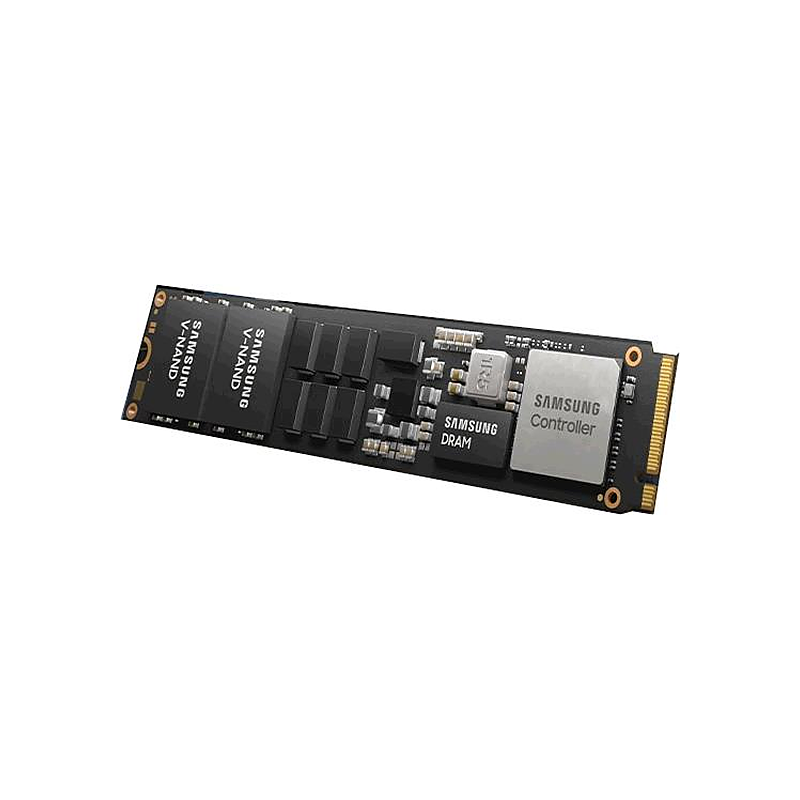
Samsung PM9A3 960GB M.2 22110 PCIe 4.0 NVMe SSD (MZ1L2960HCJR)
960 GB M.2 22110 NVMe SSD, PCIe 4.0, ordering codes MZ1L2960HCJR-00A07 / -00B7C
- Part Number
- MZ1L2960HCJR
- Brand
- Samsung
- Category
- Enterprise & Data Center SSD
- Accepted Payments
- T/T Bank Transfer PayPal Western Union
Technical Specifications
| Capacity | 960 GB |
|---|---|
| Interface | NVMe |
| Form Factor | M.2 22110 |
| PCIe Version | PCIe 4.0 |
| NAND Type | TLC |
| Endurance (DWPD) | 1 |
| TBW | 1,752 TB |
| Sequential Read | 5,000 MB/s |
| Sequential Write | 1,400 MB/s |
| Random Read IOPS | 550K IOPS |
| Random Write IOPS | 60K IOPS |
| Power | 7.5 W |
| DRAM Cache | Yes |
| Power Loss Protection | Yes |
| Encryption | AES-XTS 256 |
| Condition | New · Used |
Frequently Asked Questions
Samsung PM9A3 960 GB M.2 22110, catalogue code MZ1L2960HCJR, orderable as -00A07 and -00B7C. 5,000 MB/s sequential read and 1,400 MB/s write on PCIe 4.0 x4, 550K random read and 60K random write IOPS, 1,752 TBW at 1 DWPD. 110 mm long, 22 mm wide, 3.8 mm thick, 128-layer TLC V-NAND, capacitor-backed PLP, AES 256-bit full disk encryption, 7.5 W reading and 6.5 W writing. New and used both stocked.
The same silicon as the U.2 drive at this capacity, with a different carrier and a different power budget, and the difference is measurable. A 110 mm module has no shell to spread heat into and a 12 V rail is not available to it, so Samsung rates this version 1,500 MB/s lower on read. Endurance is identical at 1,752 TB, which is the part worth knowing before deciding the carrier does not matter.
Technical specifications
| Product family | Samsung PM9A3 (PCIe 4.0 data centre NVMe SSD, 1 DWPD) |
|---|---|
| PN | MZ1L2960HCJR (catalogue code) |
| Ordering codes | MZ1L2960HCJR-00A07 / MZ1L2960HCJR-00B7C |
| Capacity | 960 GB (unformatted; 1 GB = 1 billion bytes, formatted capacity is less) |
| Form factor | M.2 22110, single-sided, 110.0 × 22.0 × 3.8 mm, about 20 g |
| Interface | PCIe 4.0 x4, NVMe 1.4, M-key |
| NAND | Samsung V6 (128-layer) V-NAND TLC |
| Sequential read | 5,000 MB/s (128 KB transfer size, queue depth 32) |
| Sequential write | 1,400 MB/s |
| Random 4K read | 550K IOPS (queue depth 32) |
| Random 4K write | 60K IOPS (queue depth 32) |
| Endurance (TBW) | 1,752 TB |
| Endurance (DWPD) | 1 drive write per day for five years |
| Power | 7.5 W active read, 6.5 W active write, 2.5 W idle with DIPM off |
| Power-loss protection | Yes, capacitor-backed, with end-to-end data path protection |
| Encryption | AES 256-bit full disk encryption, TCG Opal 2.0, IEEE 1667 encrypted drive |
| MTBF | 2.0 million hours |
| Environment | 0 to 70 °C operating, 5 to 95% non-condensing humidity |
| Features | TRIM, garbage collection, S.M.A.R.T., secure boot |
Three generations of the same M.2 module, then the U.2 version
| Model | Capacity | Carrier | Seq read / write | Random 4 KB | TBW | Power |
|---|---|---|---|---|---|---|
| PM953 | 960 GB | M.2 22110 | 1,000 / 870 MB/s | 240K / 19K | 1,400 TB | 9 W |
| PM963 | 960 GB | M.2 22110 | 1,800 / 930 MB/s | 350K / 30K | 1,366 TB | 7.5 W |
| PM983 | 960 GB | M.2 22110 | 3,000 / 1,100 MB/s | 400K / 38K | 1,366 TB | 7.5 W |
| PM9A3 | 960 GB | M.2 22110 | 5,000 / 1,400 MB/s | 550K / 60K | 1,752 TB | 7.5 W |
| PM9A3 | 960 GB | U.2 7 mm | 6,500 / 1,500 MB/s | 580K / 70K | 1,752 TB | 9.5 W |
The three M.2 rows are the same carrier across three generations, which makes them the cleanest comparison on this page: 1,000, 3,000 and 5,000 MB/s sequential read, with random read moving from 240K to 550K. Endurance barely moved across the first two at 1,400 and 1,366 TB, then jumped to 1,752 TB here because the rating is a function of capacity and one drive write a day, not of generation.
The fourth row is the same drive in a U.2 shell, and it is the row that decides most purchases. Six thousand five hundred against five thousand on sequential read, 580K against 550K on random read, 70K against 60K on random write, for two watts more and a 7 mm carrier that needs a backplane. If the chassis already has U.2 bays, the U.2 drive is simply better; the M.2 version exists for the machines that do not.
What the module gives up, and why
A 110 mm module has no metal shell and no 12 V rail, so the whole drive runs off the 3.3 V supplied by the slot and has to live inside a power budget that a 2.5-inch carrier does not impose. Samsung's own figures show the consequence: 7.5 W active read against 9.5 W for the U.2 part, and the sequential read rating falling from 6,500 to 5,000 MB/s to match. The write path loses less, 1,500 to 1,400, because write bandwidth at this capacity was never limited by the link.
That is the trade in one line: twenty-three percent of sequential read and about two watts, in exchange for fitting a slot that has no cable and no backplane. Whether it is worth taking depends entirely on the chassis, and on whether the workload reads sequentially at all. A boot volume, a hypervisor install or a metadata store will never notice the 1,500 MB/s, because none of them stream large blocks for long enough.
What the module buys that a drive bay cannot
An M.2 slot needs no cable, no backplane and no carrier, which in a 1U chassis is the difference between a boot mirror and no boot mirror. Two 22110 positions hold a pair of these drives for 1.92 TB of redundant system storage without consuming a single front bay, and the front bays stay available for the data drives that need to be hot-swappable. That is the argument for this carrier, and it is a stronger one than the 1,500 MB/s it gives up.
The idle figure matters here too. At 2.5 W with DIPM off, a pair of modules costs 5 W at rest, against 7 W for two 3.5 W U.2 drives plus the backplane electronics that feed them. Over a fleet of a thousand servers that is a measurable line on the power bill, and it is the reason this form factor survived despite being harder to service.
What it does not buy is serviceability. Replacing an M.2 module means opening the chassis, and in a 1U that usually means removing the air shroud and sometimes a riser. A failed boot drive in a U.2 bay is a two-minute swap from the front; the same failure here is a maintenance window. Plan the redundancy around that, not around the price.
22110, not 2280 — check the slot before ordering
The most common mistake with this drive is ordering it for a board that only takes 2280 modules. At 110 mm it is 30 mm longer than the consumer standard, and a 2280 standoff will leave the far end of the card unsupported and the connector under load. Server boards designed for data-centre M.2 almost always have a 22110 position; desktop boards frequently do not, and a 2280 drive will not fill a 22110 slot's mounting hole either.
The module is single-sided at 3.8 mm, which matters in two ways: a heatsink or thermal pad designed for a double-sided 2280 module will not sit flat, and the underside of the board behind the module needs clearance for nothing at all. In a server with a dedicated M.2 riser this is a non-issue; in a densely packed desktop it is worth measuring before the order rather than after.
Ordering codes: two suffixes in this carrier
| Code | Type | Capacity | Condition | Quote |
|---|---|---|---|---|
| MZ1L2960HCJR | Catalogue code | 960 GB | New / used | Enquire |
| MZ1L2960HCJR-00A07 | Ordering code | 960 GB | New / used | Enquire |
| MZ1L2960HCJR-00B7C | Ordering code | 960 GB | New / used | Enquire |
This carrier is listed with two suffixes rather than the three that appear on the 2.5-inch part, and both describe the same module. The prefix is what has to be read correctly: MZ1L is the M.2 22110 carrier in this family, MZQL is the 2.5-inch U.2 drive at the same capacity with the same controller and a different performance rating, and MZTL is E1.S. Two of those will not fit where the third goes, and all three are sold as PM9A3 960 GB.
- MZ1L, not MZQL. The U.2 drive has the same capacity and a higher rating; ordering it for an M.2 slot is a return.
- 22110 length. 110 mm, not 80 mm. Measure the slot and the standoff position before ordering.
- 1,752 TBW. The M.2 and U.2 versions share the endurance rating, so a lower figure means a different class of drive.
- Host bytes written. Pulls of this module have usually been boot devices in 1U servers, so power-on hours are high and writes should be low.
- Heatsink clearance. Single-sided 3.8 mm. A pad or heatsink sized for a double-sided module will not seat correctly.
Warranty, lead time and purchasing
Every drive we ship carries one year of cover, sealed or pulled, and the cover is recorded against the serial so it survives a move into another machine. Pulls are erased, graded and photographed before packing and the SMART log travels with the serial. Stock is dispatched in three to seven working days with tracking issued at the point of dispatch. Two pieces is the minimum per line, other capacities and carriers in this family can be combined on one order, and a quotation is returned the same working day once part number, condition and quantity are confirmed.
Get Pricing For This Part
Tell us who you are — we reply within one working day with a firm quote, stock status and lead time. Volume discounts available.
Related Products
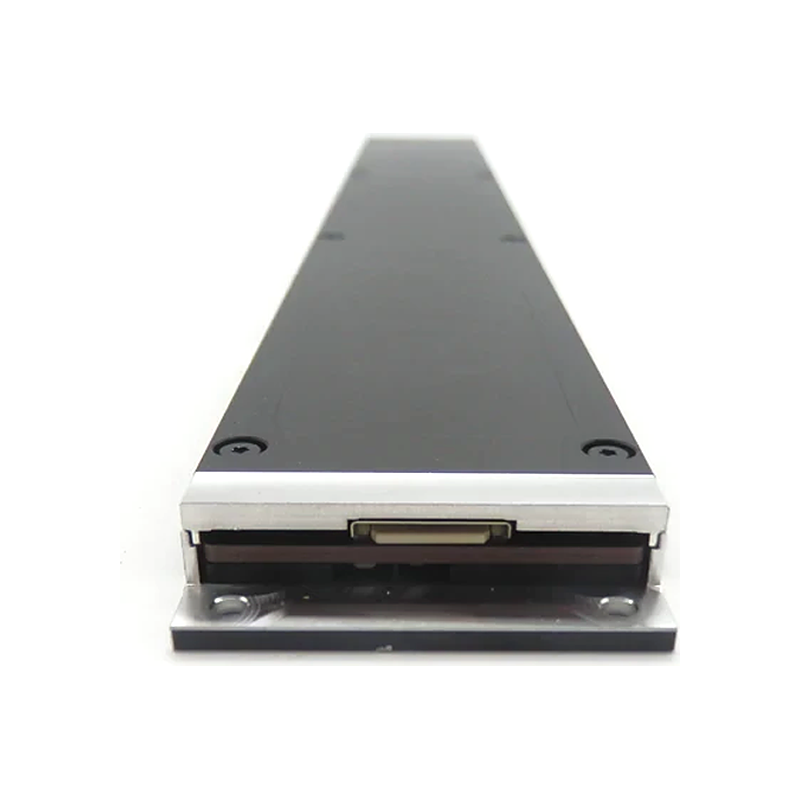
15.36 TB E1.L 1U long ruler NVMe SSD, PCIe 4.0, ordering code MZEL215THBLA-00AMV
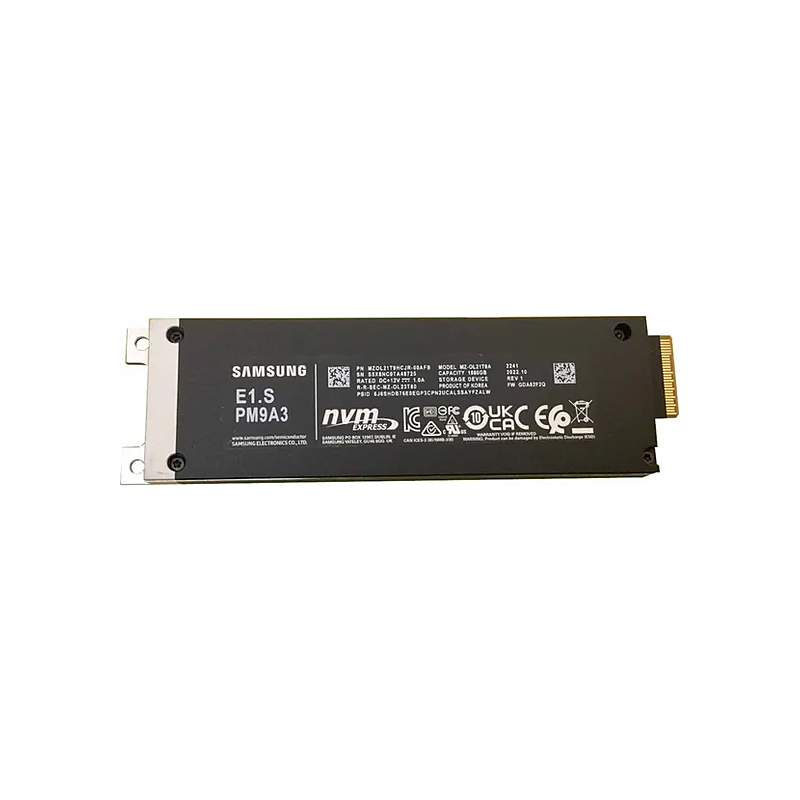
7.68 TB E1.S 1T NVMe SSD, PCIe 4.0, ordering codes MZCL27T6HBLA-00AMV / MZTL27T6HBLA-00A07
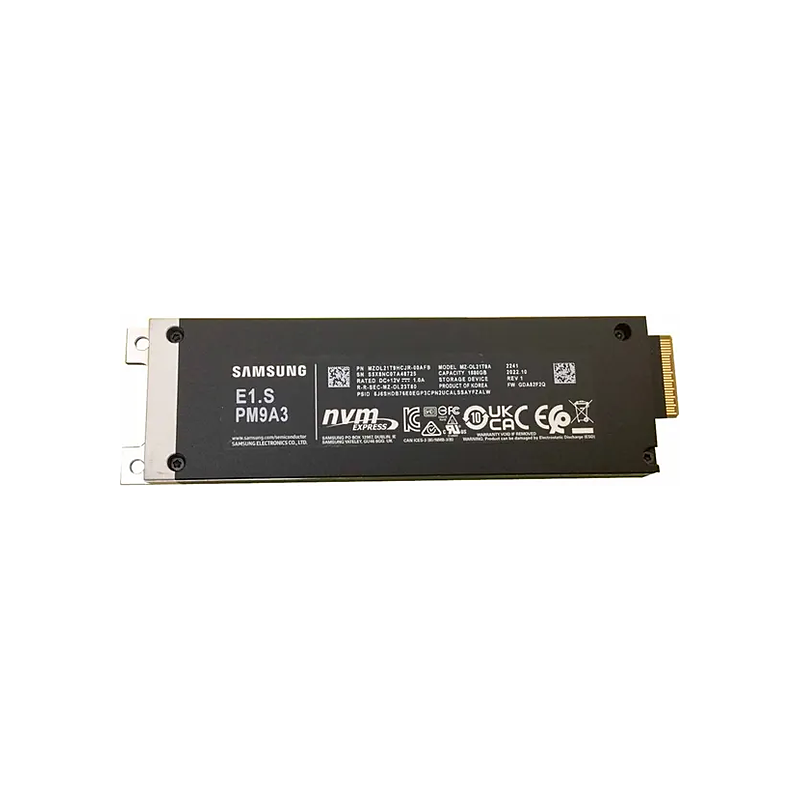
3.84 TB E1.S 1T NVMe SSD, PCIe 4.0, ordering codes MZCL23T8HCLS-00AMV / MZTL23T8HCLS-00A07
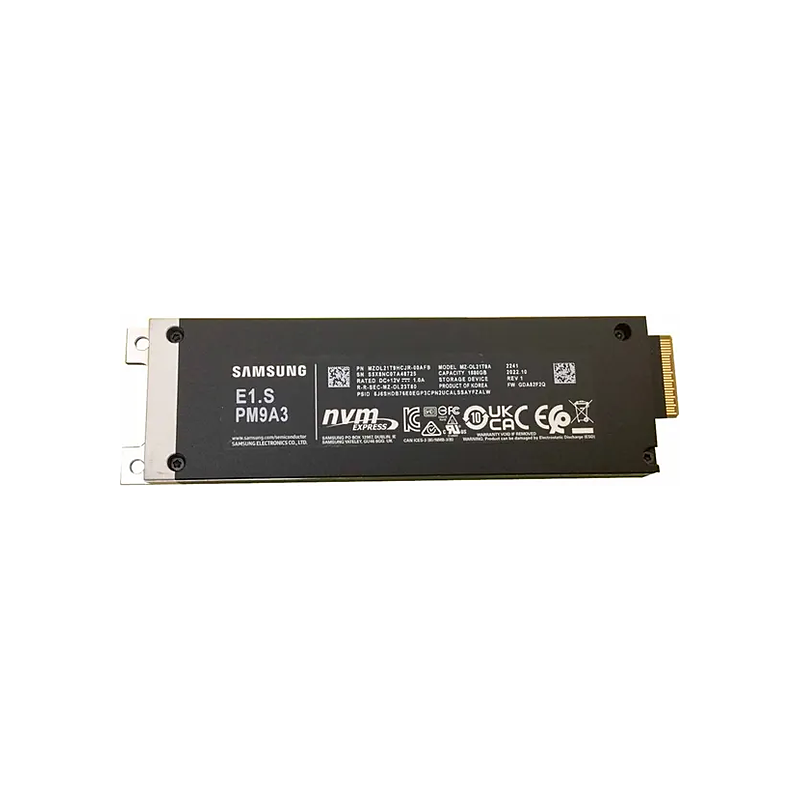
1.92 TB E1.S 1T (9.5 mm) NVMe SSD, PCIe 4.0, ordering code MZCL21T9HCJR-00AMV