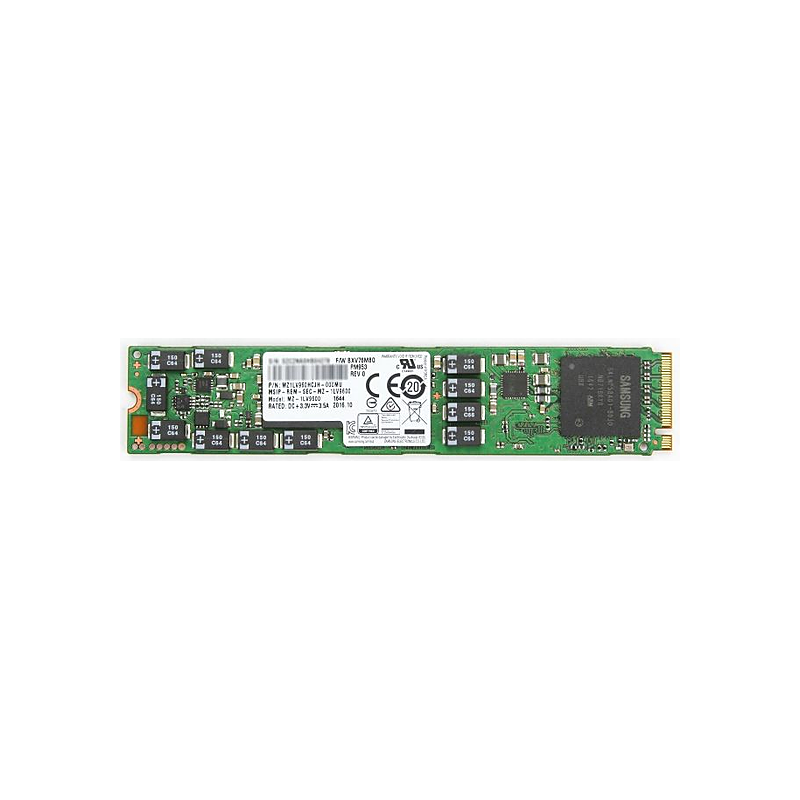
Samsung PM953 960GB M.2 22110 PCIe 3.0 NVMe SSD (MZ1LV960HCJH)
960 GB M.2 22110 NVMe SSD, ordering code MZ1LV960HCJH-00003
- Part Number
- MZ1LV960HCJH
- Brand
- Samsung
- Category
- Enterprise & Data Center SSD
- Accepted Payments
- T/T Bank Transfer PayPal Western Union
Technical Specifications
| Capacity | 960 GB |
|---|---|
| Interface | NVMe |
| Form Factor | M.2 22110 |
| PCIe Version | PCIe 3.0 |
| NAND Type | TLC |
| Endurance (DWPD) | 0.8 |
| TBW | 1,400 TB |
| Sequential Read | 1,000 MB/s |
| Sequential Write | 870 MB/s |
| Random Read IOPS | 240K IOPS |
| Random Write IOPS | 19K IOPS |
| Power | 9 W |
| DRAM Cache | Yes |
| Power Loss Protection | Yes |
| Encryption | AES-XTS 256 |
| Condition | New · Used |
Frequently Asked Questions
Samsung PM953 960 GB in the M.2 22110 build, catalogue code MZ1LV960HCJH, ordering code MZ1LV960HCJH-00003. 1,000 MB/s sequential read, 870 MB/s sequential write, 240K random read and 19K random write IOPS at 4 KB, 1,400 TBW at 0.8 drive writes a day over five years. 48-layer V-NAND TLC, tantalum capacitors for power-loss protection, AES 256-bit encryption, two million hours MTTF. Both conditions stocked, one-year warranty either way.
960 GB is the point where the PM953 stops being a compromise on the write side. The 480 GB card in the same package gives up 370 MB/s of sequential write and half its lifetime; this one does not, and it still fits in a 110 mm slot. That combination is why most of the M.2 units that survived in service are this capacity.
The point where the M.2 build reaches full speed
Compare the two M.2 capacities and the split is clean. Read is identical between them: 1,000 MB/s and 240K IOPS, because the read path was never the constraint. Write is where the 960 GB pulls away — 870 against 500 MB/s sequential, 19K against 16K random, 1,400 against 700 TB of lifetime. Twice the dies, the same controller, the same 3.3 V card.
Above this capacity nothing changes again. The 1.92 TB member of the family carries exactly these numbers, and so does the 2.5-inch version of this one. If a quote puts a 1.92 TB PM953 next to a 960 GB and asks for more money on the strength of performance, the answer is no: the extra money buys capacity and endurance, not speed.
Technical specifications
| Product family | Samsung PM953 (PCIe 3.0 enterprise NVMe SSD, read-centric) |
|---|---|
| PN | MZ1LV960HCJH (catalogue code) |
| Ordering code | MZ1LV960HCJH-00003 |
| Capacity | 960 GB (unformatted; 1 GB = 1 billion bytes, formatted capacity is less) |
| Form factor | M.2 22110, 22 × 110 mm, M-key, single-sided |
| Interface | PCIe 3.0 x4, NVMe 1.1 |
| NAND | Samsung 48-layer V-NAND TLC |
| Sequential read | 1,000 MB/s (128 KB) |
| Sequential write | 870 MB/s (128 KB) |
| Random 4K read | 240K IOPS |
| Random 4K write | 19K IOPS |
| Endurance (TBW) | 1,400 TB |
| Endurance (DWPD) | 0.8 drive writes per day for five years |
| Power | 3.3 V rail, rated 3.5 A on the label; family figure 9 W active, 1.9 W idle |
| DRAM cache | Yes |
| Power-loss protection | Yes, tantalum capacitor bank on the card |
| Encryption | AES 256-bit hardware encryption |
| MTTF | 2 million hours |
Two boards, and only one of them will take it
An 22110 card is 110 mm long and the standoff on most boards sits at 80 mm. The card will drop into the connector and then overhang the mounting hole with nothing under its far end — no screw, no support, and a connector taking the entire bending load of a 110 mm PCB. Server boards usually solve this by placing one M.2 position at the rear edge of the board, where a 110 mm part lands on a dedicated standoff; consumer boards rarely do.
Heat is the other half of the same problem. There is no enclosure on this card and no airflow of its own, so a sustained write at 870 MB/s leans entirely on whatever air the chassis pushes across the board. In a 1U with a proper shroud that is fine. On an open bench board with a single rear fan it is not, and the drive will drop to a crawl once the controller reaches its limit. The family figure is 9 W active with 1.9 W idle, and the label allows 3.5 A on the 3.3 V rail — more than most consumer M.2 slots are laid out to deliver.
Unlike the 2.5-inch version of this drive, there is no carrier, no lever and no status light. Nothing tells you it has dropped off the bus except the operating system.
What 1,400 TBW means at 960 GB
1,400 TB over 1,825 days is 767 GB of host writes a day, four fifths of capacity, the same ratio every PM953 carries at every size. Samsung states the budget twice, as 1.37 PB at 1.3 drive writes a day over three years and as the equivalent five-year figure at 0.8. We list the five-year number for consistency with the rest of the catalogue.
On a boot mirror that is generous. On anything that writes its capacity daily it is thin, and the 960 GB M.2 is a particularly poor fit for a log or a write cache: 19K random write is mid-table among SATA drives at this capacity, and the ones above it carry three to five drive writes a day. What this card is good at is reading — 240K IOPS against 95K to 98K for a SATA part — and holding an operating system or a hot dataset in a slot that would otherwise be empty.
The four PM953 capacities side by side
| Model | Package | Capacity | Seq read / write | Random 4 KB | TBW | DWPD |
|---|---|---|---|---|---|---|
| PM953 960 GB M.2 | M.2 22110 | 960 GB | 1,000 / 870 MB/s | 240K / 19K | 1,400 TB | 0.8 |
| PM953 480 GB M.2 | M.2 22110 | 480 GB | 1,000 / 500 MB/s | 240K / 16K | 700 TB | 0.8 |
| PM953 960 GB U.2 | 2.5-inch U.2 | 960 GB | 1,000 / 870 MB/s | 240K / 19K | 1,400 TB | 0.8 |
| PM953 1.92 TB U.2 | 2.5-inch U.2 | 1.92 TB | 1,000 / 870 MB/s | 240K / 19K | 2,800 TB | 0.8 |
Read the middle two rows against each other and the point of the table is clear: the 960 GB is the same drive in two packages, and the only line that differs is the one describing the package. Everything else — speed, endurance, NAND, capacitor bank — is identical. The choice between the U.2 and the M.2 is decided by whether the chassis has a bay or a slot, and by nothing in the datasheet.
The 1.92 TB row is the one worth checking before a purchase order goes out. It carries the same speed as the 960 GB and twice the endurance, so a quote that prices it above this card is charging for capacity, not performance. And the 480 GB row is the only column in the table with a visible compromise, on the write path.
Ordering codes and the 960 block
| Code | Type | Capacity | Condition | Quote |
|---|---|---|---|---|
| MZ1LV960HCJH | Catalogue code | 960 GB | New / used | Enquire |
| MZ1LV960HCJH-00003 | Ordering code | 960 GB | New / used | Enquire |
MZ1L marks the M.2 22110 package; the same capacity in a 2.5-inch shell reads MZQLV960HCHP. Then 960 for capacity, HCJH for the build, -00003 for the channel suffix. Note that the build letters changed with capacity as well as package — the 480 GB M.2 card is HCHP, this one is HCJH — so the two M.2 capacities differ in two blocks of the string, not one.
That detail matters at goods-in and on a purchase order. A 480 GB and a 960 GB card are the same length, the same thickness and the same label layout, and a photograph of either tells you nothing. The label lines that do are the model number, MZ-1LV960, and the capacity block in the P/N.
What to check at goods-in
- Model line, both blocks. MZ1L for the package, 960 for the capacity, HCJH for the build. A card reading MZ1LV480HCHP is half the drive.
- Host bytes written against 1,400 TB. Read it from SMART before wiping. At 0.8 drive writes a day the budget is real but finite, and a pull at high percentage used should be priced accordingly.
- Capacitor bank. The tantalum stack is what makes this an enterprise card rather than a consumer one, and it fails without logging anything. Every pull is discharged and measured on our bench before it is listed as tested.
- Length and key. 110 mm, M-key, single-sided. Check the board for a standoff at 110 mm before the card leaves the bench, not after.
- Firmware and date. These shipped through 2016 on BXV76M80 and a few earlier revisions. Ask for the revision string out of SMART and check it against the board vendor's compatibility list.
Warranty, lead time and purchasing
Every card we ship is covered for a year, whether it arrived sealed in a box or came out of a working server, and the cover stays with the drive if it changes hands. Warehouse stock normally turns round in three to seven working days, with tracking issued at that point. Two pieces is the minimum order, the four PM953 capacities can be mixed on one order, and we price from part number, condition and quantity — usually the same working day.
Get Pricing For This Part
Tell us who you are — we reply within one working day with a firm quote, stock status and lead time. Volume discounts available.
Related Products
15.36 TB E1.L 1U long ruler NVMe SSD, PCIe 4.0, ordering code MZEL215THBLA-00AMV
7.68 TB E1.S 1T NVMe SSD, PCIe 4.0, ordering codes MZCL27T6HBLA-00AMV / MZTL27T6HBLA-00A07
3.84 TB E1.S 1T NVMe SSD, PCIe 4.0, ordering codes MZCL23T8HCLS-00AMV / MZTL23T8HCLS-00A07
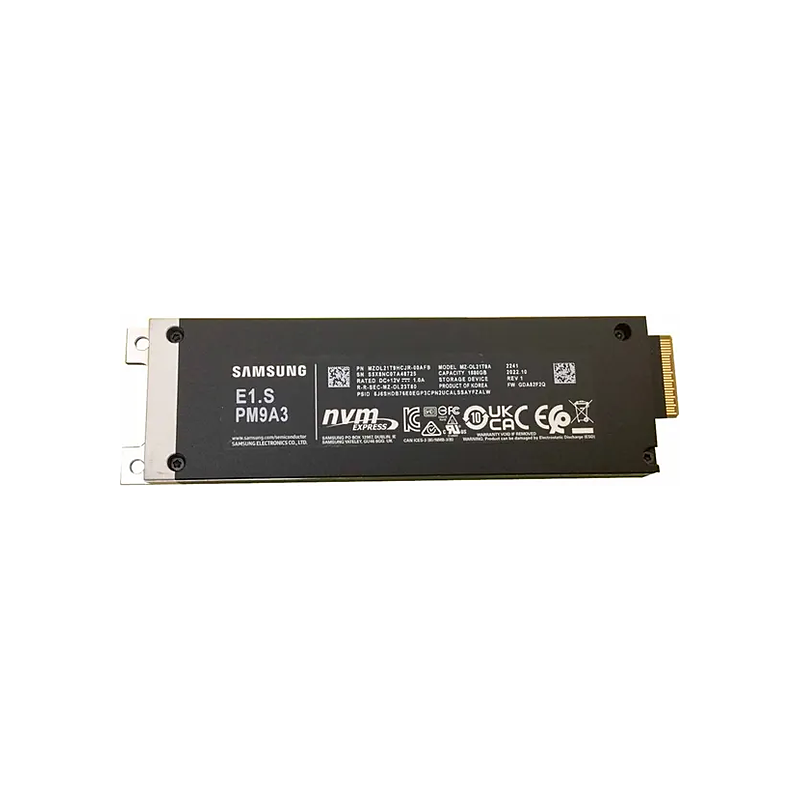
1.92 TB E1.S 1T (9.5 mm) NVMe SSD, PCIe 4.0, ordering code MZCL21T9HCJR-00AMV