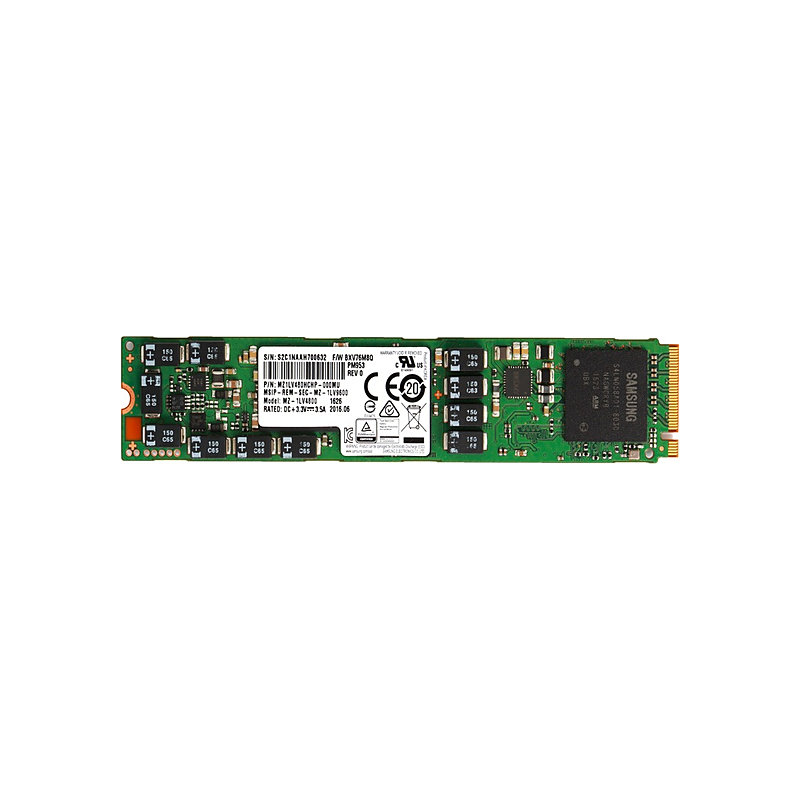
Samsung PM953 480GB M.2 22110 PCIe 3.0 NVMe SSD (MZ1LV480HCHP)
480 GB M.2 22110 NVMe SSD, ordering code MZ1LV480HCHP-000MU
- Part Number
- MZ1LV480HCHP
- Brand
- Samsung
- Category
- Enterprise & Data Center SSD
- Accepted Payments
- T/T Bank Transfer PayPal Western Union
Technical Specifications
| Capacity | 480 GB |
|---|---|
| Interface | NVMe |
| Form Factor | M.2 22110 |
| PCIe Version | PCIe 3.0 |
| NAND Type | TLC |
| Endurance (DWPD) | 0.8 |
| TBW | 700 TB |
| Sequential Read | 1,000 MB/s |
| Sequential Write | 500 MB/s |
| Random Read IOPS | 240K IOPS |
| Random Write IOPS | 16K IOPS |
| Power | 9 W |
| DRAM Cache | Yes |
| Power Loss Protection | Yes |
| Encryption | AES-XTS 256 |
| Condition | New · Used |
Frequently Asked Questions
Samsung PM953 480 GB in the M.2 22110 build, catalogue code MZ1LV480HCHP, ordering code MZ1LV480HCHP-000MU. 1,000 MB/s sequential read, 500 MB/s sequential write, 240K random read and 16K random write IOPS at 4 KB, 700 TBW at 0.8 drive writes a day over five years. 48-layer V-NAND TLC, tantalum capacitors for power-loss protection, AES 256-bit encryption, two million hours MTTF. Both conditions stocked, one-year warranty either way.
The label on the reverse repays a second read before the drive goes into a cart. It gives P/N MZ1LV480HCHP-000MU, model MZ-1LV480, a rating of DC 3.3 V at 3.5 A, a build date of 2016.06 and firmware BXV76M80. On a cabled drive those lines are paperwork. On an M.2 card they decide whether the thing fits and whether the slot can feed it.
Same drive as the 2.5-inch version, different package
Samsung shipped the PM953 on two carriers. The 2.5-inch U.2 version reads MZQLV480HCGR and mounts in a bay; this one reads MZ1LV480HCHP and mounts on a board. The silicon between them is identical, and so are the published figures: 1,000 / 500 MB/s, 240K / 16K IOPS, 700 TB of lifetime writes, 0.8 drive writes a day, the same 48-layer TLC and the same capacitor bank. Nothing about the storage changes when the package changes.
What changes is everything around it. No enclosure, no carrier, no hot-swap lever, no 12 V rail, no status light. A U.2 drive is a field-replaceable part; this is a component on a motherboard. When you pick between the two, you are picking a slot, not a specification — and the slot is decided by the chassis long before the datasheet matters.
Technical specifications
| Product family | Samsung PM953 (PCIe 3.0 enterprise NVMe SSD, read-centric) |
|---|---|
| PN | MZ1LV480HCHP (catalogue code) |
| Ordering code | MZ1LV480HCHP-000MU |
| Capacity | 480 GB (unformatted; 1 GB = 1 billion bytes, formatted capacity is less) |
| Form factor | M.2 22110, 22 × 110 mm, M-key, single-sided |
| Interface | PCIe 3.0 x4, NVMe 1.1 |
| NAND | Samsung 48-layer V-NAND TLC |
| Sequential read | 1,000 MB/s (128 KB) |
| Sequential write | 500 MB/s (128 KB) |
| Random 4K read | 240K IOPS |
| Random 4K write | 16K IOPS |
| Endurance (TBW) | 700 TB |
| Endurance (DWPD) | 0.8 drive writes per day for five years |
| Power | 3.3 V rail, rated 3.5 A on the label; family figure 9 W active, 1.9 W idle |
| DRAM cache | Yes |
| Power-loss protection | Yes, tantalum capacitor bank on the card |
| Encryption | AES 256-bit hardware encryption |
| MTTF | 2 million hours |
22110 and 3.3 V: what the slot has to supply
The number that kills these transactions is 110. Most desktop boards and a great many server boards place their M.2 standoff at 80 mm, because that is where consumer drives end. An 22110 card is 30 mm longer than that; it will seat in the connector and then hang past the last mounting hole with nothing to screw into. Some boards carry a second standoff position at 110 mm, and 1U servers often put a single 22110 slot at the rear edge near the riser. Look at the board, not at the product page.
Power is the second constraint. This is a 3.3 V part and the label allows 3.5 A on that rail, which is more than a consumer M.2 slot is typically laid out to deliver, and far more than the two-lane slots on older boards. The family figure Samsung publishes is 9 W active with 1.9 W idle; whatever the true draw lands at, an M.2 slot on a desktop board is not the electrical environment this card was designed for. In a server it sits under the air shroud with the rest of the boards, which is where it belongs.
There is no hot swap here and no light to tell you a drive has fallen off the bus. A failure means opening the chassis, which is worth knowing before you build a mirror out of two of them and call it redundant.
What 700 TBW means at 480 GB
700 TB across 1,825 days is 383 GB of host writes a day, four fifths of capacity, the same ratio every PM953 capacity carries. Samsung states the family budget twice: 0.68 PB at 1.3 drive writes a day over three years, and the equivalent five-year figure at 0.8. We list the five-year number because the rest of the catalogue is rated that way.
At 480 GB this is the tightest endurance in the PM953 range, and the gap to SATA is widest here. The PM893 480 GB we list carries 876 TB, a quarter more, on a bus a fifth as fast. Whether that trade is worth making depends entirely on whether the workload is reads. For a boot mirror or a cache device, 383 GB a day is plenty. For anything that rewrites its own capacity daily, this drive is the wrong choice and no amount of sequential read speed fixes it.
How it compares to the 480 GB drives we list
| Model | Interface | Capacity | Seq read / write | Random 4 KB | TBW | DWPD |
|---|---|---|---|---|---|---|
| PM953 480 GB M.2 | PCIe 3.0 x4 | 480 GB | 1,000 / 500 MB/s | 240K / 16K | 700 TB | 0.8 |
| PM893 480 GB | SATA 6 Gb/s | 480 GB | 550 / 520 MB/s | 98K / 29K | 876 TB | 1 |
| 5400 PRO 480 GB | SATA 6 Gb/s | 480 GB | 540 / 520 MB/s | 95K / 37K | 1,324 TB | 1.5 |
| 5400 MAX 480 GB | SATA 6 Gb/s | 480 GB | 540 / 520 MB/s | 95K / 58K | 4,380 TB | 5 |
Two columns tell the story. Read is where this card wins: 240K random read against 95K to 98K, and 1,000 MB/s against 540 to 550. Write and endurance are where it loses, and it loses badly at the bottom of the table — 16K random write against 58K, 700 TB against 4,380 TB. None of that is a defect. The M.2 PM953 is a boot and cache device that happens to read very fast; the 5400 MAX is a mixed-workload drive that happens to fit in a bay.
The PM893 row is the honest comparison for anyone replacing SATA one for one, because it is the same brand and the same job description. It gives up 2.4 times the random read and gains a quarter more endurance, a hot-swap bay and a fraction of the power. Buy the PM953 when the slot already exists and the reads dominate; buy the SATA part when it does not.
Ordering codes and the MZ1L block
| Code | Type | Capacity | Condition | Quote |
|---|---|---|---|---|
| MZ1LV480HCHP | Catalogue code | 480 GB | New / used | Enquire |
| MZ1LV480HCHP-000MU | Ordering code | 480 GB | New / used | Enquire |
Four characters carry the meaning. MZ1L is the M.2 22110 family; the same drive in a 2.5-inch shell reads MZQL instead, and that fourth character is the only thing separating two part numbers that are otherwise identical in capacity and speed. 480 is the capacity, HCHP the build, -000MU the channel suffix on this particular batch. The same drive also circulates with a -00003 suffix; the suffix describes packaging and channel, not the hardware, so either code buys the same 480 GB card.
This is the sort of distinction that survives right up to the moment somebody types the part number from memory. MZ1L and MZQL differ by two characters in the middle of a fourteen-character string, and one of them will not go into the slot the other was bought for.
What to check at goods-in
- Length before anything else. 110 mm, M-key, single-sided. Hold it against the board's standoff; if there is no hole at 110 mm the card is not going in, whatever the invoice says.
- Host bytes written. Read it from SMART before the card is wiped and set it against 700 TB. Pulls at 70 or 80 percent of rated bytes are common at this capacity and they are priced differently for a reason.
- Capacitor bank. The tantalum stack is the enterprise feature on an M.2 card and it gives no warning before it fails. We discharge and measure it on every pull, the same as on the 2.5-inch parts.
- Firmware. These shipped on BXV76M80 and a couple of earlier revisions through 2016. Ask for the string out of the SMART output and check it against the board vendor's list.
- Physical condition. No enclosure means no protection: look for lifted pads at the connector, a bent key, and thermal-pad residue that says the card ran without a heatsink.
Warranty, lead time and purchasing
Sealed cards and tested pulls carry the same one-year warranty, and it follows the drive rather than the server it came out of. Stock leaves the warehouse in three to seven working days, with tracking issued when it goes. Minimum order is two pieces, capacities from this family combine on one order, and a price comes back the same working day once we have part number, condition and quantity.
Get Pricing For This Part
Tell us who you are — we reply within one working day with a firm quote, stock status and lead time. Volume discounts available.
Related Products
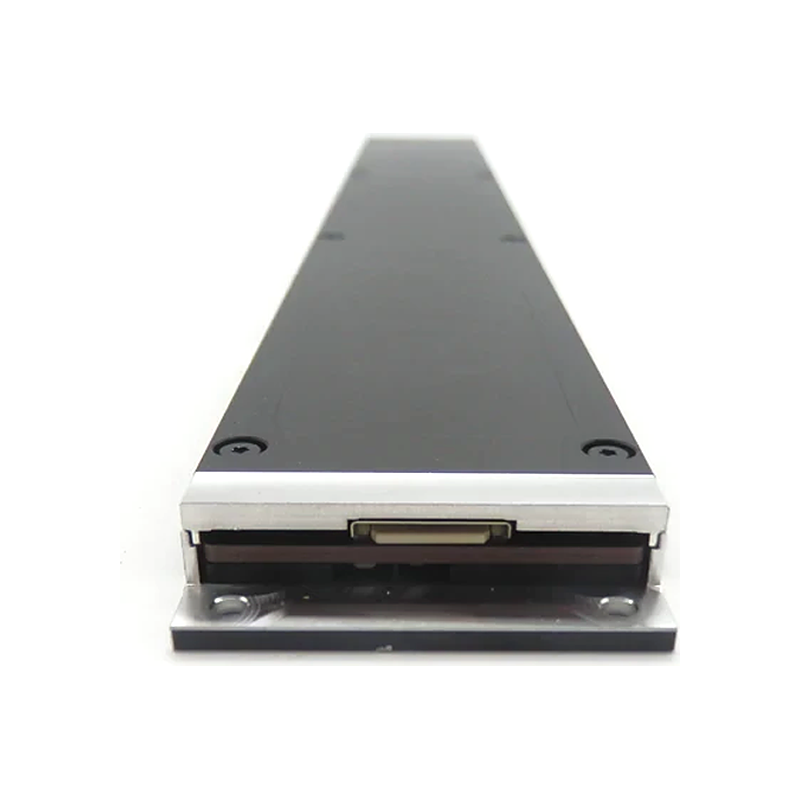
15.36 TB E1.L 1U long ruler NVMe SSD, PCIe 4.0, ordering code MZEL215THBLA-00AMV
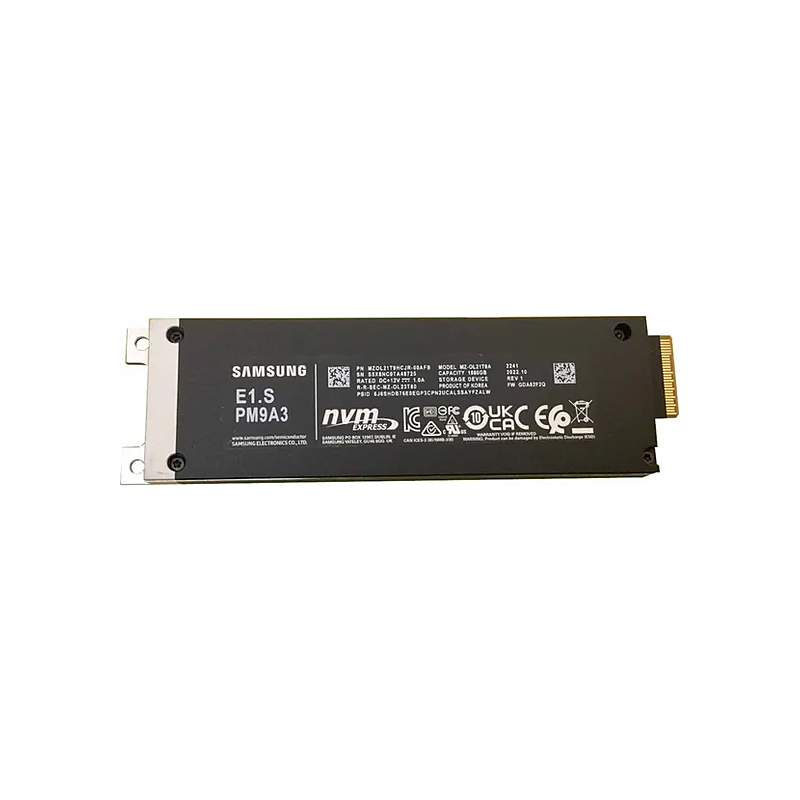
7.68 TB E1.S 1T NVMe SSD, PCIe 4.0, ordering codes MZCL27T6HBLA-00AMV / MZTL27T6HBLA-00A07
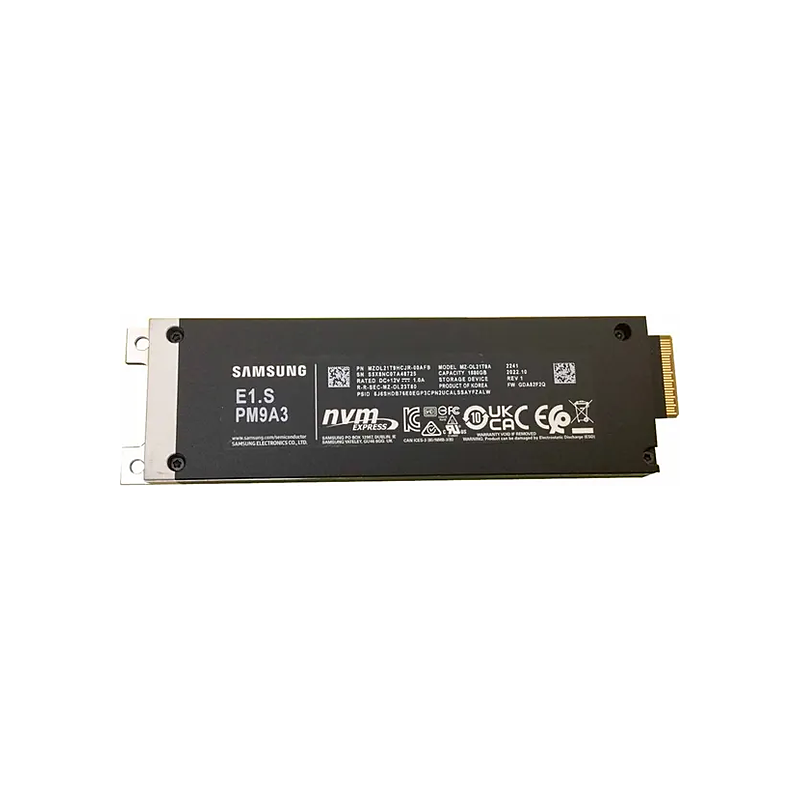
3.84 TB E1.S 1T NVMe SSD, PCIe 4.0, ordering codes MZCL23T8HCLS-00AMV / MZTL23T8HCLS-00A07
1.92 TB E1.S 1T (9.5 mm) NVMe SSD, PCIe 4.0, ordering code MZCL21T9HCJR-00AMV