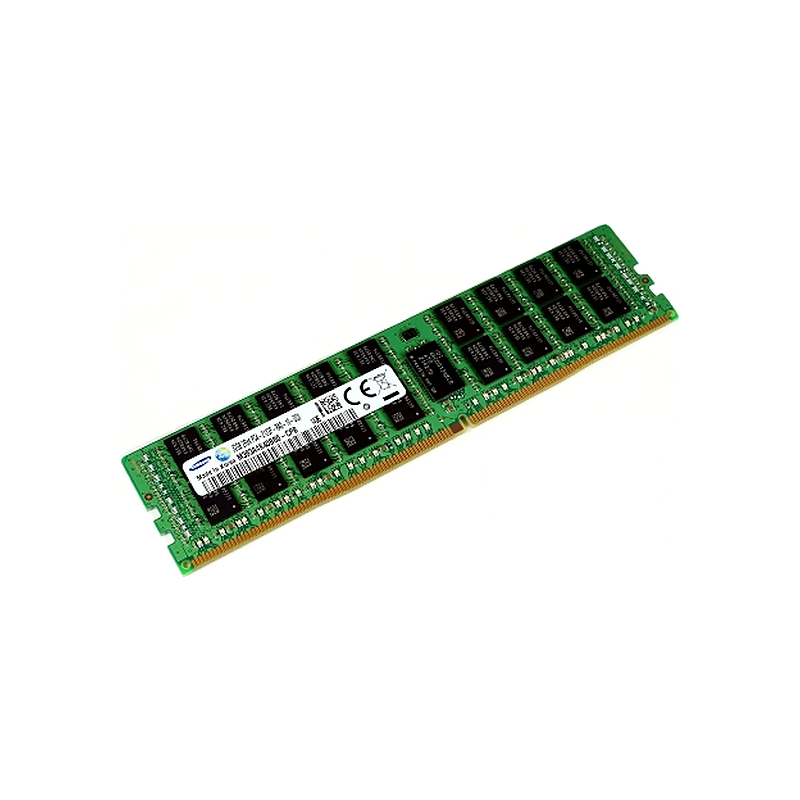
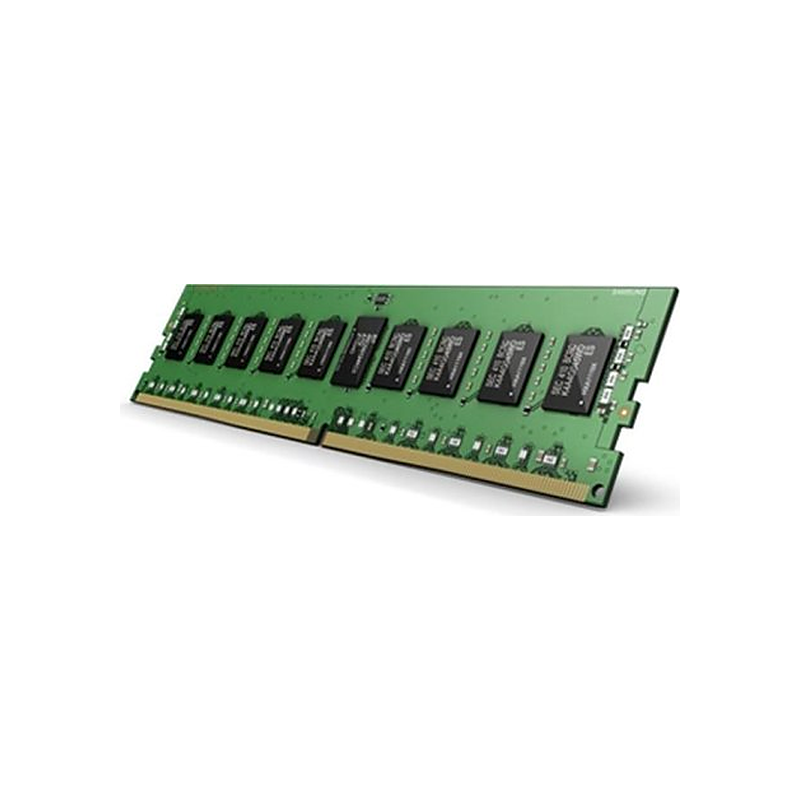
Samsung 16GB DDR4-2666 RDIMM 2Rx8 Server Memory (M393A2K43BB1-CTD)
16 GB DDR4-2666 PC4-21300 ECC registered RDIMM, 2Rx8 on eighteen 8 Gb x8 packages, 1.2 V, 288-pin; six ordering codes under M393A2K43BB1-CTD with 6Q, 6Y, 7Q, 7Y and 8Q tails
- Part Number
- M393A2K43BB1-CTD
- Brand
- Samsung
- Category
- Server Memory
- Accepted Payments
- T/T Bank Transfer PayPal Western Union
Technical Specifications
| Capacity | 16 GB |
|---|---|
| Memory Type | DDR4 |
| Speed | 2666 MT/s |
| Form Factor | RDIMM |
| Rank | 2Rx8 |
| ECC | ECC |
| Voltage | 1.2 V |
| Module Height | Standard |
| Condition | New · Used |
Frequently Asked Questions
Samsung 16 GB DDR4-2666 ECC registered RDIMM at standard height, two ranks of nine x8 devices on a 288-pin board at 1.2 V. PC4-21300 at CAS latency 19, 14.25 ns at the 1,333 MHz clock, and 21.3 GB/s peak per 64-bit channel.
Sixteen gigabytes at this clock can be built three ways, and they are not interchangeable in the ways that decide a purchase. Thirty-six x4 packages in two ranks, eighteen x4 packages in one rank, or the build on this page: eighteen x8 packages in two ranks of nine. All three hold the same data, take the same slot and run at the same speed; what differs is how much rank each occupies and how finely the error correction can act.
Six ordering codes carry it, the base plus five suffixes, in a table at the foot of the page.
Technical specifications
| Part number | M393A2K43BB1-CTD, with the six ordering codes listed under Ordering codes (catalogue code M393A2K43BB1) |
|---|---|
| Capacity | 16 GB per module, single module |
| Organisation | 2Rx8 — two ranks of nine x8 devices, eighteen 8 Gb packages in total, 144 Gb of silicon delivering 128 Gb of data plus the eight check bits that travel with every 64-bit transfer; 2G x 72 at module level |
| Speed | DDR4-2666, PC4-21300, 2,666 MT/s, 21.3 GB/s peak per 64-bit channel |
| Timings | CL19 at 1,333 MHz, 14.25 ns; JEDEC 2666V bin |
| Voltage | 1.2 V nominal |
| Form factor | 288-pin RDIMM at standard height, 31.25 mm, bare PCB with no heatspreader |
| Register | On-module register buffers the command and address bus, so the board has to accept registered memory |
| Error handling | ECC across the 64-bit data path. x8 devices give single-device symbol correction; retiring a whole device needs x4 granularity and a controller that supports it |
| Manufacture | Samsung; assembly site and date code vary by production run and are printed on the module rather than fixed by the part number |
| Condition | New and tested pulls, both stocked |
What the part number encodes
The four characters after the dash decide most of what matters, and the two characters before it decide the rest. Reading a label as one line is fine once the fields are understood separately.
| Printed as | Means | Why it matters at purchase |
|---|---|---|
| M393 | Standard-height registered module | The 31.25 mm board; the low-profile build of this capacity carries M392 |
| 2K | Sixteen-gigabyte class | Capacity, stated before rank and width narrow it to a shape |
| 43 | x8 device width | Nine devices per rank instead of eighteen, and no chipkill retirement |
| 2Rx8 | Two ranks of nine devices | Two ranks against a channel budget, which at two modules per channel is four |
| PC4-21300V | DDR4-2666, bin V, which is CL19 | The letter states the timing grade; a listing that quotes only the clock leaves latency unstated |
| -R | Registered, not unbuffered | A different electrical interface from an unbuffered module of the same capacity, and it will not train in that slot |
| BB1 | Die and raw-card revision | Records which silicon generation and raw card built the assembly; it constrains nothing ahead of it |
| CTD | The 2,666 speed block | Neighbouring blocks in this family are other clocks, so the block letter needs checking |
| 6Q … 8Q | Ordering suffix, two characters each | What the purchase order quotes; the only field that varies across the six codes stocked |
| YYWW | Date code, year and week | The only service history a pull carries, and the first field to read when judging remaining life |
Three ways to build sixteen gigabytes at 2,666
The x4 builds put eighteen devices in a rank, because a rank is seventy-two bits wide and a x4 device supplies four of them. Two ranks of eighteen is the 2Rx4 module: thirty-six packages, usually of 4 Gb silicon, which is the shape most sixteen-gigabyte DDR4 stock is in. One rank of eighteen is the 1Rx4 module: the same package count on 8 Gb silicon, and the same sixteen gigabytes with a single rank behind it.
The x8 build splits the rank in half. Nine devices carry the seventy-two bits, so eighteen packages make two ranks and the capacity arrives with the same silicon as the 1Rx4 module but twice the ranks. There is no third design goal here: the package count, the capacity and the silicon are identical to the single-rank part, and the only thing that changes is how that silicon is addressed.
That makes this the shape to recognise rather than the shape to choose. It exists because it is what a particular bill of materials asked for, and it is priced accordingly.
What the x8 width costs in rank and in ECC
Two costs follow from the split, and neither appears in a bandwidth benchmark. The first is rank. Two modules of this per channel are four ranks, which is the whole budget on most DDR4 boards at 2,666; the same two slots filled with 1Rx4 modules are two ranks and leave room. A channel built from the single-rank part will hold 2,666 through a full population more often than one built from this.
The second is error granularity. x4 devices let a controller retire a failing device and keep running on the spare bits — the feature sold as chipkill or advanced ECC, depending on the vendor. x8 devices give correction at symbol level but not device retirement, so a failing package takes its share of the data path with it. Both are ECC and both correct single-bit errors; the difference appears in the reliability matrix, not in the datasheet headline.
Where this shape comes from, and when to prefer the single-rank part
Cost and availability explain almost all of it. Eighteen packages instead of thirty-six is less assembly and less board area, and 8 Gb silicon was the cheaper route to sixteen gigabytes for most of this generation's life. Vendors specified it in volume machines, so it is common in the secondary market and it is the like-for-like replacement for a fleet that shipped with it.
If the bill of materials is yours to set and the board accepts both, the 1Rx4 module of the same capacity and clock is the better purchase: identical package count, identical silicon, half the ranks and chipkill intact. The premium, where there is one, buys population headroom and a stronger RAS story rather than speed. Where the installed base is 2Rx8, matching it keeps the fleet uniform and the spares simple, which is a real operational argument and not a technical one.
Mixing rules for the three shapes
Capacity may vary inside a channel; rank is the budget that cannot. A 2Rx8 module and a 1Rx4 module of the same capacity are electrically compatible and will train together, but a pair of them occupies three ranks, not two. Four slots of mixed stock can therefore leave the documented envelope while every individual module looks correct.
Speed settles on the slowest module in the channel, silently. Buffering is an exclusion rather than a preference: a load-reduced module is a different topology and an unbuffered one is a different interface, and neither belongs in a channel of these. On the platform side, the two native cases for this clock are Xeon Gold 5218 and Xeon Silver 4314, both rated 2,666, while Xeon Gold 6338 is rated 3,200 and will run this module at 2,666 with its extra step unused.
Ordering codes and what to check at goods-in
Six codes carry this module: the base M393A2K43BB1-CTD and five suffixed builds. The family code fixes height class, density, device width and revision, CTD fixes the 2,666 speed block, and the last two characters name the build. All five tails are two characters, and together they cover 6Q, 6Y, 7Q, 7Y and 8Q — no 4Q and no 8Y, so the list is worth reading rather than extrapolating from a neighbouring family.
| Code | Type | Build tail | Condition | Quote |
|---|---|---|---|---|
| M393A2K43BB1 | Catalogue code | Family code without a speed block; the V build listed here is the PC4-21300 / 2,666 MT/s one | New / used | Enquire |
| M393A2K43BB1-CTD | Ordering code | Base code, no suffix appended | New / used | Enquire |
| M393A2K43BB1-CTD6Q | Ordering code | 6Q | New / used | Enquire |
| M393A2K43BB1-CTD6Y | Ordering code | 6Y | New / used | Enquire |
| M393A2K43BB1-CTD7Q | Ordering code | 7Q | New / used | Enquire |
| M393A2K43BB1-CTD7Y | Ordering code | 7Y | New / used | Enquire |
| M393A2K43BB1-CTD8Q | Ordering code | 8Q | New / used | Enquire |
- CTD is 2,666. Adjacent blocks in this family are other clocks; a quote naming capacity and brand has not settled which one arrives.
- Check 43 before 2R. The width is what makes this a two-rank sixteen-gigabyte module; the 1Rx4 part of the same capacity carries 40.
- Count ranks, not modules. Two of these per channel is four ranks, which is the documented ceiling at this clock on most boards.
- Read the date code on pulls. Year and week in YYWW, the field that says most about how much service life has already been spent.
Warranty, lead time and purchasing
Cover is one year from dispatch on new stock and on tested pulls alike, recorded against the batch and the ordering code so a claim does not depend on an invoice still existing. Pulls are checked in matched sets before packing and the screening sheet ships in the box. Warehouse stock leaves in three to seven working days with tracking, and the minimum order is two pieces.
No price is printed because the line is quoted: two conditions, six codes and a per-piece figure that moves with quantity make a page number unreliable. Send the code, the quantity, the condition and the platform, and the answer returns the same working day.
Get Pricing For This Part
Tell us who you are — we reply within one working day with a firm quote, stock status and lead time. Volume discounts available.
Related Products
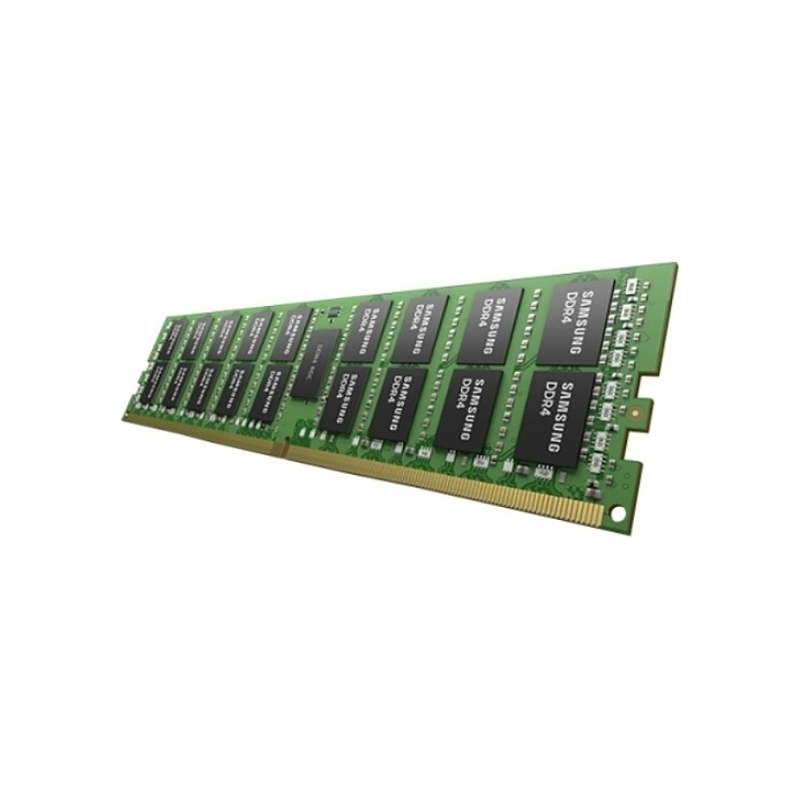
16 GB DDR4-2933 PC4-23400 ECC registered RDIMM, 2Rx8 on eighteen 8 Gb x8 packages, 1.2 V, 288-pin; six ordering codes under M393A2K43CB2-CVF with BY, CO, BQ, C0 and GQ tails
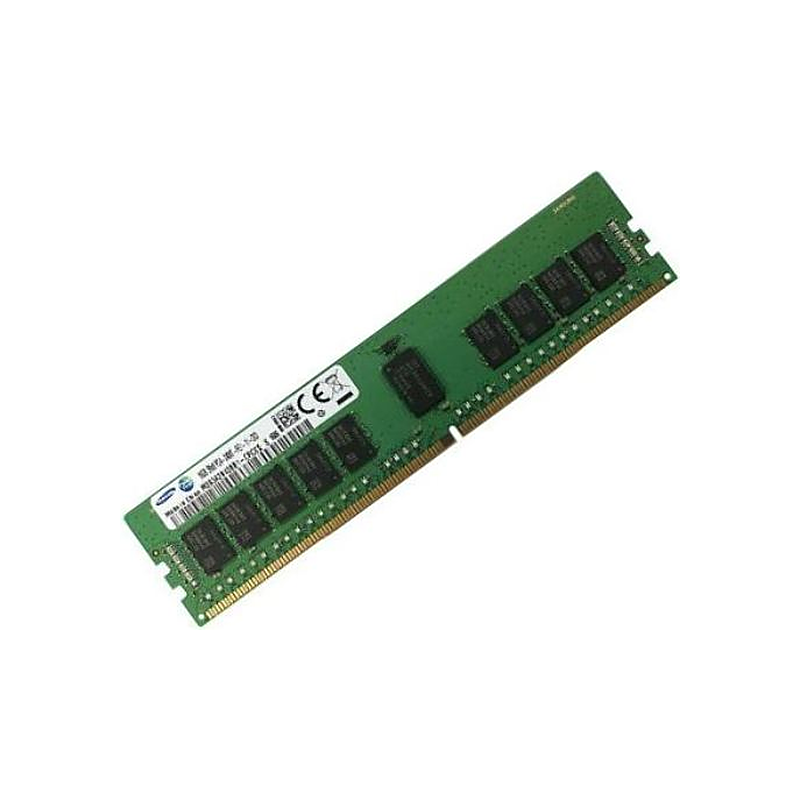
16 GB DDR4-2400 PC4-19200 ECC registered RDIMM, 2Rx8 on eighteen 8 Gb x8 packages, 1.2 V, 288-pin; eighteen ordering codes under the M393A2K43BB1 and M393A2K43CB1 revisions
16 GB DDR4-2133 PC4-17000 ECC registered RDIMM, 2Rx8 on eighteen 8 Gb x8 packages, 1.2 V, 288-pin; nine ordering codes from M393A2K43BB1-CPB through the CPBQ tail
16 GB DDR4-3200 PC4-25600 ECC registered RDIMM, 1Rx4 on eighteen 8 Gb x4 packages, 1.2 V, 288-pin; thirty-three ordering codes under the M393A2K40DB2, M393A2K40DB3 and M393A2K40EB3 revisions